

AI generated scenarios are simulated interactions or situations, built by a language model, that support learning, training, roleplay, or strategic planning. Trainers, sales managers, and instructional designers use them to rehearse conversations or decisions before the real thing happens. If you need a starting point, skip to the prompt templates below and adapt one today.
TL;DR:
- AI-generated scenarios are useful for practice but require human review to ensure accuracy, cultural sensitivity, and ethical safety.
- Structured prompts with clear objectives, personas, context, rules, and evaluation lead to more realistic and coachable role-play situations.
- Pilot small groups, involve subject-matter experts in review, and measure engagement, skill improvement, and ramp time before scaling up.
- Be cautious of biases, harmful content, and copyright issues, especially when scenarios cover sensitive or high-stakes topics.
- Call Flow offers customizable scenario tools with instant grading to accelerate training and improve sales and support team outcomes.
Table of Contents
- When to use AI-generated scenarios and what they actually deliver
- Step-by-step prompt design: a repeatable process for usable scenarios
- Copy-ready templates and worked examples you can paste into an LLM
- Tools and a simple workflow to move from prompt to deployed scenario
- How to validate, test, and measure scenario quality and learner impact
- Practical risks, ethics, and copyright considerations
- How Call Flow applies these practices in real training programs
- When to run AI scenario pilots and when to lean on human design
- Pilot Call Flow: how to turn these ideas into measurable training outcomes
- Sources
- FAQ
When to use AI-generated scenarios and what they actually deliver
AI-generated scenarios fit situations where practice matters more than theory. Sales teams use them for cold-call rehearsal. Contact centers use them to simulate an angry customer before an agent handles a real one. Classrooms use them for language practice or ethics debates. Emergency planners use them for crisis tabletop exercises. Strategy teams use them to pressure-test a business decision against several futures.
Generative AI is widely used to draft these immersive practice setups, and GPT-4 class models commonly power the exercise, with a trainer refining the draft afterward. That refinement step is not optional. The AI gives you speed and range: dozens of variations, different personas, difficult edge cases, all in minutes. What it does not give you is guaranteed accuracy or cultural nuance. A scenario about a hospital billing dispute needs someone who has actually worked billing disputes to check it.
Expected outcomes are modest but real. Reps who rehearse against a scenario report more confidence going into live calls. Ramp time drops when new hires practice edge cases before they hit the phones. None of this replaces coaching. It gives coaching something concrete to work from.
The trade-off is simple: AI scenarios scale practice time, but they need a human in the loop to catch what the model gets wrong. Skip that step and you risk training people on a flawed situation.

Step-by-step prompt design: a repeatable process for usable scenarios
A good scenario prompt is not one sentence. It is five layered instructions that together tell the model what to build and how to behave inside it.
- Objective. State the skill you are testing. "Practice de-escalating a billing complaint" is usable. "Make a customer service scenario" is not.
- Persona. Give the AI character a name, role, mood, and a reason for that mood. "Maria, a small-business owner, frustrated after two failed callbacks" beats "an angry customer."
- Context and backstory. Add the setting details that shape the conversation: what happened before this call, what the customer already tried, what is at stake for them.
- Task rules. Define turn-taking (one exchange at a time, wait for the trainee's reply) and challenge level (start calm, escalate if the trainee is dismissive).
- Evaluation request. Ask the model to close with a short summary and coaching points once the roleplay ends, not during it.
Instructional designers report that generative AI speeds up scenario drafting but also produces contextual misalignment and unreliable output without review, so designers treat the AI as a collaborator rather than a finished author. That framing matters here: write your prompt expecting a first draft, not a final product.
Common mistakes are predictable. Vague personas produce generic dialogue. Missing turn-taking rules cause the model to play both sides of the conversation and skip the trainee entirely. Skipping the evaluation request means you get a transcript with no coaching value. Structured prompts that name persona, context, and task produce more meaningful role-play than loose, open-ended prompts, and that structure carries the coaching value that follows.

Pro Tip: Ask the model to list three ways the persona could react unexpectedly before you lock the scenario, then build those reactions into your task rules as branch points.
Copy-ready templates and worked examples you can paste into an LLM
Start with a template, then adjust the details to your team and topic.
- Single-turn roleplay starter: "You are [persona], a [role] who is [emotional state] because [reason]. I am a [job title] responding to you. Wait for my reply before continuing. Stay in character until I say 'end scenario.'"
- Multi-turn coaching scenario: "You are [persona] calling about [issue]. Respond one turn at a time. If I handle the issue well, soften your tone. If I dismiss your concern, escalate once, then ask to speak to a supervisor. After I say 'end scenario,' summarize my performance and give two coaching points."
- Branching choice seed: "You are [persona] facing [situation]. After my first response, offer me two paths the conversation could take next, and continue down whichever I choose."
- Tabletop planning seed: "We are a [team type] facing [strategic problem]. Introduce three plausible pressures we might face this quarter and ask me to respond to each in turn."
A worked example: paste the multi-turn template with "a subscriber upset about an unexpected renewal charge" as the issue. The first draft often makes the customer stay angry no matter what the trainee says. Edit the prompt to add "soften your tone if the trainee acknowledges the charge and offers a clear next step," and the roleplay becomes realistic enough to coach against.
Adjust vocabulary and pacing for the learner's experience level: new hires need slower escalation and simpler language, while advanced reps can handle a persona that pushes back immediately. For scenarios crossing cultural or regional contexts, name the specifics (language register, regional customer expectations) rather than leaving them to the model's assumptions. For copy-ready customer service examples already built out, see this set of customer service role-play scenarios.
Tools and a simple workflow to move from prompt to deployed scenario
Five tool categories cover most needs: general chat LLMs for drafting, dedicated scenario-generator sites for structured output, voice simulation tools for spoken practice, authoring or LMS connectors for deployment, and red-team or testing tools for catching failure modes before rollout. For voice-based delivery and recording, tools built for spoken interaction, like AI teleprompter software, can help trainees rehearse verbal delivery alongside the scenario itself.
A workable process has four steps:
- Draft: write the five-part prompt and generate two or three variations.
- Iterate and validate: have a subject-matter expert review for accuracy and tone before anyone trains on it.
- Instrument and measure: decide up front what you will track (completion, score, time) before you run the pilot.
- Deploy and debrief: run the scenario with a small group, then collect feedback before wider rollout.
For trainers integrating this into a broader curriculum, a practical starting pilot is one scenario, one team, one week, reviewed before scaling. See this AI roleplay training overview for integration tips specific to sales and contact center teams.
How to validate, test, and measure scenario quality and learner impact
Before anyone trains on a generated scenario, run it through a short checklist.
- Consistency: does the persona stay in character across multiple runs?
- Accuracy: does a subject-matter expert confirm the facts and terminology are right?
- Cultural sensitivity: would this scenario land the same way across different backgrounds on your team?
- Safety: does the model avoid harmful, threatening, or discriminatory language under pressure?
Pilot testing follows a similar structure to formal AI evaluation work. NIST's ARIA pilot combines model testing, red-teaming, and field testing using scenario templates and tester questionnaires to catch guardrail violations before wider use, a method worth borrowing at a much smaller scale for a training rollout.
A small cohort pilot with rubric-based scoring and calibration between raters gives you a usable baseline before scaling to a full team, which matters because inconsistent scoring across reviewers is one of the most common ways pilot results become unreliable.
Track engagement (did trainees finish the scenario), skill scores against a fixed rubric, and time-to-competence on the specific skill you targeted. Measure after each pilot cohort, not just at the end of a quarter, so you can adjust the prompt before it scales to more people. For evidence on how scenario practice affects ramp time in sales teams specifically, see this breakdown of role-play scenarios and ramp time.
Practical risks, ethics, and copyright considerations
Generated scenarios can reproduce bias, generate harmful content, or drift into misinformation if left unchecked. NIST's Generative AI risk profile names harmful content, misinformation, privacy exposure, and intellectual property among the core risks organizations should manage, recommending mitigation proportional to the potential harm. For training scenarios, that means diverse human review, clear guardrails in the prompt, and a policy against publishing anything untested.
Copyright matters if you plan to publish scenario content beyond internal training. The US Copyright Office states that AI-generated material may not qualify for copyright protection unless a human contributes meaningful creative input, and registration requires disclosing which parts were AI-generated. If a scenario set is going into a published course or book, document your own edits and additions.
Keep personal data out of prompts entirely. Use anonymized names, composite situations, and invented details rather than real customer records, even when the goal is realism.
How Call Flow applies these practices in real training programs
Call Flow builds configurable roleplay scenarios for sales and contact center teams, then grades each session across five performance dimensions with instant coaching feedback. Scenarios go through iterative validation before teams rely on them, matching the review steps outlined above. Teams using this approach have reported a 147% faster ramp time and 129% improvement in resolution rates. A one-week starter pilot: pick one scenario, one small team, run it, review the coaching scores, then decide whether to expand.
When to run AI scenario pilots and when to lean on human design
AI scenarios win on speed and range. They lose on fidelity and ethical nuance when nobody checks the output. My rule: pilot small, with a subject-matter expert reviewing before rollout, and pause for human-led design whenever the topic touches legal, medical, or high-stakes emotional situations.
— Costa
Pilot Call Flow: how to turn these ideas into measurable training outcomes
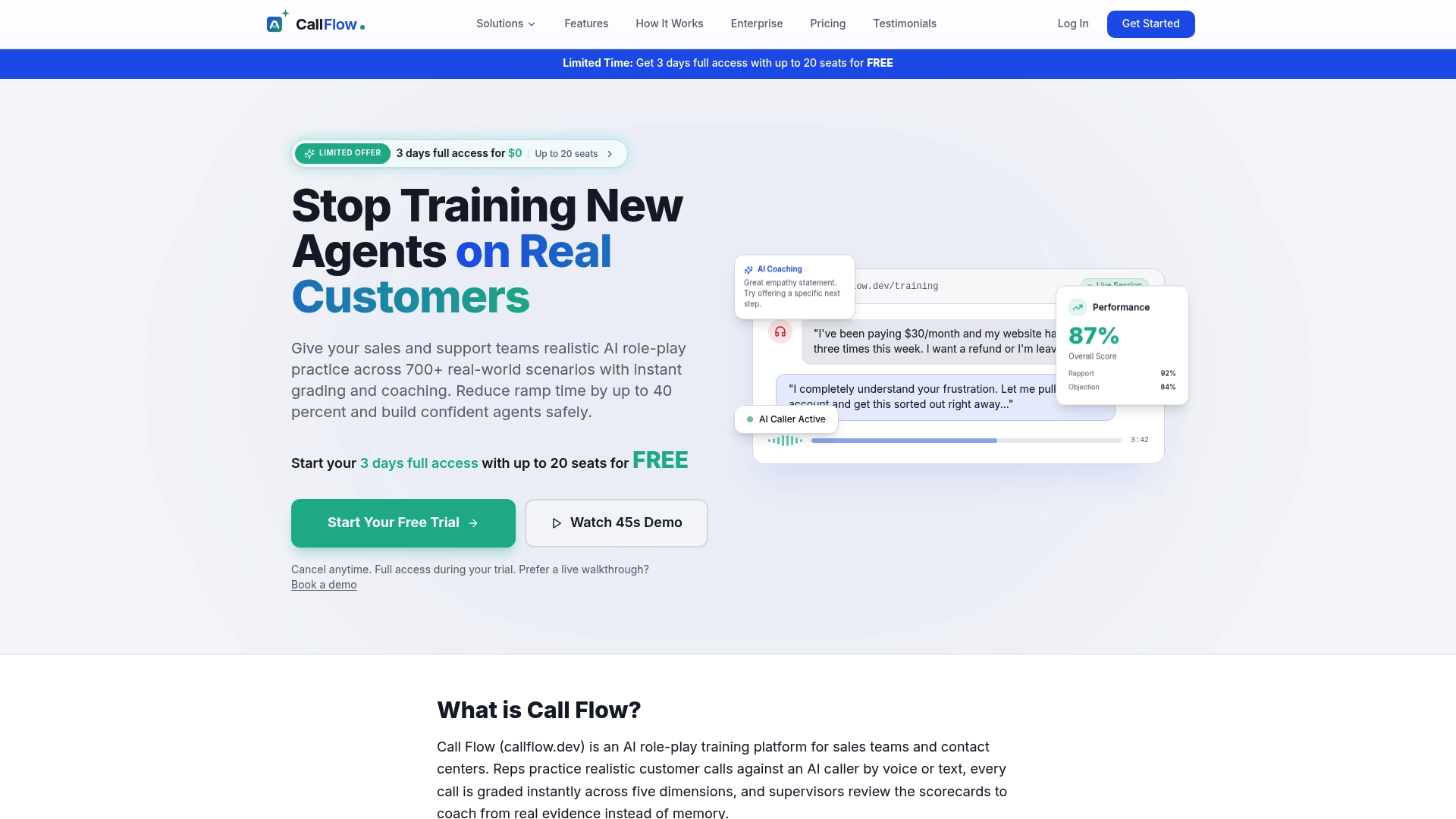
Building and validating scenarios by hand takes real time. Call Flow gives sales and contact center teams a way to generate realistic practice calls, grade them instantly across five performance dimensions, and hand reps coaching feedback the moment a session ends. That instant grading is what turns a one-off scenario into a repeatable training loop.
- Starter plans run $7.42 per month or $89 per year for smaller teams testing the format.
- Growth and Scale plans add capacity as your rollout grows, listed on the same pricing page.
- Business and Enterprise plans are available for larger rollouts through the enterprise contact page.
Every plan includes full access during a risk-free trial, so a manager can run the one-week pilot described above before committing. Start with the pricing page to pick a plan sized to your team.
Sources
- Learning through creation with generative AI — Stanford accelerate learning
- Instructional designers' reflections on generative AI use for scenario-based learning (ODU)
- Instructional Insights: AI powered role-playing — University at Buffalo
- Copyright Office policy guidance on AI and authorship
FAQ
Is it illegal to publish a book written by AI?
Publishing an AI-written book is not illegal, but it may not receive copyright protection. The US Copyright Office requires disclosure of AI-generated content in registration and grants protection only where a human made meaningful creative contributions.
What are some real-life examples of AI-generated scenarios?
Common examples include sales cold-call rehearsal, contact center de-escalation practice, classroom language roleplay, and crisis tabletop exercises for planning teams. Call Flow applies this to sales and support training with graded practice calls, as described in its role-play games overview.
Can you give me some ideas for scenarios?
Try a frustrated customer disputing a charge, a new hire handling an unclear return policy, a manager delivering difficult feedback, or a planning team facing a sudden budget cut. Each works well with the five-part prompt structure covered above: objective, persona, context, task rules, and evaluation request.
What are the possible endings of artificial intelligence scenario planning?
There is no single agreed list of "endings" for AI scenario planning. Definitions vary by field: some frame it around economic outcomes, others around safety and governance, so it is best treated as an open planning exercise rather than a fixed framework.