

This article gives you copy-ready angry customer scenarios, short scripts, and trainer actions you can use today. Each scenario includes a sample line, a script, and a teaching note tied to active listening research. The scenarios are tested in role-play sessions and built for teams that need to practice fast, including support from tools like Call Flow.
TL;DR:
- Most scripted responses rely on acknowledging the customer's issue, owning the problem, and providing a clear next step with a specific timeframe to prevent escalation.
- De-escalation techniques like the HEARD framework and active listening significantly reduce customer anger and increase gratitude, especially when addressing high-emotion complaints first.
- Role-play practice should focus on one skill at a time, with brief scenarios and immediate feedback, supported by AI tools for scalable, self-paced repetition.
- Clear policies are essential for handling abusive customers, including warnings, call termination, and documentation, with escalation to management for threats of violence.
- Trainers should emphasize reading the customer’s emotional state to prioritize empathy and de-escalation, rather than rushing to technical fixes or generic scripts.
Table of Contents
- 1. Top angry customer scenarios with copy-ready scripts
- 2. De-escalation methods every trainer should teach
- 3. How to run role-play practice and score de-escalation skills
- 4. Setting policy for abusive versus angry customers
- 5. Cheat sheet: go-to lines and phrases to avoid
- 6. Why role-play practice changes how agents handle anger
- 7. Call Flow: scale practice and measure de-escalation skills
- 8. Research and resources for trainers
- Sources
- FAQ
1. Top angry customer scenarios with copy-ready scripts
Trainers need scenarios that mirror real calls, not generic examples. Below are ten scenarios agents face often, each with a customer line, a short script, and a note on why the approach works.
- Incorrect order. Customer says: "This is not what I ordered, and I need it fixed now." Script: "I see the mix-up, and I understand why that's frustrating. Let me pull up your order now and get the correct item sent out. I can confirm a replacement ships promptly." The ownership phrase before the fix keeps the customer's arousal from spiking further.
- Late delivery. Customer says: "My package was supposed to arrive three days ago." Script: "You're right to expect it by now, and I'm sorry for the delay. I'm checking the carrier update right now. I'll have a new delivery window for you very shortly." Naming the delay without excuses signals accountability.
- Billing overcharge. Customer says: "You charged me twice for the same order." Script: "That's not right, and I want to get it corrected today. I can see the duplicate charge on your account. I'll process the refund now, and it should post within 3 to 5 business days." Concrete timing reduces the follow-up calls that fuel repeat anger.
- Faulty product. Customer says: "This thing broke after one use." Script: "That shouldn't happen, and I'm sorry it did. Let's get you a replacement or a refund, whichever works better for you. I can start that process right now while we're on the call." Giving a choice restores a sense of control the customer lost.
- Service outage. Customer says: "Your service has been down all morning and I'm losing business." Script: "I hear you, and I know downtime costs you money. Our team is aware and working on it. I'll text you the moment service is restored, and I can note your account for a service credit where applicable." Acknowledging the business impact, not just the technical issue, matters here.
- Data loss or account access. Customer says: "I can't log in and all my data might be gone." Script: "I understand how alarming that sounds. Let's check your account status together right now. Your data is backed up, and I can walk you through a password reset quickly." Speed of reassurance is more important than technical detail at this stage.
- Missing promised feature. Customer says: "I was told this plan included a feature that isn't here." Script: "That's on us for the confusion, and I want to make it right. Let me check what was promised at signup. I can either activate the feature today or adjust your plan to match what you expected." This script avoids blaming the customer for a sales miscommunication.
- Rude or abusive customer. Customer says a version of: "This is useless, and so are you." Script: "I want to help you solve this, and I'll stay on the line to do that. Let's focus on the issue so I can get you a fix. Can you tell me what happened first?" This keeps the agent's tone level while redirecting to the problem, not the insult.
- Repeated unresolved issue. Customer says: "I've called three times about this and nothing has changed." Script: "I can see the history here, and I understand why you're out of patience. This time, I'll stay with it until it's resolved. I'll give you a direct update within one hour." A specific commitment breaks the cycle of vague promises.
- Escalation to supervisor. Customer says: "I want to speak to your manager right now." Script: "I understand, and I'll bring in a supervisor for you. Before I transfer you, let me note the details so you don't have to repeat everything. I'll have someone with you in the next few minutes." Passing context along, not just the call, respects the customer's time.
Each script follows the same shape: acknowledge, own it, give a next step with a timeframe. That structure gives trainers a repeatable pattern rather than ten separate scripts to memorize. For more scenario templates trainers can adapt for practice sessions, see this collection of role-play scenarios.
2. De-escalation methods every trainer should teach
Scripts only work when agents understand the reasoning behind them. Three frameworks give trainers a shared vocabulary for teaching de-escalation: HEARD, active listening, and mirroring.
The HEARD method breaks a complaint into five steps: Hear the customer out without interrupting, Empathize with a short acknowledgment, Apologize when appropriate, Resolve the issue with a concrete action, and Deliver on that action. A line like "I hear you, and that sounds frustrating" covers Hear and Empathize in one breath. "Here's what I'm going to do right now" moves into Resolve. Teaching HEARD as a sequence, not a checklist, helps agents feel less scripted on the call.
The research backs this up. A study on complaint de-escalation found that active listening and empathy reduce high-arousal anger and increase customer gratitude, with controlled experiments showing measurable arousal reduction when agents used these techniques. The same research found that moving a customer from a public complaint channel to a private one, without addressing the emotion first, can backfire. Emotional de-escalation should happen before or alongside any channel switch or recovery offer.
Emotional arousal in customers drops measurably when agents use high empathy or high active listening, according to this research, which also links these behaviors to higher customer gratitude after the interaction.
Micro-skills trainers should drill:
- Mirroring: repeat back the customer's own words or phrasing to build a sense of being heard.
- Paraphrase templates: "So what I'm hearing is..." followed by a one-sentence summary of the complaint.
- Pacing: slow down speech rate on calls; on chat, keep sentences short and avoid long blocks of text.
- Concise apologies: one sentence, no qualifiers like "but" or "however" attached.
The same research on language mirroring found that when agents match a customer's language style and demonstrate active listening, customers show more trust and are more likely to express gratitude, both of which predict better outcomes after the recovery step.
Trainers should teach agents to prioritize emotion-first responses for high-arousal complaints, such as anger or frustration, before moving to technical fixes. For calmer or purely informational complaints, moving straight to resolution is fine. The skill is in reading which mode the moment calls for.
3. How to run role-play practice and score de-escalation skills
A role-play session works when it has a clear objective, a time box, and a way to measure what happened. Here is a structure trainers can set up in under 30 minutes.
- Set one objective per session. Pick a single skill, such as paraphrasing or apology clarity, rather than trying to cover everything at once.
- Assign roles clearly. One agent plays the rep, one plays the customer using a scenario script, and one observes with a checklist.
- Time box each round. Five minutes per scenario keeps energy up and avoids over-rehearsed responses.
- Score against a short rubric. Track three to five measurable signals: did the agent paraphrase the complaint, was the apology clear and brief, did the next step include a specific time.
- Give immediate feedback. One coach note plus one action item works better than a long debrief. "Good ownership line. Next time, name a time frame in your first sentence."
- Run calibration sessions separately. Trainers should periodically review real escalated calls together to agree on what counts as an acceptable paraphrase or apology, which keeps scoring consistent across a larger team.
The progression ladder matters as much as the scenario itself. Start with micro-drills that isolate one skill, like practicing paraphrase lines in isolation. Then move to full scenarios that combine multiple skills. Finish with a graded simulation that mirrors a real call from start to end. This sequence builds confidence before agents face the harder, combined version.
Pro Tip: Run the same scenario twice in one session, once with no coaching and once right after feedback, so agents hear the improvement themselves.

For volume practice between live coaching sessions, AI role-play tools let agents repeat scenarios on their own schedule and get instant scoring without waiting on a trainer's calendar. This is useful for teams that need more repetitions than a trainer has hours to supervise. For a deeper look at building the communication drills behind these sessions, see this guide to agent communication skills.
4. Setting policy for abusive versus angry customers
Angry customers are frustrated about an issue. Abusive customers direct personal attacks, threats, or discriminatory language at the agent. Trainers need a clear line between the two, because the response differs.
A contact-center policy framework recommends a staged approach:
- Warning one: "I want to help you, but I need us to keep this respectful so I can focus on solving it."
- Warning two: "I understand you're upset, but I'll need to end the call if the language continues."
- Termination: "I'm going to end this call now. Please call back when we can continue calmly, and I've noted the details on your account."
- Route repeat offenders to a specialist team or supervisor rather than the general queue on their next contact.
- Document the call immediately after ending it, including exact language used, for the agent's protection and for management review.
Escalate to legal or senior management only for threats of violence or repeated harassment across multiple contacts, following documented escalation procedures.
5. Cheat sheet: go-to lines and phrases to avoid
Print this list for agents to keep at their desk or pinned in their chat tool.
Go-to lines mapped to HEARD:
- Hear: "Go ahead, I'm listening and taking notes."
- Hear: "Tell me exactly what happened so I get the full picture."
- Empathize: "I understand why that's frustrating."
- Empathize: "That would bother me too."
- Apologize: "I'm sorry this happened."
- Apologize: "That's on us, and I want to fix it."
- Resolve: "Here's what I'm going to do right now."
- Resolve: "I can offer you two options, whichever works better."
- Deliver: "You'll have an update within the hour."
- Deliver: "I'll confirm this by email once it's done."
- Closing: "Is there anything else I can take care of for you?"
- Closing: "Thank you for your patience while we sorted this out."
Traps to avoid and their rewrites:
- Avoid "Calm down." Say "I want to help, let's work through this together."
- Avoid "That's not my department." Say "Let me connect you to the right person myself."
- Avoid "You should have..." Say "Here's what we can do from here."
- Avoid "There's nothing I can do." Say "Let me check what options are available."
- Avoid a bare "Sorry about that." Say "I'm sorry this happened, and here's how I'll fix it."
- Avoid long silence on chat. Send a short holding line: "Still checking, one more minute."
On phone, keep sentences full and pacing steady. On chat, use short fragments and confirm receipt quickly. On social channels, move to a private message only after the first empathy line is public and visible.
6. Why role-play practice changes how agents handle anger

Agents who rehearse difficult calls before facing them stop treating anger as a personal attack. That shift shows up fastest in role-play, where a rep can hear their own tone and adjust it before a real customer is on the line. The scenarios in this article work because they force a specific habit: acknowledge first, act second, always with a timeframe attached.
Trainers get more value from five minutes of focused practice on one skill than from a full mock call that tries to cover everything. Pick the harder scenario for your team, run it twice, and give one piece of feedback. That single block, repeated weekly, builds the kind of consistency that a quarterly training day never will.
— Costa
7. Call Flow: scale practice and measure de-escalation skills
Running these scenarios with a full team takes hours a trainer often does not have. Call Flow gives agents realistic voice and text role-play scenarios they can practice on their own schedule, with instant AI grading across five performance dimensions so trainers see where each rep stands without sitting in on every session.
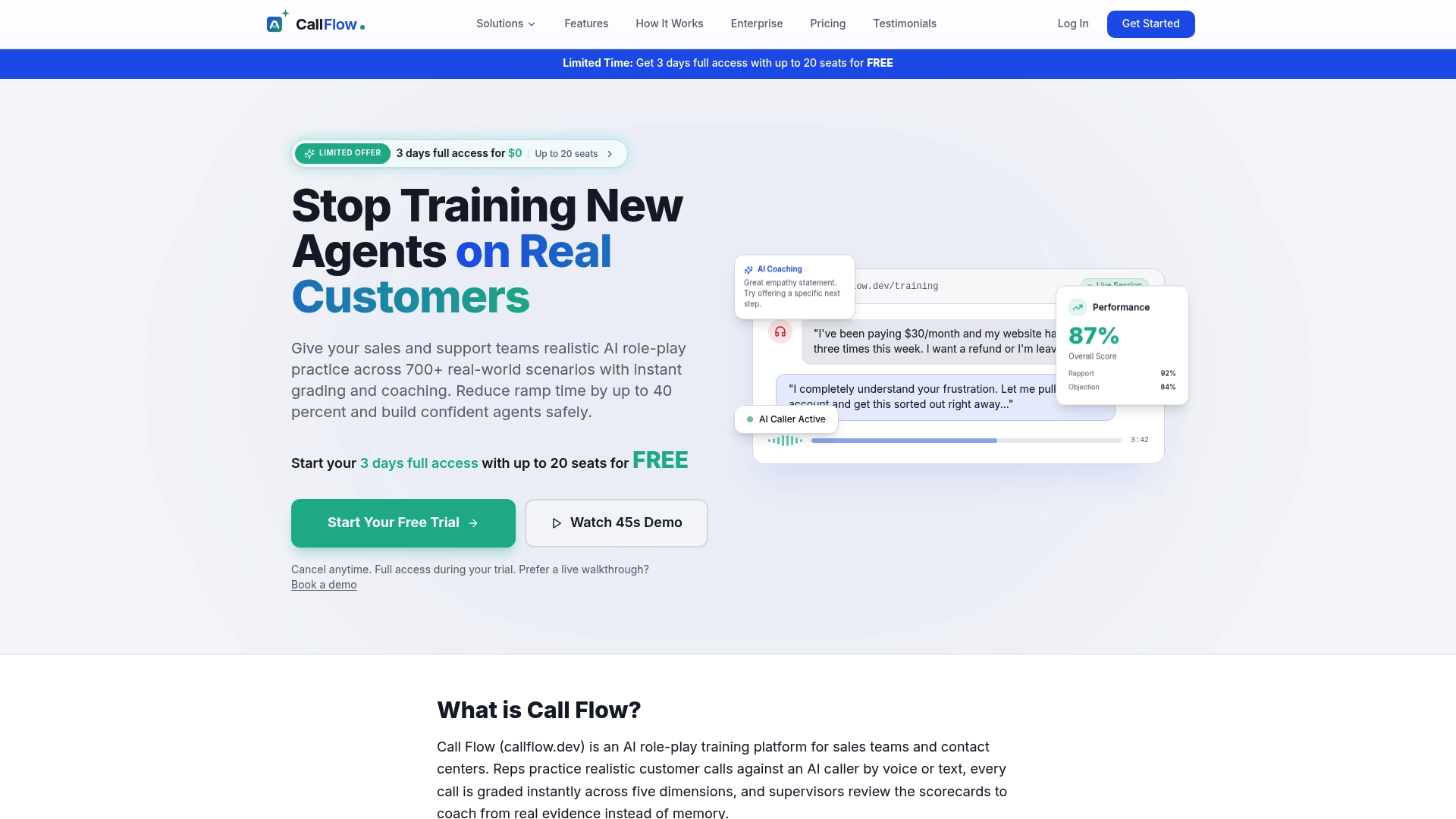
- Configurable scenario library covering sales and support situations, including angry customer calls.
- Instant grading and coaching feedback after every practice session.
- Supervisor dashboards and skill analytics to track progress across a team.
- Transparent pricing with a self-serve, full-feature trial to start without a sales call.
| Plan | Monthly price | Annual price |
|---|---|---|
| Starter | $7.42 | $89 |
| Growth | $14.92 | $179 |
| Scale | $33.25 | $399 |
Larger teams with custom deployment needs can review the Business and Enterprise plans for options beyond the standard tiers. Structured practice and quick coaching also tend to support the revenue and retention gains that come from handling complaints well. Start a trial on the pricing page and run your first graded scenario today.
8. Research and resources for trainers
The de-escalation techniques in this article draw on complaint de-escalation research, the HEARD framework, and abusive caller policy guidance. For a ready-to-adapt session template, see this training manual.
Sources
- Complaint de-escalation strategies on social media (Herhausen et al., 2022)
- A policy for dealing with abusive customers - Call Centre Helper
FAQ
Can you give me an example of an angry customer?
A common example is a customer who received a late delivery and calls demanding an explanation and a refund. The agent should acknowledge the delay, avoid excuses, and give a specific next step, such as a refund timeline within a set number of business days.
What are some examples of difficult customer scenarios?
Frequent scenarios include incorrect orders, billing overcharges, faulty products, service outages, and repeated unresolved issues. Each requires the same basic pattern: acknowledge the problem, take ownership, and commit to a concrete, timed next step.
Can you provide some script examples of angry customer situations?
A billing overcharge script might be: "That's not right, and I want to get it corrected today. I can see the duplicate charge, and I'll process the refund now, which should post within a few business days." The structure works because it pairs an apology with a specific action and timeframe.
What to do when an angry customer approaches you?
Start by listening fully without interrupting, then acknowledge the frustration in one short sentence before offering a fix. This follows the HEARD method, which pairs emotional acknowledgment with a clear resolution step to reduce tension faster than jumping straight to a solution.