

To improve first call resolution (FCR), measure it the way your customer sees it, find out why people call back, and fix the causes. Then train agents on those exact situations until they can handle them without escalation. Most gains come from knowledge, authority, routing and practice, not from asking agents to work faster.
This guide gives you the steps in order. It covers how to set a baseline, how to find repeat-call causes, what to change, and how to check that the gain holds.
TL;DR
- Measure FCR from the customer's view. Internal quality scores can overstate resolution by a wide margin.
- Link every repeat contact to the first one. Then sort the causes: knowledge, authority, routing or training.
- Give agents customer history, current knowledge articles and room to use judgment.
- Practice hard calls before they happen. Role play and fast feedback close skill gaps sooner than live calls do.
- Track FCR next to CSAT and quality. Watch the gap between your best and worst agents.
Table of Contents
- Set a baseline you can trust
- Find out why customers call back
- Step 1: Give agents the context before they speak
- Step 2: Send the call to the right agent
- Step 3: Let agents resolve, not just relay
- Step 4: Train the listening and diagnosis skills
- Step 5: Practice the hard calls before they happen
- Step 6: Coach on a steady rhythm
- Step 7: Track FCR with quality and CSAT
- Step 8: Check that the gain is real and lasting
- What improvement can be worth
- Try it on your own repeat-call causes
- FAQ
- Sources
Set a baseline you can trust
You cannot improve a number you measure loosely. Start with one written definition of "resolved".
A common rule is a time window. One utility regulator filing counts a contact as resolved when no further case for the same customer and issue type opens within 7 calendar days. Pick your window, write it down and keep it fixed. Changing it midyear breaks your trend line.
Then check your number against the customer's experience. A COPC case study in financial services found customer-survey FCR of 71%. A redesigned, customer-centered quality approach measured 68%. The existing internal quality process reported 96%. That process was overstating resolution.

The lesson is simple. If a QA form says "resolved" and the customer calls again, the form is wrong.
What a good target looks like
New York State suggests a common FCR target of 70 to 75% for its agencies. It also says standards should fit each agency's needs. Use that as a reference point, not a promise. Your mix of simple and complex issues sets what is realistic.
Split your baseline by issue type. The U.S. General Services Administration notes that measuring FCR shows which kinds of inquiries drive volume, such as simple requests versus ones that cross departments. One blended number hides this.
Find out why customers call back
Repeat calls are expensive. SQM Group data from 2022 says repeat calls make up 23% of a call center's operating budget on average. The same source says that when FCR is not achieved, customers make 2.5 calls on average to resolve the issue. It adds that 25% of customers with an unresolved issue say they intend to defect.
Here is how to find the causes.
- Link each repeat contact to the original contact by customer and issue.
- Pull a sample of the original calls. Listen to them, or read the transcripts.
- Tag each one with a root cause.
- Count the tags. Fix the biggest one first.
Use four tags to start:
| Root cause | What it looks like on the call | Typical fix |
|---|---|---|
| Knowledge gap | Agent guesses, puts the customer on hold, or gives wrong information | Better articles, product training, practice |
| Authority gap | Agent agrees the fix is right but must escalate | Raise approval limits, add guided exceptions |
| Routing gap | Customer reaches the wrong team or skill group | Skill-based routing, cleaner menus |
| Skill gap | Agent does not diagnose the real issue, or leaves the customer unsure | Role play, coaching, call review |
This matches the approach in one root-cause guide for repeat calls, which links repeat cases to the original issue and looks for barriers in knowledge, authority, routing and training.
SQM Group makes a related point in its book excerpt. FCR works best as an operating philosophy shared by people, process and technology, not as a lone agent KPI. If only agents own the number, nobody fixes the broken process behind it.
Step 1: Give agents the context before they speak
Agents who start cold spend the first minutes asking questions the customer already answered. Fix that first.
- Show account history and past contacts on one screen.
- Keep scripts short and use them as prompts, not as a wall of text.
- Keep troubleshooting guides current, with an owner for each article.
- Retire articles that agents do not trust.
Technology helps here. If you are reviewing your stack, this overview of call center technology solution types covers routing, call recording and reporting, which all affect FCR.
Step 2: Send the call to the right agent
Some repeat calls start before the agent says hello. A billing question that lands with a technical team gets transferred, and each transfer cuts the odds of resolution.
Review your menu and routing rules against the repeat-call tags. If one issue type fails again and again, route it to a smaller skill group. Train that group deeply on it.
Self-service can also take simple requests off the queue. Then agents spend their time on the harder calls. Well-built AI chatbots in customer support can handle routine questions and hand over the rest with context. Check that the handoff passes the full history. A customer who must repeat everything is a likely repeat call.
Step 3: Let agents resolve, not just relay
Authority gaps are easy to miss. The agent knows the answer but cannot act on it.
List the top ten reasons for escalation. For each one, ask a plain question: does this need a supervisor, or only a rule? Many need only a rule. Write the rule, set a limit and let agents act within it.
Trust has to come with support. Agents who can make decisions need practice making them. That is where the next step comes in.
Step 4: Train the listening and diagnosis skills
Most unresolved calls are not about missing facts. The agent solved the wrong problem, or the customer was not sure the problem was fixed.
Teach four habits:
- Ask open questions before offering a fix.
- Repeat the issue back in your own words.
- Give steps one at a time, and confirm each one.
- Close by asking if anything else needs attention.
These are the same habits that RingCentral recommends: active listening, clear step-by-step instructions, and a final check at the end of the call.
New York State's call center standards also call for ongoing training in empathy, active listening, product knowledge and compliance. One class at hire is not enough. Skills fade without use.
For empathy in particular, see our guide to scoring role plays like live calls.
Step 5: Practice the hard calls before they happen
Live calls are a poor place to learn. The customer is waiting, and the cost of a mistake is a repeat call.
Role play fixes this. An agent takes the call, makes mistakes, gets feedback and tries again. The problem is that manager-led role play is slow and hard to scale. A manager can run only so many sessions a week, and agents tend to play it safe in front of a peer.
AI role play removes that limit. Agents can practice any time, on the exact scenarios your repeat-call review found. A study of generative AI in contact centers, published in 2025, reported a 28% rise in agent confidence and a 35% cut in response time with AI-assisted systems. That study covers AI assistance in general, not any one product, but it shows the direction.
To build scenarios from your own repeat-call data:
- Take the top five root causes from your review.
- Write a customer profile and a goal for each one.
- Add the usual twists: an angry customer, a wrong account, a policy exception.
- Set the pass mark to match your QA scorecard.
For more on the method, read our overview of AI role play training and the guide to getting started with AI contact center training.
Step 6: Coach on a steady rhythm
Training sets the skill. Coaching keeps it. Quality monitoring is the engine behind both.
The contact center professional body ICMI advises agreeing up front on KPIs, scorecards, sampling, evaluators and who owns the analysis. It also advises reviewing trends rather than single incidents, and calibrating evaluators on the same calls so scores mean the same thing from one reviewer to the next.
Calibration matters for FCR. If two reviewers score the same call differently, agents get mixed messages. Our guide on aligning quality standards to scorecards shows how to set that up.
A good coaching session is short and specific:
- Pick one call and one behavior.
- Play the moment, not the whole call.
- Let the agent say what they would change.
- Send them to a practice scenario on that exact skill.
- Recheck in a week.
Step 7: Track FCR with quality and CSAT
FCR is easy to game. An agent who never transfers and never admits a problem can look good while customers call back. That is why you track it as part of a set.
Watch these together:
| Metric | Why it sits next to FCR |
|---|---|
| CSAT | Shows whether customers feel resolved |
| Repeat-contact rate | Catches the cases the FCR survey misses |
| Quality score | Shows whether the process was followed |
| Average handle time | Warns you if speed is pushing out resolution |
One published review of call center measurements notes that many centers put efficiency metrics such as handle time ahead of service quality, which can hurt the real resolution experience. Do not push handle time down while FCR is the goal. If you need to cut handle time, start with after-call work, as in our guide to automating after-call work first.
COPC's view is a useful rule for the quality side: a quality score earns its place only if it predicts the customer's actual outcome. Score an unresolved issue as unresolved, even when the agent was polite and followed the script. For a wider metric set, see our call center performance metrics guide.
Step 8: Check that the gain is real and lasting
After you change something, test it.
McKinsey suggests judging coaching by performance trends over time, including FCR, and by whether the spread between agents narrows. It says a gap well above 30 to 40 percentage points between the top and bottom quartiles can point to weak coaching.
Use that as a monthly check:
- Rank agents by FCR.
- Compare the top quartile with the bottom quartile.
- If the gap is wide, review what top agents do differently.
- Turn those habits into practice scenarios and coaching points.
Also keep the customer's voice in the loop. SQM Group reports client gains of 3% to 12% from a voice-of-the-customer performance system, 1% to 10% from process initiatives, and 1% to 5% from skills or technology initiatives. Results vary by organization, so treat these as ranges and measure your own.
What improvement can be worth
Published cases show what is possible. They are not guarantees.
- A medium-sized call center reported FCR rising from 60% to 75%, CSAT up 20% and turnover down 10% after a QA and coaching program.
- Optimum raised first-contact resolution by 3.5 points to 81.8%. Its 24-hour repeat rate fell 24%, and care agent attrition fell 20%.
- SQM Group's 2022 data links each 1% gain in FCR to about a 1% gain in CSAT and a 1% cut in operating costs.
The turnover link is worth noting for HR and team leaders. Agents who resolve calls feel more successful, and agents who feel prepared tend to stay.
Our view: resolution is a skill you can rehearse
Most FCR programs fix the process and then hope the agents adapt. We think the order should include practice. A new article or rule changes nothing until an agent has used it under pressure.
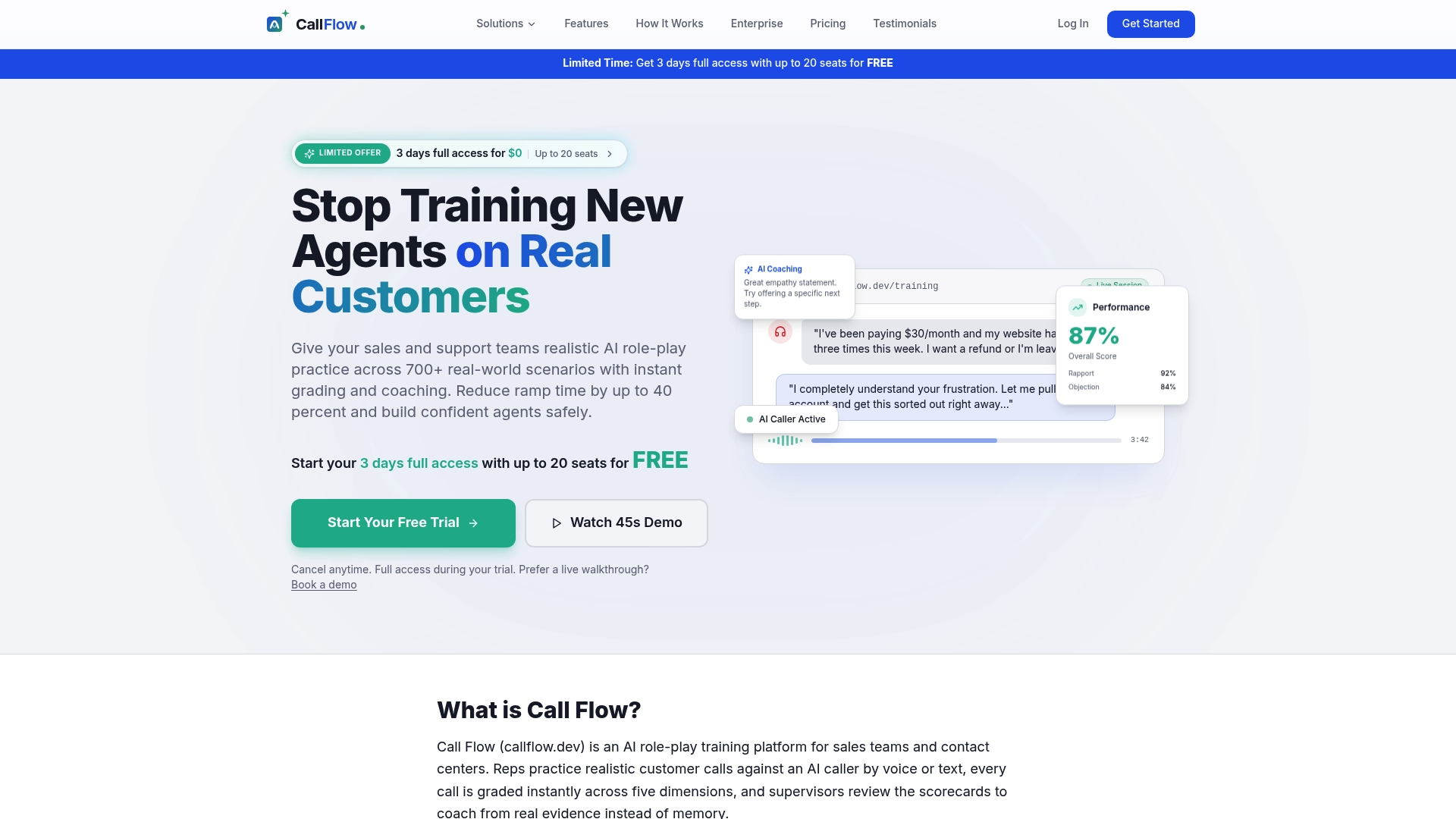
That is why we built Call Flow around realistic role play. Agents take simulated customer calls by voice or text. They get instant grading across five performance dimensions and coaching they can act on. Supervisors see skill analytics and can review and override scores.
Our scoring is calibrated to match your existing QA standards. So the feedback an agent gets in practice is the feedback they will get on a live call. We report faster ramp time and better resolution rates from teams that practice this way.
Practice is cheap and safe. A repeat call is neither.
Costa
Try it on your own repeat-call causes
Call Flow lets you build scenarios from the causes your review found, then lets agents practice them with instant scoring. You can see every feature in a free, full-feature trial. Plans are billed per team, and the prices on our pricing page are flat: Starter is $7.42 per month or $89 per year, Growth is $14.92 per month or $179 per year, and Scale is $33.25 per month or $399 per year.
Larger teams can look at the Business and Enterprise plans. For a wider view of our approach, visit the Call Flow homepage.
FAQ
What is a good first call resolution rate?
It depends on your issue mix. New York State suggests a common target of 70 to 75% for its agencies and says each should tailor its standard. Set your own target from your baseline, split by issue type, and aim to improve it steadily.
What is the fastest way to improve first call resolution?
Find your top three repeat-call causes and fix those first. Link repeat contacts to the original call, tag the root cause, and act on the biggest group. Often that means a knowledge article, an approval limit or a routing change, plus practice for agents.
How do you measure first call resolution?
Choose a rule, such as no new contact on the same issue within a set window, and apply it the same way every month. Then compare it with what customers say in surveys. Internal data alone can overstate resolution.
Can improving FCR hurt other metrics?
It can if you chase it alone. Pair FCR with CSAT, repeat-contact rate and quality scores. Do not use handle time as a target at the same time. Agents then feel free to take the time a complete answer needs.
How does role play help first call resolution?
Role play lets agents practice diagnosis, listening and escalation decisions before a real customer is on the line. Build scenarios from your repeat-call causes and give feedback right after each attempt. Agents then arrive on live calls having already handled the hard moments.
Sources
- Ameren Illinois performance metrics filing, Docket No. 25-0574
- COPC case study: linking quality results to business outcomes
- Call Center Standards, State of New York
- How to Measure Contact Center Performance, GSA
- Agent Call Handling Training Guide, SQM Group
- First Call Resolution book excerpt, SQM Group
- Improve First Call Resolution: Diagnose Repeat Calls
- What is First Call Resolution and How to Improve It, RingCentral
- Transforming the Working Style of Call Center Agents, IJACSA 2025
- 4 Best Practices to Implement a Quality Monitoring Program, ICMI
- A Review of Call Center Measurements
- Smarter call-center coaching for the digital world, McKinsey
- How to Measure the ROI for QA and Coaching in Call Centers, QATC
- Optimum case study, CX Professionals Association
- 10 Types of Call Center Technology Solutions
- AI Chat Bots: Enhancing Efficiency in Customer Support