

Six skills separate agents who resolve calls fast from agents who create repeat contacts: active listening, empathy, clarity and positive language, questioning and call control, cross-channel adaptability, and problem ownership. The fastest way to build them is not a slide deck. It's targeted role-play paired with rubric-driven, immediate feedback, tracked against FCR and CSAT. Tools like Callflow exist because that combination, done consistently, moves ramp time and resolution rates faster than lecture-based training ever does.
TL;DR:
- Effective training should focus on repeated, rubric-driven role-play with immediate feedback rather than one-time classroom lectures.
- Building skills like empathy, call control, and clarity requires consistent practice across scenarios of increasing difficulty and regular reinforcement.
- Different communication channels—voice, chat, email—necessitate tailored training on pacing, tone, and framing, with QA monitoring across all contact types.
- Metrics such as first contact resolution, CSAT, and ramp time are key indicators of training effectiveness, validated through controlled pilots and specific QA scoring.
- Using flexible scripts, deliberate pauses, and cultural cues enhances customer rapport, de-escalates conflicts, and improves trust during support interactions.
Table of Contents
- Core Communication Skills for Agents (And How to Spot Them)
- Training Methods That Actually Build These Skills
- Adapting Training for Voice, Chat, and Email
- Measuring Whether Communication Training Is Working
- Role-Play and Instant Coaching in Practice
- Your 30-60-90 Day Training Checklist
- Handling Difficult or Irate Customers
- Cultural Sensitivity in Customer Interactions
- Building Rapport and Trust With Customers
- Using Scripts Flexibly Instead of Reading Them
- The Role of Silence and Pauses
- Why Most Training Programs Get This Backward
- Sources
Core Communication Skills for Agents (And How to Spot Them)
Each skill below has observable behaviors. If you can't see it or hear it on a call, you can't coach it. That's the standard to hold every drill and QA form to.
Active listening shows up as paraphrasing ("So the charge appeared twice on your statement, correct?"), clarifying questions, and a brief summary before moving to resolution. Agents who skip the paraphrase step tend to solve the wrong problem, then get surprised when the customer pushes back. A two-minute drill works well here: play a recorded customer complaint, pause it, and have the trainee paraphrase back what they heard before the recording continues.
Empathy and emotional intelligence separate agents who sound like a script from agents who sound like they're actually listening. Validation language matters more than most training programs admit: "That's frustrating, and I understand why you're upset" does more de-escalation work than any policy explanation. Tone cues (a slower pace, a lower pitch, a brief pause before responding) signal composure to an agitated customer even when the words are neutral.
Clarity and positive language means killing internal jargon and reframing restrictions as options. "That's not something we can do" becomes "Here's what I can do instead." Step-by-step explanations beat single dense sentences, especially on technical issues. A useful rewrite drill: give trainees five negative-phrasing sentences pulled from real transcripts and have them convert each to a positive-framing alternative.
Questioning and call control requires knowing when to open a question up and when to close it down. Open questions ("Can you walk me through what happened?") surface context early. Closed questions ("Is the light on the router green or red?") speed up diagnosis once you have direction. Agents also need transition phrases to regain control from a rambling caller: "I want to make sure I get this resolved for you, so let me ask a couple quick questions." ICMI's multichannel communications framework treats questioning and call control as a distinct training module for exactly this reason. It doesn't happen naturally; it has to be drilled.
Adaptability and style-matching means reading a customer's pace and formality within the first thirty seconds and adjusting. A rushed, clipped caller needs brevity. A caller who's chatty and anxious often needs a slightly slower pace and more explicit reassurance before you can move to resolution.
Problem ownership closes the interaction properly: confirming what was done, setting a clear expectation for what happens next, and stating a timeline if one applies. "I've reset your password and sent a confirmation email. If you don't see it in ten minutes, call back and reference ticket 4471" beats "You're all set" every time.
- Paraphrase and summarize before offering a resolution
- Use explicit validation language before troubleshooting starts
- Rewrite restrictive phrasing into what's possible, not what isn't
- Match question type (open vs. closed) to the stage of the call
- Read pace and formality cues in the first thirty seconds
- Close every contact with a confirmation and a next-step timeline
Pro Tip: Build a one-page "behavior card" for each skill with three good examples and three bad examples pulled from real (anonymized) transcripts. Agents retain contrast far better than abstract description.
Training Methods That Actually Build These Skills
Knowing the six skills doesn't help if your training program is a one-time onboarding lecture. Skill acquisition needs repetition with feedback, and the structure of that repetition matters as much as the content.
- Design role-plays in progressive difficulty tiers. Start with a straightforward account question, move to a moderately frustrated customer, and end with a genuinely difficult, multi-issue call. Trainees who only ever practice easy scenarios freeze the first time a real call goes sideways.
- Run short, deliberate-practice drills daily rather than long sessions weekly. A ten-minute listening drill or a five-minute tone-calibration exercise, done every shift, beats a two-hour workshop once a month. This lines up with the broader evidence on deliberate practice with immediate feedback, which accelerates skill acquisition far more than passive instruction.
- Score with a behavioral rubric, not a gut check. Break the call into four to six dimensions (listening, empathy, clarity, control, resolution) with a 1 to 5 anchor for each, so coaching feedback points to something specific rather than "that was okay."
- Choose your practice format by what you're building. AI role-play and recorded simulations work well for repetition at scale and for skills that need many reps (tone calibration, objection handling). Live peer role-play works better for judgment calls that need real-time adaptation, like reading an unpredictable partner's reactions.
- Reinforce on a spaced cadence. A skill trained once in week one and never revisited fades. Build in short refreshers at two weeks, six weeks, and quarterly, tied to whatever the QA data shows is slipping.
Trainers building a curriculum from scratch can lean on a ready-to-adapt training manual rather than reinventing the module structure, and pair it with structured reinforcement practices so the skills don't decay after week one.
Pro Tip: Score the same call twice, a week apart, with two different coaches using your rubric. If the scores diverge by more than one point on any dimension, your rubric anchors are too vague, not your coaches.
Adapting Training for Voice, Chat, and Email
Phone, chat, and email put different cognitive loads on an agent, and a script that works on the phone often falls flat in writing. Research on contact center skills makes this point directly: training the phone script alone doesn't transfer automatically to chat performance, because typing speed, reading patterns, and asynchronous expectations change how clarity and empathy need to be expressed.
- Voice: Train pacing, deliberate pauses, tone control, and signposting (IVR voice over) ("First I'll check your account, then I'll walk you through the fix").
- Chat: Use the 7 Cs framework (clear, concise, concrete, correct, coherent, complete, courteous) as a written-message checklist, and set expectations on response timing since silence reads differently in text than on a call.
- Email: Structure for scanning: a clear subject line, a short opening that states the issue, and an explicit call to action with a timeline.
- Social and messaging: Keep it brief, hold brand voice consistent, and train explicit escalation triggers so agents know when a public thread needs to move private.
QA should sample across channels, not just the phone queue, so trainers catch when a strong voice agent is producing weak, jargon-heavy chat transcripts.
Measuring Whether Communication Training Is Working
Four KPIs tell you whether skill training is landing: First Contact Resolution (FCR), CSAT, Average Handle Time (AHT), and escalation rate. FCR rises when active listening and questioning reduce misdiagnosis. CSAT tracks empathy and tone. AHT should drop as clarity improves, not because agents rush, but because they explain things correctly the first time. Escalation rate flags where call control is breaking down.
Underneath those, track training-specific metrics: ramp time (how long until a new hire hits target performance), QA rubric scores by dimension, and coaching session completion rates.
Run pilots in small batches. A two to four week role-play pilot with a matched control group, sampling QA scores before and after, gives you a real signal without committing your whole floor to an untested method. Small, measured pilots consistently give managers the fastest read on whether a training change is worth scaling. When reviewing raw QA notes, tag recurring behaviors (missed paraphrase, no validation language, weak close) so qualitative feedback becomes something you can count and trend over time.
- FCR and escalation rate flag whether questioning and control skills are working
- CSAT reflects empathy and tone more directly than any other metric
- Ramp time and rubric scores show whether training itself is effective
- A four-week pilot with a control group beats a floor-wide rollout on faith
For a fuller framework connecting these metrics to specific coaching moves, see the CSAT playbook for contact center leaders.
Role-Play and Instant Coaching in Practice
Peer role-play has a real limit: it's slow to schedule, inconsistent in scoring, and hard to repeat at scale across a large team. Simulated or AI-driven role-play solves the repetition problem. An agent can run the same difficult de-escalation scenario ten times before their first live call, with scoring that doesn't depend on which coach happened to be in the room.
Some AI-driven role-play platforms apply this directly, scoring practice calls across multiple performance dimensions and returning feedback immediately instead of days later in a coaching session. Such platforms can help reduce ramp time and improve resolution rates, though these figures should be validated against your own baseline rather than taken as a guarantee for every environment. The right test is a small pilot: run one team through structured role-play for a month, compare ramp time and FCR against a team on your existing process.
Placement matters as much as the tool. Slot role-play early in onboarding, before agents take live calls, then bring it back as a scheduled refresher every few weeks tied to whatever skill your QA data shows is slipping.
Your 30-60-90 Day Training Checklist
- Days 1 to 30: Baseline your current QA scores, add one or two micro-drills per shift, and start a small role-play pilot on one team.
- Days 31 to 60: Build structured role-play labs, switch QA to a behavioral rubric, and track early movement in FCR or CSAT.
- Days 61 to 90: Scale whatever worked, fold the drills into standard onboarding, and connect coaching outcomes to performance reviews.
A 30-60-90 training plan template can save you the setup work. The single highest-leverage move in all three phases is the same: focused role-play paired with immediate, specific feedback.
Handling Difficult or Irate Customers
The instinct to defend policy first is almost always the wrong move. An irate customer needs to feel heard before they can process any explanation, so the sequence matters: validate, then explain, then resolve.
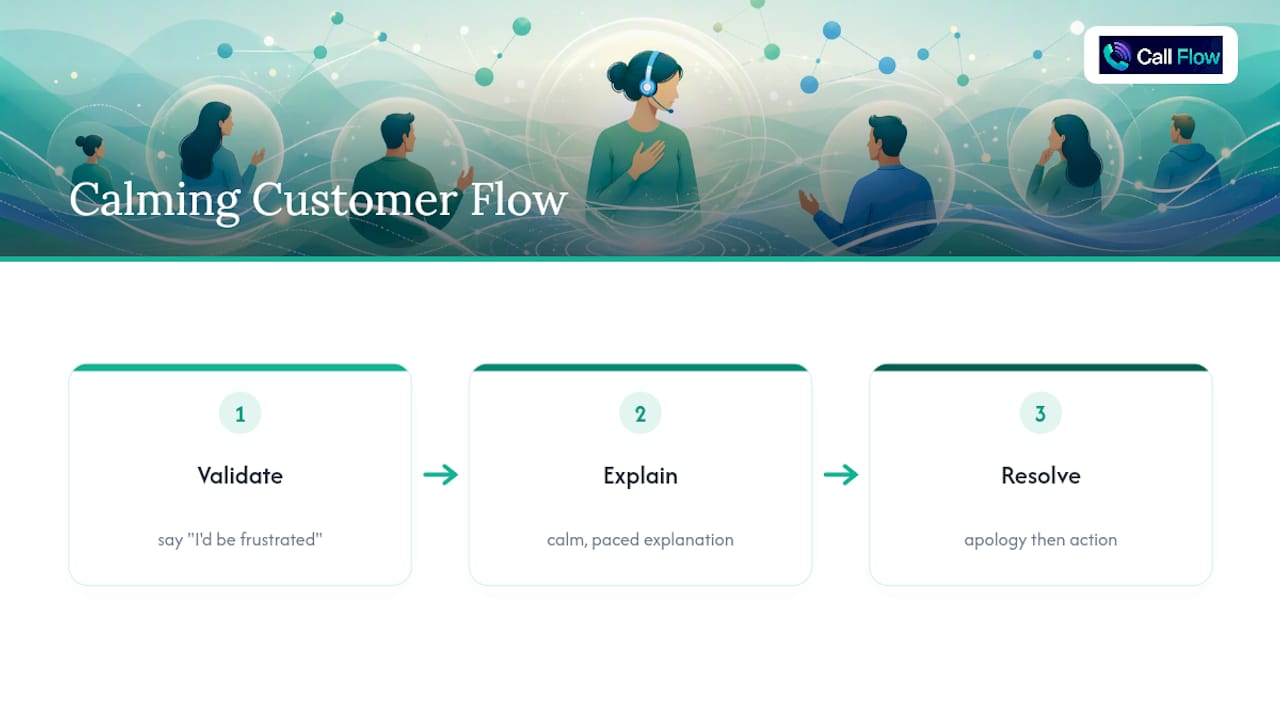
Start with explicit validation, not just a neutral acknowledgment. "I'd be frustrated too if that happened to me" lands differently than "I understand your frustration," which can sound like a script line. Lower your pace and pitch slightly. Agitated customers often speak fast and loud; an agent who matches that energy escalates the call, while one who stays measured tends to bring the temperature down within the first minute.
Avoid the trap of over-apologizing without acting. Three apologies with no forward movement reads as stalling. One clear apology, followed immediately by "Here's what I'm going to do," moves the call forward.
Give agents explicit permission to set boundaries. If a customer becomes abusive, a calm, scripted line ("I want to help you, and I need us to keep this respectful so I can") protects the agent and often resets the tone. Train the exact wording in advance. Agents who have to improvise a boundary-setting line in the moment either freeze or overreact.
Finally, train the handoff. If a call needs to escalate, the language matters: "I'm bringing in someone who can approve this directly" sounds like progress. "I have to transfer you" sounds like a dead end, even when it's the same action.
Cultural Sensitivity in Customer Interactions
Communication norms around directness, formality, and pacing vary widely across customer bases, and a script written for one cultural default can misfire with another. Some customers expect a formal, title-based address and a slower build to the point. Others read that same approach as evasive and want the resolution stated immediately.
Train agents to listen for cues rather than assume. Formality in a customer's own language, pace of speech, and how much small talk they initiate all signal what register to match. An agent who defaults to casual language with every caller will read as disrespectful to some customers and overly familiar to others.
Idioms and figurative language are a common failure point, especially with non-native English speakers or customers using a translation tool on their end. "That should do the trick" or "let's circle back" can genuinely confuse someone parsing English as a second language. Training agents to default to plain, literal phrasing when they sense a language gap avoids unnecessary friction.
Name pronunciation deserves specific attention. A simple "I want to make sure I'm saying your name correctly" said early in a call does more relationship-building than most agents realize, and it signals respect without requiring the agent to be fluent in every naming convention they'll encounter.
None of this requires memorizing country-by-country etiquette guides. It requires training agents to notice signals and adjust, which is a teachable skill, not an innate trait.
Building Rapport and Trust With Customers
Rapport on a support call gets built in the first thirty seconds or it often doesn't get built at all. Customers calling with a problem are primed to expect friction, so an agent who opens with genuine acknowledgment, rather than a rushed script line, sets a different tone immediately.
Using the customer's name naturally, without overdoing it, helps. So does referencing something specific from the account or the conversation rather than sounding generic: "I see you called about this same issue last month, so let's make sure we actually fix the root cause this time" builds more trust than a blanket "How can I help you today?"
Trust also comes from transparency about limits. An agent who says "I can't waive that fee, but I can do this instead" builds more credibility than one who avoids the boundary and lets the customer discover it later. Customers generally forgive a firm no more easily than they forgive a vague answer that turns out to be a no in disguise.
Consistency across contacts matters more than any single great call. A customer who gets a warm, competent agent once and a cold, scripted one the next time doesn't trust the brand, they trust the individual. That's why rapport-building behaviors need to be part of the standard skill set every agent trains on, not a personality trait some agents happen to have.
Using Scripts Flexibly Instead of Reading Them
A script read verbatim sounds like a script, and customers notice within the first sentence. The fix isn't eliminating scripts. It's training agents to treat them as a skeleton, not a transcript.
Give agents the required elements (compliance language, specific policy wording, mandatory disclosures) and leave everything else open to personalization. "I'm going to look into your account now" can become "Let me pull that up, give me one second" depending on the agent's natural voice and the customer's tone. The required content stays intact; the delivery adapts.
Train agents to insert something specific to the call before returning to the script framework: referencing what the customer just said, acknowledging a detail from earlier in the conversation, or adjusting formality to match. This is a drillable skill. Give trainees a standard script line and have them rephrase it three different ways for three different customer personas (rushed, chatty, frustrated) without losing the required content.
Watch for agents who go too far the other direction and drop required disclosures in the name of sounding natural. The goal is flexible delivery of fixed content, not improvised content. QA should check both: did the required information get delivered, and did it sound like a human said it.
The Role of Silence and Pauses
Dead air makes new agents anxious, and that anxiety leads to a common mistake: filling every pause with words, often mid-thought or before the customer has actually finished speaking.
A deliberate pause after a customer finishes talking, even just one or two seconds, signals that the agent actually processed what was said instead of racing to the next script line. It also gives upset customers room to add something they hadn't said yet, which often surfaces the real issue behind their complaint.
Silence during hold time or system lookups needs explicit handling, not the same instinct to fill it. "I'm still checking, one more moment" said once is enough. Repeating filler phrases every few seconds reads as more anxious, not more helpful.
There's a harder skill here too: letting an angry customer vent without interrupting. The instinct to jump in and defend or explain mid-rant almost always backfires. Training agents to hold silence, take a breath, and respond only once the customer has actually stopped talking is one of the more underrated drills in de-escalation training, and one most programs skip entirely in favor of scripted phrases.
Why Most Training Programs Get This Backward
Most call center training still treats communication skills as something you explain once and expect to stick. Slide decks describe active listening. A quiz confirms the agent understood the definition. Then the agent takes a live call and reverts to whatever their instinct tells them to do, because a definition was never going to change a behavior under real pressure.
The evidence points somewhere else entirely: skills like empathy, call control, and clarity only become reliable under pressure when they've been rehearsed under pressure, with feedback specific enough to correct the exact behavior that went wrong. That's the gap between programs that produce confident agents and programs that produce agents who can pass a knowledge check but freeze on a real escalated call.

The most overrated element in a lot of training curricula is scenario variety for its own sake. Managers often chase more scenarios instead of better feedback loops on fewer scenarios. A tight rubric applied consistently across five role-plays beats twenty unscored role-plays every time.
If you take one thing from this: build the rehearsal loop first, then worry about coverage. Repetition with real feedback is what turns a skill list into a habit.
— Costa
Callflow builds that rehearsal loop directly into onboarding: configurable role-play scenarios, instant scoring across five performance dimensions, and coaching feedback delivered immediately instead of at the next one-on-one. Teams typically use it to run the exact progression this article describes, easy scenarios first, then escalating difficulty, scored against a consistent rubric instead of whichever coach happens to be reviewing that day. You can see how a configured practice scenario works in practice, and most teams start with full access during a risk-free trial before committing to a plan.
Sources
- The 7 Cs of Communication — MindTools
- Multichannel Communications for Agents — ICMI
- 10 essential skills for modern contact center agents — TechTarget