

The fastest way to build agent empathy is repeated, realistic role-play paired with targeted coaching and measurable practice blocks. Short one-time workshops raise empathy scores briefly, but effects fade within about 90 days without follow-up practice. Start this week: run a 15 to 30 minute role-play micro-session with your team and track one KPI.
TL;DR:
- Run weekly practice and monthly 30 to 45 minute scenario sessions; a single workshop’s empathy gains returned to baseline by 90 days without reinforcement.
- Pilot one team: score a baseline week, run four weeks of weekly practice, then compare CSAT, first call resolution, and empathy scores against a later week.
- Use role switching and diagnostic listening rather than scripted apologies; score whether agents identify the customer’s actual need, not merely whether they use empathetic phrases.
- Live role play costs least to start, VR supports controlled individual practice, and AI simulation scales fastest; calibrate automated scores to your existing QA rubric.
Table of Contents
- Practical Empathy Exercises Trainers Can Run Today
- Building an Empathy Training Program That Actually Sticks
- Role-Play, VR, and AI Simulation: What Fits Your Team
- Measuring Impact: KPIs and a Simple Empathy Rubric
- Coaching Agents Without Burning Them Out
- Manager Toolkit: Templates and a 30/60/90 Plan
- Why Experiential Practice Beats Scripts
- How Call Flow Supports an Empathy Training Pilot
- FAQ
- Sources
Practical Empathy Exercises Trainers Can Run Today
Empathy is a skill, not a script. The strongest sessions mix listening drills, role-play, and perspective-taking, each with a clear facilitation note so any trainer can run them without extra prep.
Active-listening drills. Pair agents up. One plays the customer, reading from a short complaint scenario. The other listens without responding, then summarizes what they heard before offering a solution. Run several rounds, switching roles each time. Watch for agents who interrupt, rush to solve, or miss the emotional cue under the complaint. For a structured version of this drill with more detail, our active listening training guide breaks down the technique step by step.
Role-play formats. Match the format to the skill you're building:
- Micro role-play (5 to 10 minutes): One scenario, one skill focus, immediate verbal feedback.
- Scenario role-play (20 to 30 minutes): A fuller interaction with a twist (a billing error plus an angry tone), followed by a short debrief.
- Complex debrief: A multi-turn, high-difficulty scenario with a recorded playback and group discussion.
Switch roles often. Agents who have played the frustrated customer handle real frustration differently afterward, because they've felt the other side of the interaction.
Perspective-taking exercises. Build two or three customer personas (the rushed parent, the confused first-time buyer, the long-time customer who feels ignored) and have agents role-play from inside that persona before switching back to the agent seat. Follow with a reframing exercise: ask agents to rewrite a scripted response in the customer's own likely words.
Empathy mapping and journaling. After a tough call, have agents fill a simple empathy map: what the customer said, what they likely felt, what they needed. A brief written reflection after each shift can help build the habit.
Live-call micro-practices. Teach three small moves agents can use mid-call:
- Name the emotion out loud ("It sounds like this has been frustrating.")
- Reframe the problem in the customer's terms before offering a fix.
- Slow down when the customer's voice speeds up or gets louder.
Do's and don'ts. Avoid scripting empathy word for word. Research on call center interactions found that scripted affective phrases like "I'm sorry" are often less effective than cognitive and attentive empathy, where agents diagnose the real issue and act on it. Train for what that research calls "empathy work": diagnostic listening paired with action, not apology alone.
Pro Tip: Record one role-play per agent per week and replay just 30 seconds of it in the next coaching session. Short, specific playback sticks better than a long general critique.
Building an Empathy Training Program That Actually Sticks
A single workshop will not hold. A randomized study of empathy training found that scores rose at 7 days post-training but returned to baseline by 90 days, meaning the gains from a one-off session are temporary unless reinforced. Build the program around repetition, not an event.
Recommended cadence:
- Onboarding: a structured empathy module covering listening, cognitive empathy, and emotional regulation basics.
- Weekly: a brief micro-practice session, rotating through the exercises above.
- Monthly: a longer scenario block (30 to 45 minutes) with recorded playback and peer review.
- Periodically: a calibration session where managers and QA align on what "good empathy" sounds like on a call.
Integrating with existing QA and coaching:
- Add one empathy-specific line item to your existing QA scorecard instead of building a separate process.
- Use recorded calls already pulled for QA as role-play source material, with names and details removed.
- Fold empathy feedback into the regular one-on-one coaching cycle rather than treating it as a separate program.
Time budgeting by team size:
- Small teams: one trainer can run weekly micro-sessions for the whole group.
- Mid-size teams (15 to 50): split into cohorts of 8 to 10 for role-play so everyone gets practice reps, not just observation time.
- Large or multi-location teams: stagger sessions by shift or site and use a shared scenario library so every location practices the same material.
Manager checkpoints matter as much as the sessions themselves. A brief check-in after each practice block (what felt hard, what worked) helps keep the habit from going stale, and pairing agents for peer practice between formal sessions spreads the coaching load without adding headcount.
Role-Play, VR, and AI Simulation: What Fits Your Team
Live role-play, immersive VR, and AI-driven simulation all build empathy differently, and the right mix depends on team size, budget, and how fast you need feedback.
Live role-play remains the baseline. Structured role-switching, where an agent plays the customer and then switches back, builds cognitive empathy because the agent has to model the other person's perspective in real time rather than just imagine it.
VR and AI-avatar training extends this further. A VR system using LLM-driven avatars, CoEmpaTeam, produced measurable increases in cognitive empathy across multi-session practice and showed signs of transfer into everyday interactions in lab testing. The key variable wasn't the headset, it was the repetition and the role-switching built into the design.
AI-driven role-play platforms sit between the two: more scalable than live-only practice, with instant feedback that live role-play can't match without a second trainer in the room.
**Statistic callout: ** Experimental research on empathic chatbots and AI-driven interactions found that empathy perceived as warm and competent increases customer satisfaction and word-of-mouth intent, a signal that applies directly to how we judge agent empathy in service interactions, not just chatbot empathy.
Trade-offs to weigh:
- Live role-play costs the least to start but needs a trainer or peer present for every session.
- VR training needs more setup and hardware but supports repeated, controlled practice at individual pace.
- AI-driven simulation scales fastest across large or distributed teams and gives instant scored feedback, but calibration against your own QA rubric is necessary so the scoring means the same thing to agents and managers.
Implementation notes. Whichever method you pick, build scenarios that mirror your actual call types, not generic templates. Calibrate any automated scoring against the same rubric your QA team already uses, so an agent's AI feedback and their manager's QA score never contradict each other. For teams exploring AI-based practice specifically, our AI role-play training guide covers setup in more depth.
Measuring Impact: KPIs and a Simple Empathy Rubric
Track outcomes you already measure plus one or two empathy-specific markers.
Core KPIs:
- CSAT (customer satisfaction), watched for movement after each practice cycle, not just monthly.
- First Call Resolution (FCR), since cognitive empathy often resolves issues faster by addressing the real problem.
- Escalation rate, which tends to drop when agents de-escalate early.
- Average Handle Time (AHT), tracked for context only. A short rise is often fine if FCR and CSAT improve.
- QA empathy score, a dedicated line item scored by a human reviewer or calibrated AI grading.
A simple rubric separates three types of empathetic behavior so scoring stays consistent across reviewers:
| Behavior type | What it looks like on a call | Example indicator |
|---|---|---|
| Attentive empathy | Agent listens fully before responding | No interruptions, accurate summary of the issue |
| Cognitive empathy | Agent understands and names the customer's situation | Reframes the problem in the customer's terms |
| Affective empathy | Agent expresses emotional concern | Tone matches the moment without over-apologizing |
A simple pilot design. Pick one team or shift. Score a baseline week of calls on the rubric above, run four weeks of weekly micro-practice, then score another week. Compare CSAT, FCR, and empathy scores before and after. For a slightly larger test, split a cohort in two: one group gets weekly role-play, the other continues as usual, and you compare both against the same rubric at the end of the month.
A caveat worth tracking: sincerity and scripted phrasing score differently even when the words sound similar. A rubric that only checks for the presence of empathetic phrases will reward scripting over genuine diagnostic listening, so pair any scorecard with a reviewer listening for whether the response matches what the customer actually needed.
Coaching Agents Without Burning Them Out
Empathy work is emotional labor, and how agents perform it with high emotional intelligence affects how long they last in the role. Surface acting, masking feelings without actually shifting perspective, is linked to higher exhaustion and weaker outcomes. Deep acting, where an agent genuinely adopts the customer's perspective, is the behavior worth coaching toward.
Coaching micro-scripts for high-arousal calls: teach agents a short internal reframe before responding to an angry customer: "This frustration is about the problem, not about me." A steady, calm tone works better than mirroring a customer's anger, since matching high-arousal negative emotion tends to escalate rather than de-escalate the call.
On-task supports:
- Short micro-breaks between difficult calls to reset before the next interaction.
- AI-assisted reframe prompts: one LLM-based assistant tested in simulations produced messages that customer service reps rated as more sincere and actionable than human-written ones, helping them regulate emotion and reframe the interaction mid-shift.
- Peer debriefs with a teammate after a hard call can help reduce isolation.
Organizational policies: rotate agents off high-conflict queues periodically, and run short pulse surveys on emotional load so managers catch strain before it shows up in attrition numbers.
Pro Tip: Coach the reframe, not just the words. An agent who genuinely shifts perspective on a hard call recovers faster than one who just repeats a calming phrase.
Manager Toolkit: Templates and a 30/60/90 Plan
30/60/90 roadmap: Days 1 to 30, onboarding module plus weekly 15-minute micro-practice. Days 31 to 60, add monthly scenario blocks with recorded playback. Days 61 to 90, add peer review and a first KPI checkpoint against baseline.

Templates: a brief micro role-play (one scenario, one skill, immediate feedback) and a coached scenario with group debrief.
Ready-made material helps here: our role-play scenario library and angry-customer scenarios give trainers scripts to run this week without writing new content from scratch.
Why Experiential Practice Beats Scripts
Scripts teach agents what to say. Role-play teaches them what to notice, which is the harder and more valuable skill. The evidence keeps pointing the same direction: repeated, measurable practice with real feedback builds empathy that scripted phrasing never will. Operationalize it with a scenario library and a role-play routine, not a one-time deck.
— Costa
How Call Flow Supports an Empathy Training Pilot
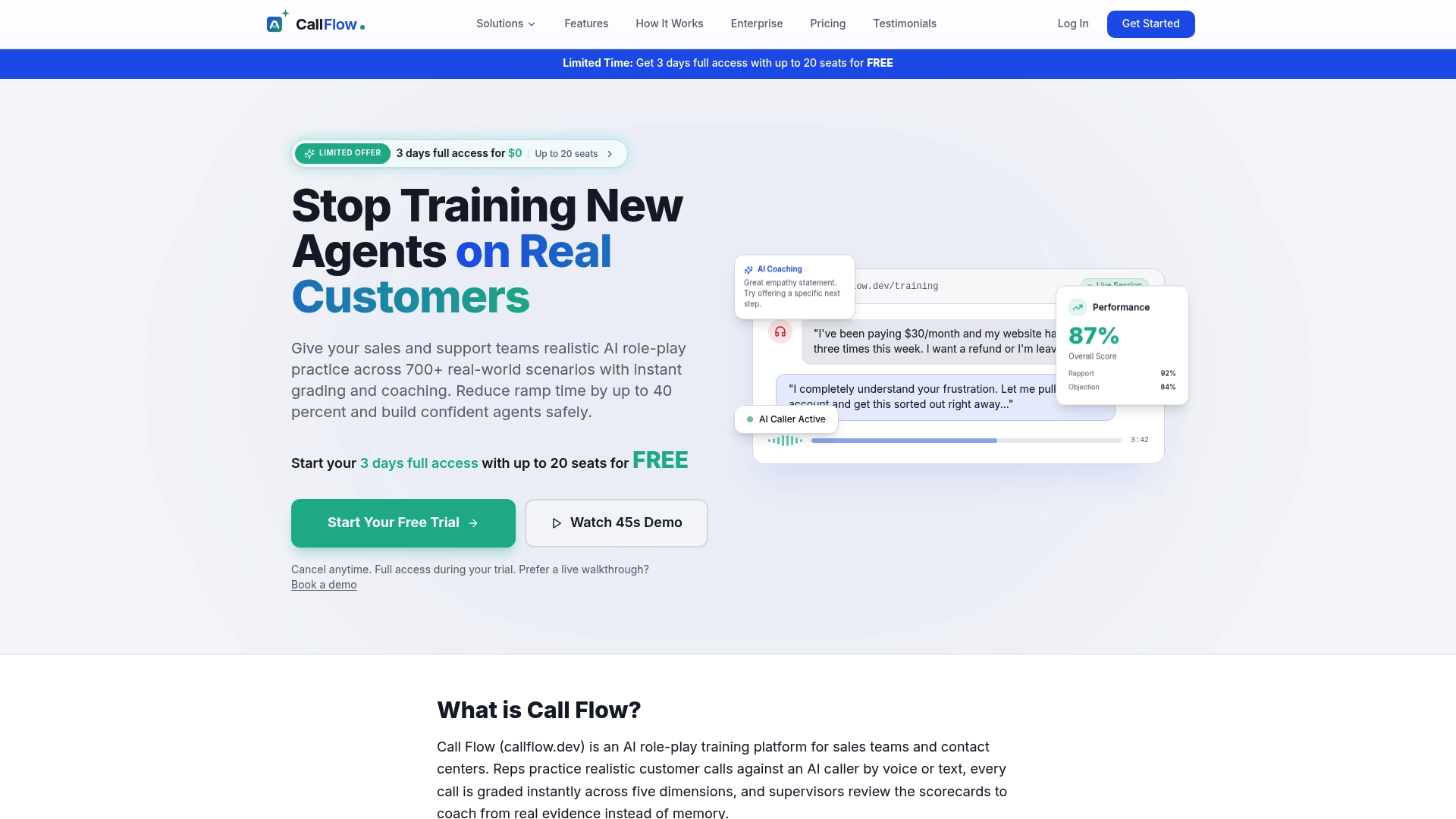
We built Call Flow for exactly this kind of recurring practice: realistic role-play scenarios with instant AI feedback across multiple performance dimensions, plus supervisor review so coaching stays connected to what agents actually practiced.
- Run an empathy pilot with regular micro-practice and a pre and post KPI check.
- Scale scenario-based practice across shifts or locations without adding a trainer for every session.
- Start on Starter (current prices are on our pricing page) or review options for larger teams on our enterprise page.
FAQ
What is empathy training for agents?
Empathy training for agents teaches customer service and sales reps to recognize a customer's emotional state and respond in a way that resolves the issue, not just acknowledges the feeling. The strongest programs combine active listening, role-play, and ongoing coaching rather than a single workshop.
How long does empathy training take to show results?
A randomized study found empathy scores rose at 7 days after a short intervention but faded back to baseline by 90 days without follow-up. Sustained results require ongoing weekly or monthly practice, not a one-time session.
Are role-play exercises more effective than scripted responses?
Yes. Research on call center interactions found that cognitive and attentive empathy, the kind built through role-play and diagnostic listening, tends to outperform scripted affective phrases like repeated apologies.
Can AI or VR role-play actually build real empathy skills?
Early evidence suggests yes, when the practice is repeated and includes role-switching. A VR system using LLM-driven avatars showed measurable gains in cognitive empathy across multi-session training in lab testing, with some transfer to everyday interactions.
What does Call Flow cost for a small team pilot?
Current prices for Call Flow's Starter plan are on our pricing page, making it possible to review costs for a small-team pilot before scaling to a larger plan.