

Active listening training teaches people to listen on purpose so they understand and respond accurately, not just wait for their turn to speak. Most programs cover three core elements: focus (blocking distractions and attending fully), reflect (paraphrasing and checking understanding), and respond (replying to what was actually said, not what you assumed). To start now, pick one conversation today and paraphrase the speaker's last point before you reply. Then schedule a 20-minute peer practice session this week using the exercises in this guide.
- Focus: direct full attention to the speaker, including body language and tone
- Reflect: paraphrase or summarize before responding
- Respond: answer what was said, not what you expected to hear
Pro Tip: Set a phone reminder before your next important call that says "listen first." That single cue shifts your default from reply-mode to receive-mode.
Table of Contents
- What does active listening training actually teach?
- Why organizations invest in active listening training
- Core active-listening techniques taught in training
- What delivery format fits your team's needs?
- Listening Lab exercises you can run right now
- How do you measure improvement after training?
- How to design a short active listening training program for teams
- How Callflow fits into an enterprise active listening training plan
- Sources
What does active listening training actually teach?
Active listening training is a structured practice program that builds the specific behaviors required to understand a speaker accurately, not just hear their words. It differs from general communication workshops, which typically cover presentation, writing, and interpersonal style. Listening training focuses narrowly on the receiver's side: how to attend, process, and respond in ways the speaker can verify as accurate.
Harvard Business Review describes professional listening as a multi-skill practice that requires managing attention, reading body language, tracking tone, and handling internal distractions simultaneously. That framing matters because it separates "hearing" (a passive sensory event) from active listening (a deliberate cognitive and behavioral practice that can be trained).
Most active listening training curricula include four components:
- Nonverbal cue recognition: reading posture, eye contact, facial expression, and vocal tone
- Paraphrasing and summarizing: restating content in your own words to confirm understanding
- Clarifying questions: open-ended prompts that invite the speaker to expand or correct
- Listening Labs: structured exercises where participants practice under observation and receive feedback
The 3 R's give learners a quick diagnostic they can apply in any conversation: Receive (attend without filtering), Reflect (process and paraphrase), Respond (reply to what was actually communicated). Training operationalizes each step with observable behaviors, which is what makes the skill measurable and coachable.
Why organizations invest in active listening training
The business case for listening training is direct. Conversations that break down at the listening stage produce repeated meetings, misread requirements, and eroded trust. Training addresses those failure points at the source.
Organizational benefits include:
- Fewer repeated conversations and clarification loops on projects
- Faster decision cycles because information is captured accurately the first time
- Better feedback acceptance, since people feel heard before they are evaluated
- Reduced conflict escalation in customer-facing and cross-functional teams
Individual benefits are equally concrete. Professionals who complete structured listening programs report stronger stakeholder relationships and fewer misunderstandings in high-stakes conversations. The Center for Creative Leadership frames active listening as a core coaching competency, noting that managers who listen attentively, reflect accurately, and respond to what was said create the conditions for others to think clearly and act on feedback.
Research published in peer-reviewed clinical literature supports that listening-focused interventions measurably change rapport and relational outcomes, providing a broader evidence base for why structured listening practice transfers beyond the training room.
For sales and customer service teams specifically, the payoff shows up in first-call resolution rates and customer satisfaction scores. When agents listen to understand rather than to script a reply, they resolve issues faster and reduce call-back volume.
The business case for listening skills is especially strong for managers and L&D leaders who need to show measurable ROI from soft-skills investment. Listening training produces observable, storable behaviors, which makes it one of the easier communication skills to assess and report on.
Core active-listening techniques taught in training
Most programs organize listening into five or six steps. The sequence below reflects the framework used across the majority of workplace training curricula.
The 5-step framework:
- Pay attention. Face the speaker, reduce environmental distractions, and commit full cognitive attention before the conversation starts.
- Show you are listening. Use brief verbal acknowledgments ("I see," "Go on") and open body language to signal engagement without interrupting.
- Clarify. Ask open-ended questions when meaning is unclear: "Can you say more about what you mean by that?"
- Reflect. Paraphrase the speaker's content and, when relevant, name the feeling underneath it: "It sounds like you're frustrated that the timeline shifted without notice."
- Summarize. At natural breaks, pull together the key points: "So the three main concerns are X, Y, and Z. Is that right?"
- Respond. Reply to what was actually said, not to your internal interpretation of it.
The 3 R's (Receive, Reflect, Respond) work as a quick in-conversation diagnostic. If you catch yourself skipping Reflect and jumping straight to Respond, you are likely reacting to your assumption rather than the speaker's actual message.
Example phrases that model the skill:
- Paraphrase: "What I'm hearing is that the deadline is the main pressure point, not the scope itself."
- Validate without fixing: "That sounds genuinely difficult. What would be most helpful right now?"
- Clarifying question: "When you say the process is broken, which step specifically causes the most friction?"
The S.A.I.D. framework from Duarte's Adaptive Listening® program adds a useful diagnostic layer: before you decide how to listen, identify the conversation's goal. Is the speaker seeking Support, trying to Advance a decision, wanting you to Immerse in detail, or asking you to Discern a complex situation? Each goal calls for a different listening posture. Generic "listen and nod" training misses this entirely, which is why many teams plateau after a basic workshop.
Pro Tip: Before your next one-on-one, ask yourself: "What does this person need from this conversation?" That single question shifts you from reactive to adaptive listening before the meeting starts.
What delivery format fits your team's needs?
Active listening training is available in several formats. The right choice depends on team size, budget, and how persistent you need the behavior change to be.
Common formats:
- Self-paced online courses. Coursera's Active Listening: Enhancing Communication Skills is a 5-hour, module-based course with videos, practical activities, and discussion prompts. Cost: typically $49–$79 per learner. Best for individuals who need a structured introduction on their own schedule.
- Live workshops and Listening Labs. Facilitated sessions of 2–4 hours where participants practice in pairs or triads with a trainer observing. Cost: varies widely by provider and group size. Best for teams that need shared vocabulary and immediate feedback.
- Peer practice sessions. Structured partner exercises run without a trainer, using a prompt sheet and a simple rubric. Cost: near zero. Best for reinforcing skills between formal sessions.
- AI role-play simulations. Platforms that generate realistic conversation scenarios, score responses across multiple dimensions, and deliver instant coaching. Best for distributed teams, high-volume practice, and measurable ramp-up.
How to choose:
- If you need one person to build a baseline quickly, start with a self-paced course.
- If you need a team to develop shared listening norms, run a live workshop first.
- If you need frequent, measurable repetitions at scale, add an AI simulation platform.
- If budget is the constraint, peer practice with a structured rubric costs nothing and still produces gains.
Typical duration ranges: a single introductory workshop runs 2–4 hours; a multi-session team program spans 3–5 sessions over 4–6 weeks; an enterprise platform subscription gives ongoing access with no fixed end date.
Listening Lab exercises you can run right now
These four exercises come from established facilitation practice. Each one targets a specific listening failure mode.
Exercise 1: The short-silence pause
Based on StoryCorps Listening Lab materials, this exercise exposes the "inner voice" habit of filling silence with your own thoughts.
- Pair participants. Speaker shares a 2-minute story about a recent work challenge.
- When the speaker finishes, the listener waits 6–8 seconds before responding.
- The listener then paraphrases what they heard before adding any comment.
- Debrief: ask the listener what they noticed during the silence. Ask the speaker whether the paraphrase was accurate.
The 6–8 second pause is a practical training tool. Trainers report it reduces premature interjection and often reveals unspoken context the speaker was about to add.
Exercise 2: The paraphrase circle
- Seat 4–6 participants in a circle.
- One person makes a statement about a real work topic (30–60 seconds).
- The next person must paraphrase the statement accurately before adding their own point.
- If the original speaker says the paraphrase was inaccurate, the listener tries again before the group moves on.
- Rotate until everyone has paraphrased at least twice.
Exercise 3: Listening triads
- Assign three roles: Speaker, Listener, Observer.
- Speaker discusses a real problem for 3 minutes. Listener practices the 5-step framework. Observer scores using the rubric below.
- Rotate roles so each person plays all three.
- Use the Constructive Dialogue activity guide for structured debrief prompts and timing.
Exercise 4: Loud Brain
Adapted from Trevor Muir's active listening activities, this exercise makes the inner voice visible.
- While a speaker talks, the listener narrates their own internal thoughts out loud in a whisper.
- A second observer notes when the listener's inner voice overrides attention to the speaker.
- Debrief: what triggered the inner voice? Was it a word, a topic, or a pause?
Observation rubric (1–4 scale):
| Behavior | 1 (Not observed) | 2 (Partial) | 3 (Consistent) | 4 (Exemplary) |
|---|---|---|---|---|
| Maintains eye contact | Avoids or minimal | Occasional | Steady | Natural, adaptive |
| Paraphrases accurately | Does not attempt | Misses key points | Captures main idea | Captures nuance |
| Asks clarifying questions | None | One generic question | Relevant follow-up | Probes and checks |
| Waits before responding | Interrupts | Minimal pause | 3–5 second pause | 6–8 second pause |

Pro Tip: Run the Loud Brain exercise before any other drill. It gives participants a concrete, visible experience of how often their attention leaves the speaker, which creates the motivation to practice the other techniques.
How do you measure improvement after training?
Assessment is where most listening programs fall short. Without measurement, behavior change is invisible and hard to justify to stakeholders.
Four practical assessment methods:
- Behavioral rubric observation. Use the 1–4 scale above during live practice. An observer scores each behavior in real time, then shares the scorecard in debrief.
- Simulated role-play scoring. AI platforms score responses across dimensions like paraphrase accuracy, question quality, and response timing. This produces a numeric baseline you can track over time.
- Self-assessment. After each practice session, participants rate their own performance on the same rubric. Comparing self-scores to observer scores reveals blind spots.
- Peer observation. Structured peer feedback using specific prompts ("What did the listener do when the speaker paused?") produces more useful data than general impressions.
Structured listening exercises have been shown in occupational health research to improve listener responsiveness, which supports using rubrics and repeated measurement to track gains over time.
Suggested measurement cadence:
| Window | What to measure | What to expect |
|---|---|---|
| Immediately after training | Rubric scores from in-session practice | Gains in paraphrase accuracy and pause length |
| 30 days post-training | Peer observation in real meetings | Partial transfer; some regression under pressure |
| 90 days post-training | Manager observation or simulation re-score | Stable behavior change if reinforced with practice |
At 30 days, some regression is normal. Participants who have done at least two peer practice sessions between the initial training and the 30-day check tend to hold their gains better than those who only attended the original workshop.
How to design a short active listening training program for teams
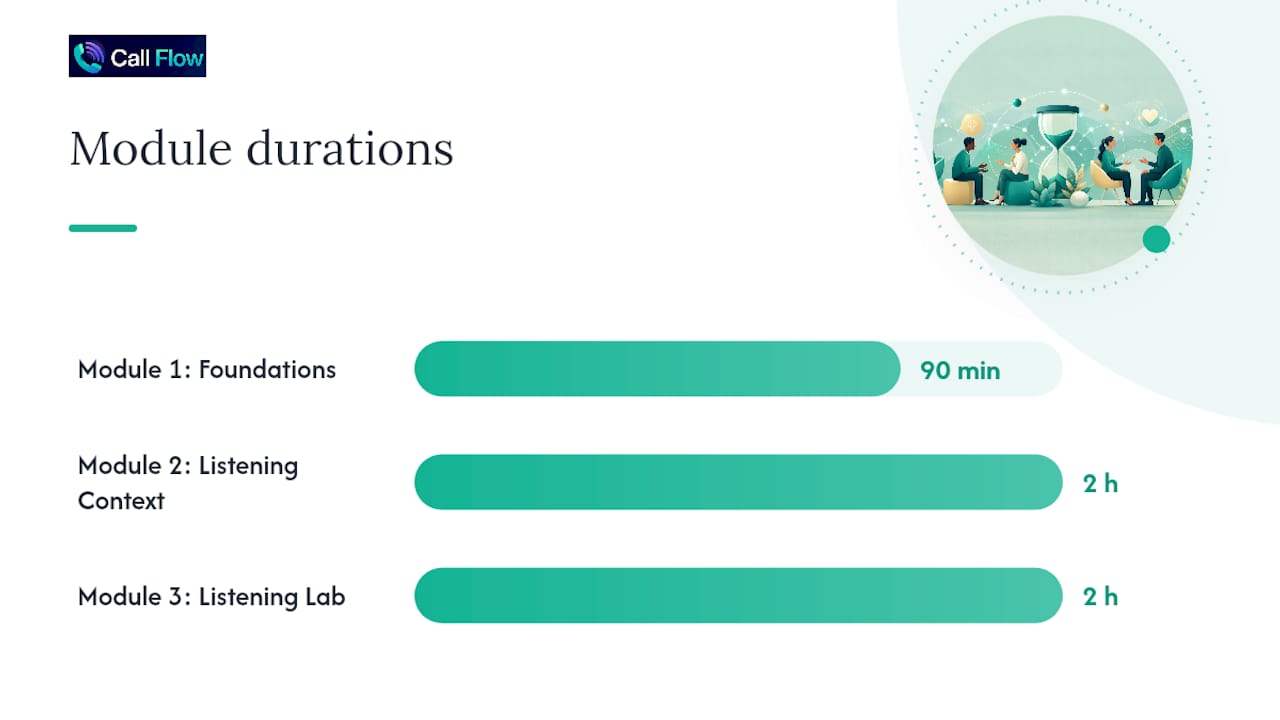
A 3-module program covers the core skills in roughly 6–8 hours of total contact time. Here is a ready-to-adopt blueprint.
Module 1: Foundations (90 minutes)
- Objective: distinguish hearing from active listening; introduce the 5-step framework and the 3 R's
- Activities: short-silence exercise, paired paraphrase drill
- Materials: rubric handout, prompt cards
Module 2: Listening in Context (2 hours)
- Objective: apply the S.A.I.D. framework to diagnose conversation goals; practice adaptive listening across two scenario types
- Activities: listening triads, role-play with observer scoring
- Materials: scenario cards, observer rubric
Module 3: Listening Lab and Measurement (2 hours)
- Objective: run a full Listening Lab, collect baseline rubric scores, and set individual practice goals
- Activities: paraphrase circle, Loud Brain, self-assessment debrief
- Materials: self-assessment form, 30-day practice plan template
For a single-session workshop (2–4 hours), compress Modules 1 and 2 and skip the full Listening Lab. For a multi-session program (4–6 weeks), add a 30-minute peer practice check-in between each module.
Trainer checklist:
- Prework: send participants a 10-minute pre-read on the 3 R's and ask them to note one recent conversation where they felt unheard
- Room setup: chairs in pairs or triads, no tables blocking body language
- Role-play setup: prepare 2–3 scenario cards relevant to the team's actual work (customer complaint, performance feedback, cross-team handoff)
- Follow-up: schedule a 30-day peer observation and share the rubric in advance
Cost shape options:
- DIY with free materials (StoryCorps lesson plan, Constructive Dialogue guide): near zero
- External facilitator for a half-day workshop: typically $1,500–$5,000 depending on group size and customization
- Enterprise platform subscription: ongoing access with measurable repetitions at scale
Pro Tip: Use the coaching-focused listening framework from Leaderly to align your module objectives with the coaching conversations managers already have. That connection makes the training feel immediately relevant rather than theoretical.
How Callflow fits into an enterprise active listening training plan
For sales teams and contact centers, Callflow is an AI role-play training platform built specifically for the volume and consistency demands that live workshops cannot match alone.
What Callflow provides:
- Configurable call scenarios that mirror real customer interactions, including objection handling, complaint resolution, and needs discovery
- Instant AI grading across five performance dimensions after every practice call
- Actionable coaching feedback delivered immediately, not days later
- Voice and text simulation modes for different training contexts
- Supervisor dashboards and skill analytics so managers can track team-level progress
- Gamification and custom scenario creation tools for ongoing engagement
Callflow reports significantly faster ramp time and notable improvement in resolution rates for teams using the platform, making it a measurable complement to classroom Listening Labs rather than a replacement for them.
When to use instructor-led Listening Labs vs. AI role-play simulation:
| Situation | Instructor-led Listening Lab | AI role-play (Callflow) |
|---|---|---|
| Building shared team vocabulary | Best fit | Secondary |
| High-volume repetition for new hires | Impractical at scale | Best fit |
| Practicing emotional and cultural nuance | Best fit | Supplementary |
| Distributed or remote teams | Logistically difficult | Best fit |
| Measurable scoring and progress tracking | Requires trained observer | Built-in |
| Immediate feedback after each attempt | Delayed (debrief-based) | Instant |
Teams that combine framework-based Listening Lab practice with measurable simulation feedback achieve faster, more persistent behavior change than lecture-only programs, according to Duarte's Adaptive Listening® research.
Pro Tip: Use Callflow for active listening practice in sales and customer service contexts. Run a live Listening Lab first to build the vocabulary, then move to AI simulations for volume and scoring. The two formats reinforce each other.
Key takeaways
Active listening training produces measurable behavior change when it combines a clear framework, structured practice exercises, and consistent assessment.
| Point | Details |
|---|---|
| Start with the 5-step framework | Pay attention, show listening, clarify, reflect, summarize, and respond to what was actually said. |
| Use Listening Labs for shared vocabulary | Short-silence, paraphrase circle, and listening triads build skills faster than lecture alone. |
| Measure with a 1–4 rubric | Score paraphrase accuracy, question quality, and pause length immediately after training and at 30 and 90 days. |
| Match format to need | Self-paced courses suit individuals; live workshops suit teams; AI simulations suit distributed or high-volume contexts. |
| Callflow scales practice | Callflow delivers instant AI grading across five dimensions, with faster ramp time reported for sales and contact center teams. |
What actually separates good listening training from wasted time
Most listening training fails not because the techniques are wrong but because the program stops at awareness. Participants learn the 5-step framework, nod in recognition, and then return to their desks and keep interrupting people.
The programs that produce lasting change share three features. First, they enforce silence during practice. The 6–8 second pause exercise is uncomfortable precisely because it exposes how rarely people actually wait. That discomfort is the learning. Second, they use observable scoring. When a peer or a platform tells you that your paraphrase missed the speaker's main point, you have a specific behavior to fix, not a vague instruction to "listen better." Third, they repeat. A single workshop builds awareness. Four to six weeks of structured peer practice builds a habit.
The S.A.I.D. framework from Duarte's Adaptive Listening® program is worth adding to any team program because it addresses the most common plateau: people who have learned to paraphrase but still listen the same way regardless of what the speaker actually needs. Diagnosing the conversation goal before you decide how to listen is a more sophisticated skill, and it is the one that separates competent listeners from genuinely useful ones.
For sales and customer service contexts, the active listening challenge for technical teams is worth reading. Technical professionals often resist listening training because they associate it with soft-skills theater. Framing it as a diagnostic skill, not an empathy exercise, changes the reception entirely.
Scale your team's listening practice with AI role-play
Teams that complete a Listening Lab workshop still face a volume problem: one session per quarter is not enough repetitions to change behavior under pressure. Callflow solves that by giving every agent or rep unlimited AI-driven practice calls, each scored instantly across five performance dimensions with specific coaching feedback.
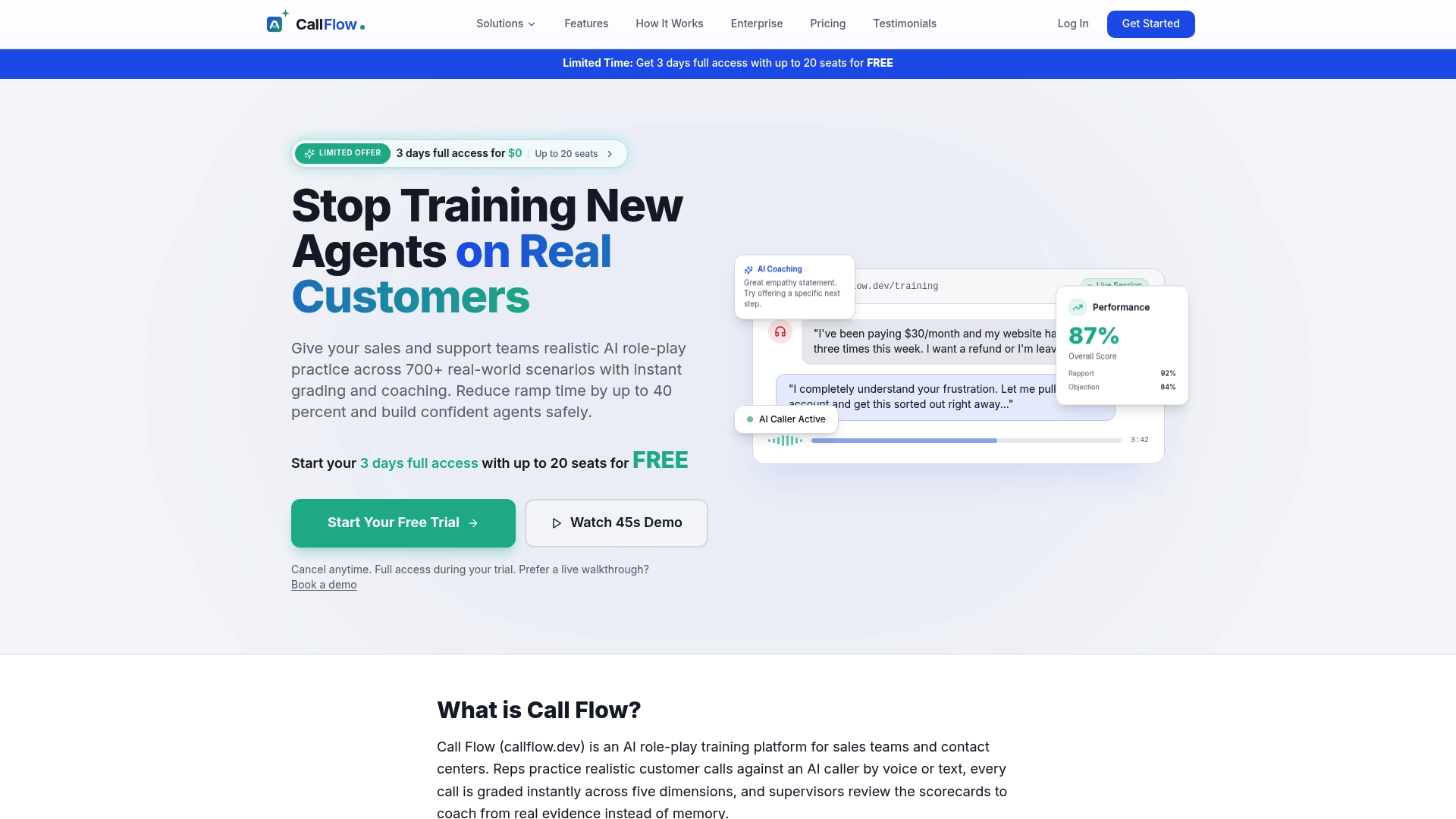
During a free trial, test the scenario creation tools with two or three call types your team handles daily. Check the supervisor dashboard to see how individual scores shift across attempts. Pair those simulation sessions with a live Listening Lab for the emotional and cultural nuance that AI practice supplements but does not fully replace. For sales teams, the sales coaching tools page shows how the platform fits into a full ramp program. Contact center teams can review the call center AI platform for agent-specific metrics and ramp-time benchmarks. Start your free mock call practice session to see the scoring and feedback format before committing to a subscription.
Sources
These resources are directly actionable for trainers and individual learners.
- Active Listening: Enhancing Communication Skills | Coursera
- Lesson: The Power of Active Listening - StoryCorps
- Active Listening: Using Listening Skills to Coach Others | CCL
- What is active listening? - Harvard Business Review