

Run a 60 to 90 minute workshop built around two or three delivery-focused exercises, back it with daily two-minute micro-practice, and follow up with AI role-play so the skill sticks after the room empties. That is the whole formula. Skip any one piece and the training fades within two weeks.
A first session needs:
- A single learning objective (example: "shift from flat statements to warm, controlled inflection on hold and apology lines")
- Two practice exercises, minimum, with a partner or small group
- One measurable signal to track before and after (a supervisor rating, a self-recorded clip, a customer-facing script read-aloud)
- A follow-up practice plan for the next two to four weeks
Open the session with proof it matters: cite a documented mechanism like breath control's effect on stress response. Mention any accreditation or CPD-eligible hours if your provider offers them, and state the time commitment up front so nobody feels ambushed by a surprise afternoon.
Key Takeaways
Tone-of-voice training works when a live workshop teaches the mechanics and repeated practice, ideally through AI role-play, turns that instruction into a lasting habit.
| Point | Details |
|---|---|
| Start with one objective | A 60 to 90 minute session should target a single measurable delivery shift, not five vague goals. |
| Train delivery, not just words | Pitch, pace, pause, and power drills change how a message lands more than script rewrites do. |
| Measure over 8 to 12 weeks | Track CSAT, resolution rate, and peer-observed skill ratings before declaring the training worked. |
| Customize by role | Healthcare, sales, collections, and support each need a different tone emphasis, not a generic script. |
| Reinforce with AI role-play | Call Flow's configurable scenarios and instant grading extend workshop gains into daily practice. |
Table of Contents
- What Is Tone-of-Voice Training and Why Does It Matter?
- Core Components Every Tone-Of-Voice Course Should Include
- How Do You Run a Practical Tone-Of-Voice Workshop?
- Voice Exercises and Role-Plays Worth Running
- Sample Agendas: 90-Minute Session vs. Half-Day Workshop
- Measuring Impact and Making It Stick
- How AI Role-Play Speeds Up Tone Skill-Building
- Customizing Training for Different Industries and Roles
- Bringing Tone Guidelines Into Email and Chat
- What Trainers See in the First Ten Minutes
- Turn Workshop Skills Into Daily Habit With Call Flow
- Frequently Asked Questions
- Sources
What Is Tone-of-Voice Training and Why Does It Matter?
Tone-of-voice training teaches people to control pitch, pace, pause, and emphasis so the way something is said matches, or improves on, what is actually meant. It sits next to communication skills training but focuses specifically on vocal delivery rather than word choice or structure.
The gap between wording and delivery is real and it is not subtle. Research from USC found that when spoken tone conflicts with the literal words, listeners trust the tone. A rep can say "I understand your frustration" in a voice that sounds bored, and the customer hears the boredom, not the empathy. That mismatch is what tone training exists to close.
What to measure once training starts:
- Customer satisfaction scores on calls and chats
- Ramp time for new hires reaching full proficiency
- First-call resolution rates
- Internal collaboration quality (fewer misread emails, fewer Slack blowups)
Breath control plays a bigger role here than most managers assume. Harvard Health's research on breath control shows that controlled breathing reduces the stress response that makes voices tighten and speed up under pressure. Teach people to slow their breath and their tone follows.
Core Components Every Tone-Of-Voice Course Should Include
A useful curriculum has to cover both what you say and how it lands. Voiceplace's framework for tone training separates voice (who you consistently are) from tone (how you flex for context), and a good course teaches both.
Look for these modules:
- Self-awareness and analysis — recorded self-review, usually the first eye-opener for most participants
- Diction and clarity — enunciation drills for words that get slurred under pace
- Pacing and rhythm — controlling speed so listeners can actually follow
- Emphasis and inflection — where stress falls in a sentence and why it changes meaning
- Nonverbal alignment — posture and facial expression, since they leak into voice even on audio-only calls
- Written-tone templates — email and chat phrasing standards, including active-versus-passive sentence construction
Micro-modules (15 to 20 minutes) work for diction and written templates. Inflection and role-play need live facilitation, ideally in a half-day block. If a course offers CPD-style credit hours, that is a reasonable signal of structured rigor, not just a nice badge.
How Do You Run a Practical Tone-Of-Voice Workshop?
Start with a single measurable outcome. A workshop succeeds when every attendee can demonstrate one specific shift, like turning a flat "no problem" into something that sounds like it means it.
Here is a workable 90-minute sequence:
- Opener (10 minutes) — play two recorded clips of the same script, one flat and one warm. Ask the room to identify the difference without seeing the words.
- Demonstration (15 minutes) — the facilitator models the pitch, pace, pause, power framework live, showing how each lever changes perceived tone.
- Paired practice (30 minutes) — partners take turns reading scripted lines, then improvising responses, while the observer scores delivery on a simple rubric.
- Group reflection (20 minutes) — pairs share one thing that worked and one thing that felt awkward. Awkward is expected and worth normalizing.
- Action plan (15 minutes) — each person picks one phrase or habit to practice daily for the next two weeks.
Facilitators should give observers a specific job: listen for pace and pitch, not content. That keeps feedback from turning into a grammar lecture. For remote sessions, record audio in breakout rooms so pairs can replay themselves, since self-review without a recording rarely sticks.
Voice Exercises and Role-Plays Worth Running
These are the drills that actually change how people sound, not just how they think they sound.
- Breath-control warmups — four counts in, hold for four, out for six, repeated three times before any speaking exercise
- Pitch glides — sliding the voice from low to high on a single vowel sound to loosen a locked register
- The stress-shift drill — say "I never said she stole my money" seven times, stressing a different word each time, to show how emphasis alone rewrites meaning
- Pace-and-pause mapping — read a script marking where pauses should land, then read it again without the markers
- Tone-matching role-plays — one partner sets an emotional tone (rushed, annoyed, confused) and the other has to match and de-escalate it
- Scripted-to-freeform transitions — start with a written script, then improvise the same scenario without notes
Rotate roles between observer, actor, and coach so everyone practices giving feedback, not just receiving it. Targeted inflection drills on pitch, pace, pause, and power produce observable delivery changes faster than open-ended "just talk more warmly" coaching.
Pro Tip: Have participants record one live customer call (with permission) within 48 hours of the workshop and score it against the same rubric used in the session. Practice that never touches a real call rarely transfers.
Sample Agendas: 90-Minute Session vs. Half-Day Workshop
Pick based on how much runway you have and whether this is a first exposure or reinforcement training.
| Element | 90-minute session | Half-day workshop |
|---|---|---|
| Group size | 6 people | 10 to 20 people |
| Practice cycles | 1 paired round | 3 to 4 rounds with rotation |
| Materials needed | Recording device, script bank, scoring sheet | Recording devices, script bank, scoring sheets, breakout rooms |
| Follow-up assignment | One daily two-minute drill for two weeks | Weekly peer feedback pairing for one month |
| Measurement plan | Self-recorded call comparison | Supervisor-observed calls plus CSAT tracking |
Both formats need a script bank covering your three or four most common customer scenarios and a scoring sheet simple enough to fill out in under a minute per rep.
Measuring Impact and Making It Stick
Track a small set of signals rather than everything at once: CSAT or NPS shifts, first-call resolution rate, average handle time, peer-observed skill ratings, and the ratio of active to passive phrasing in written templates.
Give it 8 to 12 weeks before drawing conclusions. Behavior change in voice work is slower than in scripted-process training because it requires new muscle memory, not just new knowledge.
- Compare a trained cohort against an untrained one over the same period for a rough A/B read
- Run brief weekly check-ins (five minutes, one clip each) rather than one big quarterly review
- Use a voice or tone auditor to flag drift in written communication before it reaches customers
- Escalate to one-on-one coaching if a rep shows no measurable shift after two reinforcement cycles
Weekly micro-sessions beat monthly deep-dives for retention, mostly because voice habits decay fast without repetition.
How AI Role-Play Speeds Up Tone Skill-Building
Live workshops teach the mechanics. AI role-play is what makes the mechanics stick, because it gives reps unlimited safe repetitions instead of the two or three tries a workshop allows.
Call Flow builds its practice sessions around this gap: configurable scenarios that mirror real customer calls, instant grading across five performance dimensions, and coaching feedback delivered immediately instead of days later in a review meeting. Teams using structured AI role-play as reinforcement have reported significant improvements in ramp times and resolution rates compared to workshop-only training, according to Call Flow's own platform data.
What matters for tone practice specifically:
- Voice simulation mode, so reps hear their own pitch and pace, not just read a transcript
- Scenario variability, preventing reps from memorizing one script instead of internalizing a skill
- Instant multidimensional coaching, catching tone slips the moment they happen
- Supervisor dashboards, showing which reps need a second workshop and which are ready for harder scenarios
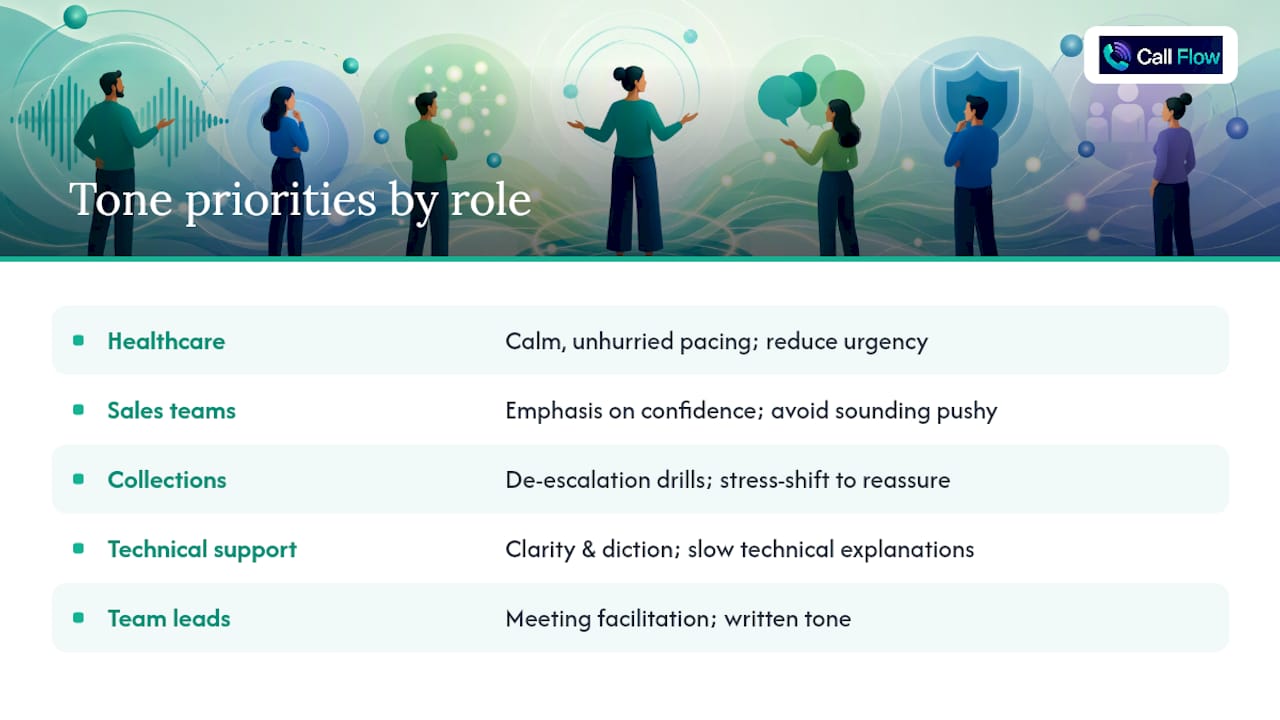
Customizing Training for Different Industries and Roles
A hospital scheduling line needs a different tone baseline than a debt collection call center, and a SaaS sales team needs something different from both. Generic tone training tends to underperform because "sound warmer" means something different in each context.
For healthcare and patient-facing roles, the priority is calm, unhurried pacing that reduces perceived urgency even when the topic is serious. Rushing a patient through instructions, even accurately, reads as dismissive.
For sales teams, emphasis and confidence markers matter more. Reps need to sound sure of the product without sounding pushy, which is a pace-and-pitch balance more than a script issue.
For collections and high-friction support, de-escalation drills dominate. The stress-shift exercise becomes essential here, since the same sentence can sound like a threat or a reassurance depending on which word carries the weight.
For technical support, clarity and diction outrank warmth. Callers frustrated by a broken product care more about understanding the fix than feeling emotionally soothed, so slow the pace of technical explanations rather than the pace of the whole call.
For team leads and internal-facing roles, the training shifts toward meeting facilitation and written tone, since most of their daily communication is Slack messages and one-on-ones rather than live customer calls.
Build one shared foundation curriculum, then swap the role-play scenarios and scoring emphasis by department. The pitch, pace, pause, power framework stays constant. What changes is which lever gets the most coaching attention.
Bringing Tone Guidelines Into Email and Chat
Voice training tends to stop at the phone, but most workplace communication is written, and written tone drifts just as easily as spoken tone.
Build a short reference document, not a style manual nobody reads: three to five example phrases per common scenario (apology, delay notice, upsell, escalation) showing the tone you want versus a flat or overly formal alternative. Keep it to one page.
Watch sentence construction specifically. Passive phrasing ("your request has been received") reads colder and less accountable than active phrasing ("we've got your request"), and that shift alone changes how professional communication lands, per Cambridge's grammar reference on passive voice.
A few integration habits that hold up over time:
- Add a one-line tone check to your existing QA process for chat and email, not a separate review step nobody has time for
- Run new templates through a brand voice analyzer before rolling them out company-wide, so drift gets caught before it reaches customers
- Give managers a short list of banned openers (the ones that sound automated) rather than a long rulebook
- Revisit the reference sheet quarterly, since tone standards that felt right a year ago often sound stiff or dated now
Written tone training pays off fastest in support and sales teams that spend more time typing than talking.
What Trainers See in the First Ten Minutes
Most groups fixate on word choice, not delivery, until someone plays back a recording. Monotone and rushed pacing are the two habits I see most, and both fix fast once someone actually hears themselves.
The quickest correction: slow the breath before the words. Handle resistance by normalizing the awkwardness early. Nobody likes hearing their own voice, and saying so out loud defuses most pushback in the room.
Turn Workshop Skills Into Daily Habit With Call Flow
A workshop starts the shift. Daily repetition is what makes it permanent, and that is where most training budgets quietly fail, since nobody has time to schedule another live session every week.
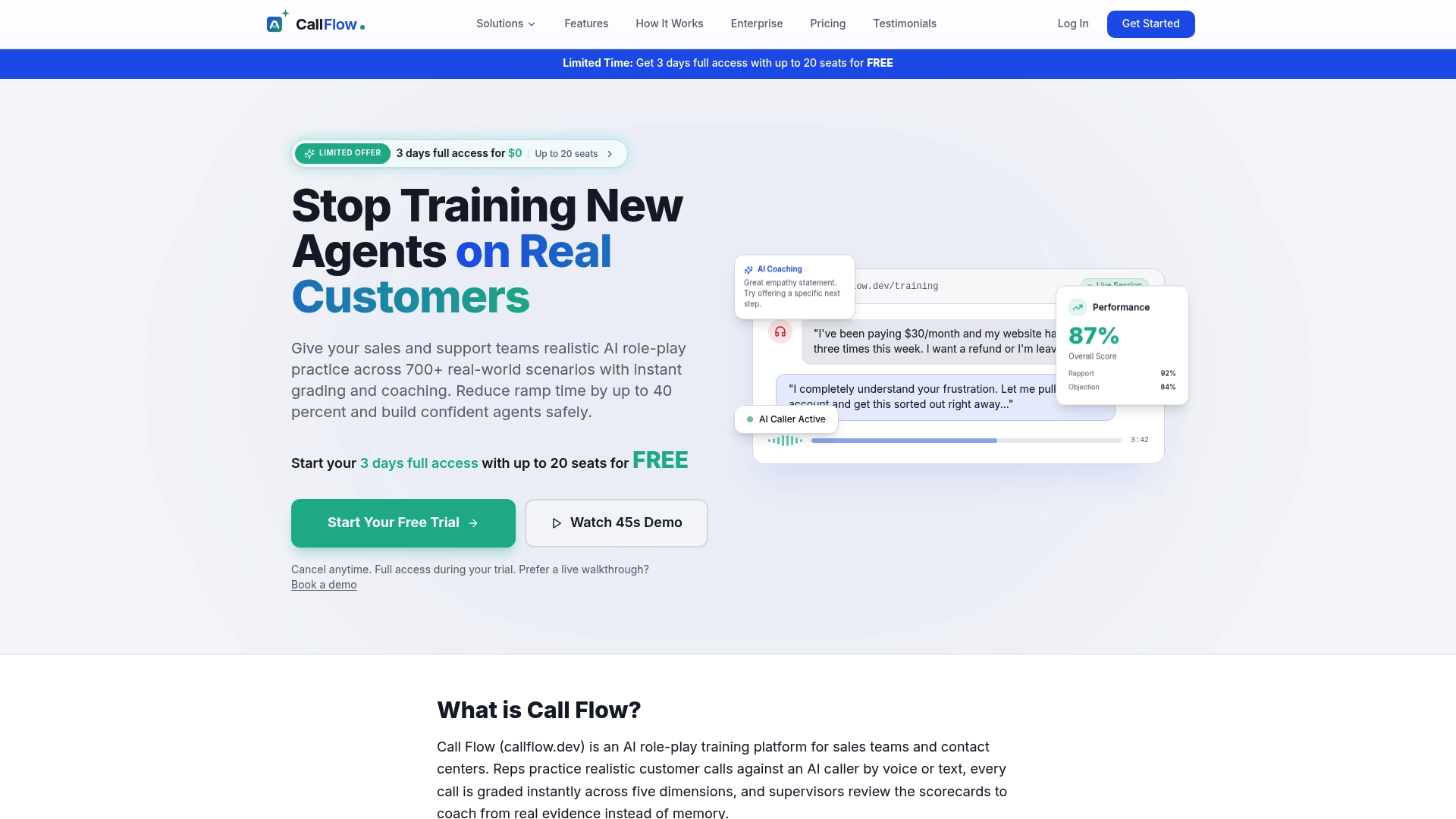
Call Flow gives your team a structured place to keep practicing after the room clears: configurable scenarios built around your actual customer types, instant grading across five performance dimensions, and both voice and text simulation modes so reps can rehearse tone, not just content. Supervisor dashboards show exactly who needs another round and who is ready for a harder scenario, and full access is available during a risk-free trial period, so there's no long commitment before you know it fits. If your last workshop produced a burst of energy that faded in two weeks, start a free mock-call practice session and give that energy somewhere to go.
Frequently Asked Questions
How long should tone-of-voice training take? A single workshop runs 60 to 90 minutes for a focused skill or a half-day for broader coverage. Lasting change needs daily two-minute practice for at least two to four weeks after.
Can tone-of-voice training work for remote teams? Yes. Record breakout-room audio so pairs can replay their own delivery, and use AI role-play tools for asynchronous practice between live sessions.
What's the difference between tone-of-voice training and general communication skills training? Communication skills training covers structure, clarity, and message content. Tone-of-voice training focuses specifically on vocal delivery, pitch, pace, and emphasis, alongside written-tone consistency in emails and chat.
How do you measure whether tone training actually worked? Track first-call resolution, CSAT or NPS shifts, and peer-observed skill ratings over 8 to 12 weeks, comparing a trained cohort against an untrained one where possible.
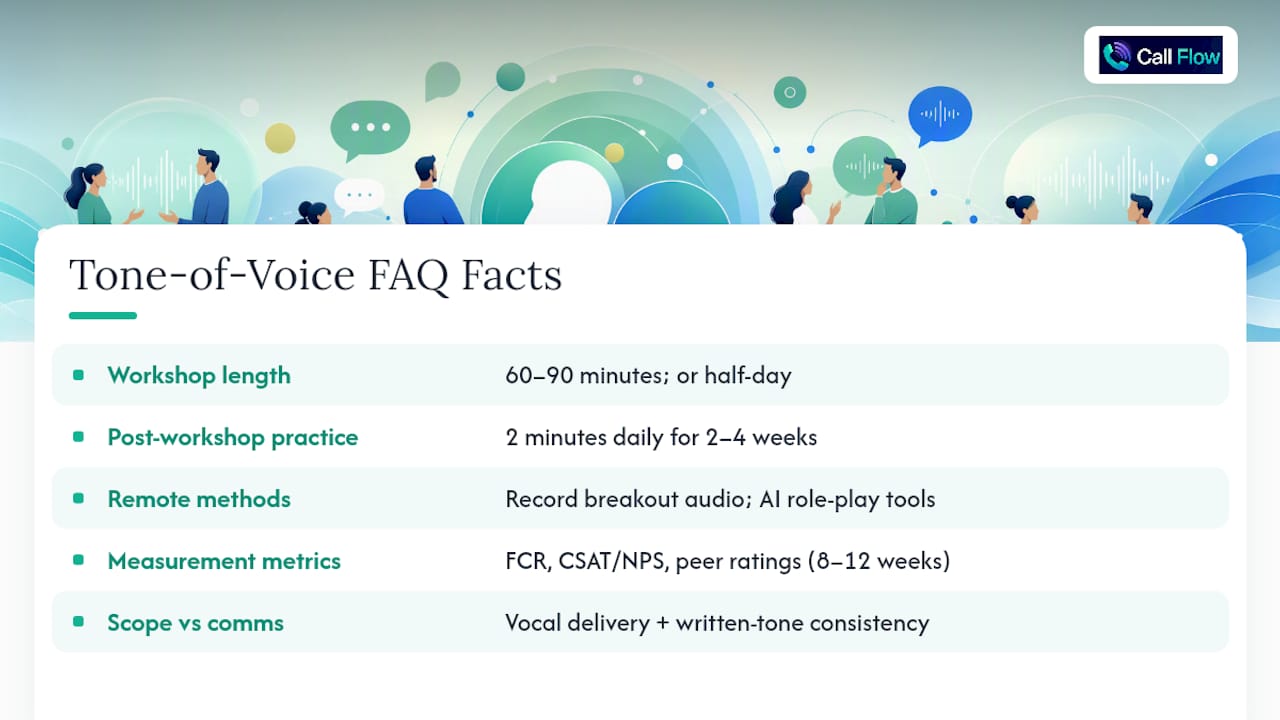
Does tone-of-voice training help with written communication too? Yes. Sentence construction, including active-versus-passive phrasing, affects how professional and warm written messages read, so a full program covers email and chat templates alongside spoken drills.