

Run role-play sessions in small groups of 4 to 8, give every actor exactly one learning objective, timebox the practice to 5 to 10 minutes, and close with a 3-step debrief. Add AI-driven repetition between live sessions so learners get instant feedback without waiting for the next workshop. Done right, this combination shortens ramp time and sharpens listening skills and empathy on real calls.
TL;DR:
- Small group sizes of 4 to 8 participants optimize observation quality and allow each learner to practice, observe, and receive targeted feedback.
- Repeating scenarios multiple times, rather than once, significantly enhances communication skills and self-efficacy through deliberate practice.
- Clear role definitions and specific behaviors for observers help reduce anxiety and generate concrete, actionable feedback during sessions.
- AI-driven role-play tools enable daily repetitions with instant scoring across multiple skill dimensions, scaling practice for large teams.
- Effective scaling relies on pilot programs, manager involvement, and combining AI feedback with human coaching to reinforce learning between live workshops.
Table of Contents
- What Makes Soft Skills Role Play Actually Work?
- How Do You Structure a Role Play Session Step by Step?
- Ready-to-Run Soft Skills Role Play Scenarios
- How Do You Stop Role Play From Becoming Scripted Autopilot?
- Can AI Actually Scale Soft Skills Role Play Training?
- What Actually Matters When You Scale This Across a Team
- Give Your Team Practice That Actually Sticks Between Sessions
- Sources
- FAQ
What Makes Soft Skills Role Play Actually Work?
Reading about active listening doesn't make anyone a better listener. Rehearsing it does. Learning-by-doing converts abstract knowledge into behavior you can observe and correct, which is why role-play consistently outperforms lecture-based soft skills training.
The group size matters more than most trainers assume. Research on teaching communication skills through role-play recommends groups of 4 to 8 learners, a range small enough for every person to act, observe, and get direct feedback, but large enough to generate varied reactions and perspectives. Push past eight and observation quality drops fast. Educational research on scenario-based role-play found measurable gains in communication skills and self-efficacy when learners repeated scenarios rather than running them once and moving on.
None of that works if people feel judged. Framing each round as low-consequence practice, not a test, is what lets people take risks with tone and phrasing they'd never try on a live customer call.
- Small groups (4 to 8) protect both engagement and psychological safety.
- Repetition, not a single pass, drives measurable skill gains.
- Practice framing (not evaluation framing) is what makes people willing to try something new.
How Do You Structure a Role Play Session Step by Step?
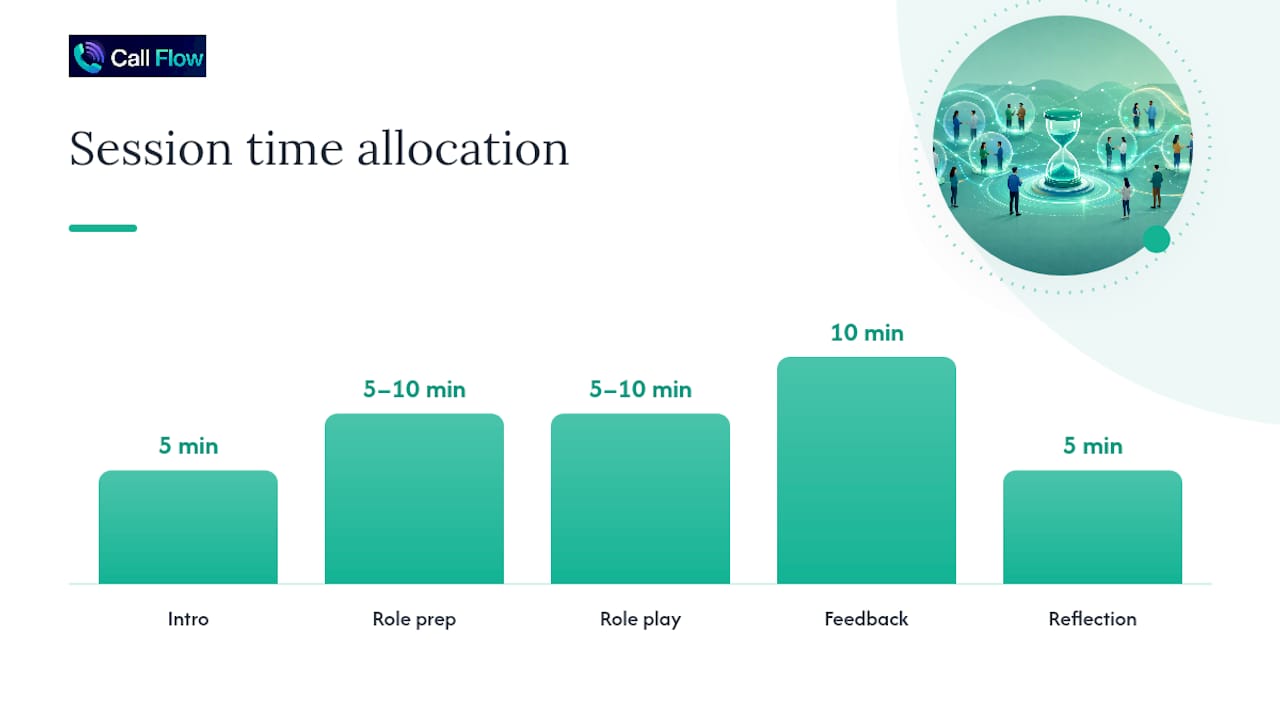
A session that runs long or skips the debrief wastes the group's time. Use this template and adjust the middle blocks to fit your room:
- Intro (5 minutes). State the single skill being practiced and why it matters for the team's actual work.
- Role prep (5 to 10 minutes). Hand out role cards, assign actor and observer roles, and give observers a specific behavior checklist.
- Role play (5 to 10 minutes). Run the scenario. Allow a facilitator time-out or "rewind" if an actor freezes or the scene goes off-track.
- Feedback (10 minutes). Observer reports first, then the actor self-assesses, then the facilitator adds one or two concrete notes.
- Reflection (5 minutes). Ask what the actor will do differently next time, in one sentence.
Facilitators, actors, and observers each need clear jobs. The facilitator manages time and calls time-outs. The actor commits fully to the role instead of hedging. The observer tracks one behavior only, like whether the actor paraphrased before responding, and says nothing until the debrief starts.
Pro Tip: Give the observer a single behavior to watch, not a general "how did it go" impression. Vague observation produces vague feedback, and vague feedback doesn't change anything.
Ready-to-Run Soft Skills Role Play Scenarios
Each scenario below includes context, one objective, two role prompts, and a debrief question. Adapt the names and details to your industry.
- Active listening check-in. A colleague vents about a missed deadline. Objective: paraphrase before responding. Roles: "frustrated colleague" and "listener who may not interrupt for 60 seconds." Debrief: "What did you notice yourself wanting to say instead of listening?"
- Constructive feedback delivery. A manager needs to address a report's missed detail without demoralizing them. Objective: lead with the behavior, not the person. Roles: "manager" and "defensive employee." Debrief: "Which phrase landed as criticism versus coaching?"
- De-escalating an upset customer. A customer is angry about a billing error. Objective: acknowledge emotion before offering a fix. Roles: "escalated customer" and "support rep." Debrief: "At what point did the tone shift?"
- Negotiating a tight deadline. A project owner asks for an unrealistic turnaround. Objective: counter-offer without sounding uncooperative. Roles: "requester" and "team lead." Debrief: "Did the counter-offer sound like a no or an alternative?"
- Coaching a plateaued performer. A tenured employee has stopped improving. Objective: ask more than tell. Roles: "manager" and "stagnant performer." Debrief: "How many questions versus statements did the manager use?"
- Setting a boundary at work. A peer keeps assigning you their overflow tasks. Objective: decline clearly without over-explaining. Roles: "over-asker" and "boundary-setter." Debrief: "Where did the boundary get fuzzy?"
- Handling a sales objection. A prospect says the price is too high. Objective: probe the real concern before defending price. Roles: "hesitant buyer" and "sales rep." Debrief: "Did the rep address the stated objection or the real one?"
- Cross-team conflict. Two departments blame each other for a missed handoff. Objective: find one shared fact before assigning blame. Roles: "team A lead" and "team B lead." Debrief: "What fact did both sides agree on?"
The negotiation and objection-handling scenarios translate directly into contact center and sales training, where the same rep faces dozens of live variations of that exact conversation every week.
How Do You Stop Role Play From Becoming Scripted Autopilot?
The fastest way to kill a role-play session is letting actors recite a memorized response instead of reacting. Demonstration role-plays fix this early: have the facilitator or a confident volunteer run the scene first, so newer learners see what "good" looks like before they're asked to perform it themselves. Pairing that with clear observer assignments reduces the anxiety that pushes people into rehearsed, safe answers.
Assign one micro-behavior per round, not five. Someone working on tone doesn't need to also worry about closing technique that same round.
- "I noticed you paraphrased twice, that's the behavior we wanted."
- "Your tone softened right when the customer raised their voice, what triggered that shift?"
- "You jumped to a solution before naming the emotion, try that again."
Pro Tip: Ban the phrase "good job" from debriefs. It feels supportive but teaches nothing. Name the specific behavior instead.
Can AI Actually Scale Soft Skills Role Play Training?
AI Chat Bots solve the volume problem live facilitation can't. A trainer can run maybe six live sessions a week per cohort. An AI platform lets every rep on a 40-person team run that same scenario daily, with instant scoring instead of a two-day wait for manager feedback.
The realistic pattern looks like this: pilot the AI tool with one team on one scenario, then layer it into a blended cadence (live sessions biweekly, AI drills between them), then hand managers the analytics dashboard to guide 1:1 coaching. Callflow's approach to AI role-play training follows exactly that pattern for sales and contact center teams, using instant grading across five performance dimensions instead of a single pass/fail score.
- Instant scoring on tone, clarity, and objection handling instead of a delayed manager review.
- Voice and text simulation modes for reps who train differently.
- Supervisor dashboards that show skill gaps across a whole team, not just one rep.
Don't let the AI score replace the facilitator's judgment. A dashboard shows what happened, not why. Combine the platform's data with your own debrief notes before making coaching decisions, and treat the AI drills as structured objection-handling practice between the sessions where a human is actually watching. AI platforms are strongest for closing the gap between knowing a skill and actually doing it under pressure, an area where repeated, instant feedback beats an occasional workshop.
What Actually Matters When You Scale This Across a Team
Pick one behavior to measure, not five. Run a two-week pilot before rolling out to the whole team, and get manager buy-in early, because coaching after the practice is what makes it stick, not the practice itself. Between live sessions, short AI drills keep the skill warm. None of it works without facilitators who know how to call a time-out and deliver feedback that doesn't sting.
— Costa
Give Your Team Practice That Actually Sticks Between Sessions
Live workshops build the skill. The gap is what happens between them, when reps go weeks without structured practice and slide back into old habits. This gap can be addressed with configurable role-play scenarios, AI grading across multiple performance dimensions, and voice or text simulation modes that teams can run frequently.
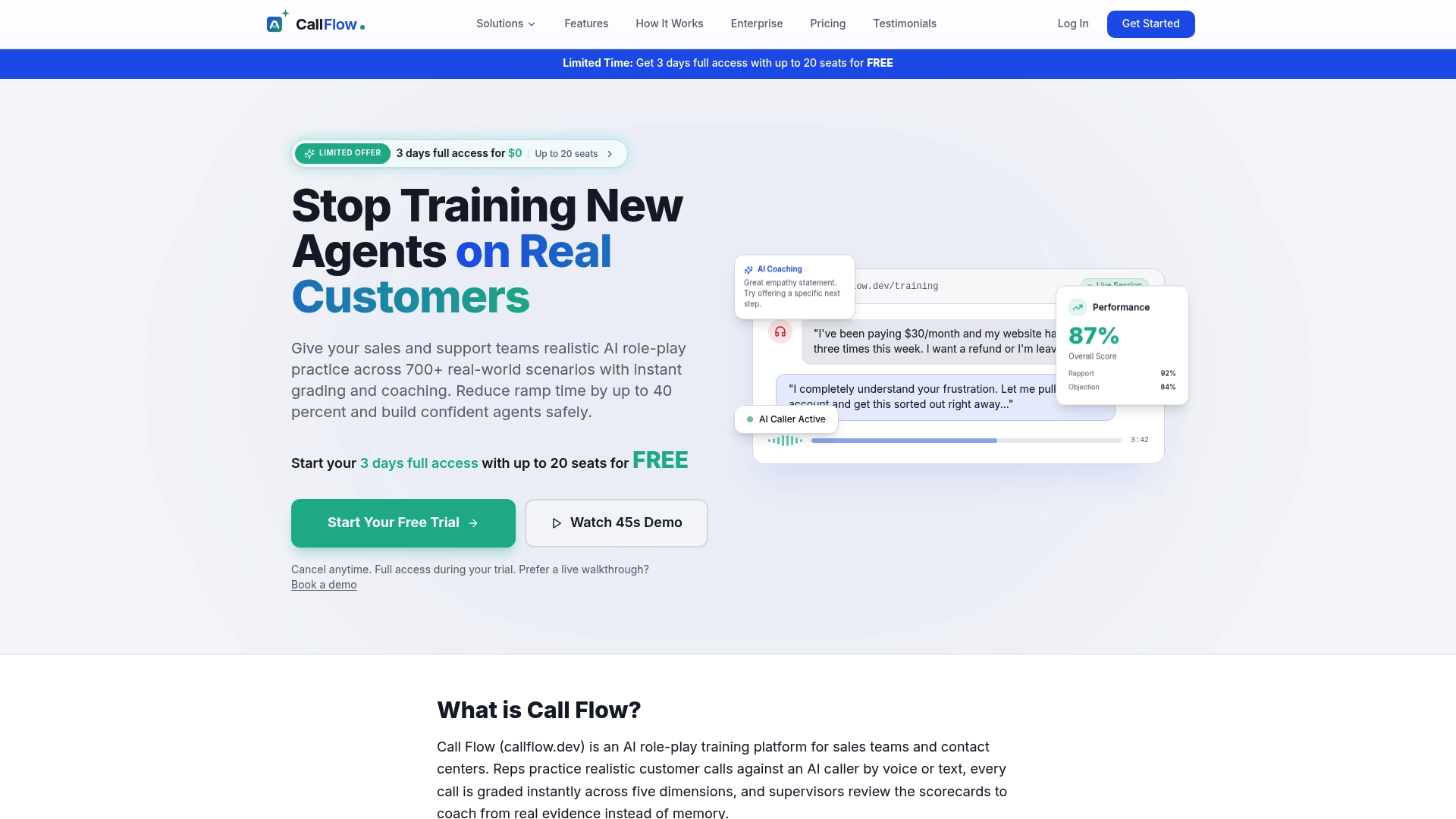
Supervisor dashboards show exactly where a rep's tone slips or where objection handling breaks down, so managers walk into coaching conversations with data instead of a vague impression. This approach aims to help teams improve ramp time and resolution rates. If your current training relies entirely on scheduled live sessions, start a risk-free trial and see how AI-driven repetition fits between them.
FAQ
What Are the 7 Major Soft Skills?
Most frameworks group them as communication, active listening, empathy, teamwork, adaptability, conflict resolution, and time management, all of which respond well to structured role-play practice.
What Skills Can Be Learned Through Role Play?
Role play builds active listening, feedback delivery, de-escalation, negotiation, boundary-setting, and objection handling by letting learners rehearse the exact language and tone a real conversation demands.
What Are 10 Examples of Soft Skills?
Communication, active listening, empathy, adaptability, teamwork, conflict resolution, time management, negotiation, feedback-giving, and emotional regulation all count as soft skills trainers commonly target with role play.
What Are Good Role-Playing Scenarios for the Workplace?
Strong scenarios include de-escalating an upset customer, delivering constructive feedback, negotiating a deadline, handling a sales objection, and resolving cross-team conflict, each with one clear objective per round.
How Does AI Fit Into Soft Skills Role Play Training?
AI platforms like Callflow let learners repeat high-stakes scenarios daily with instant feedback on tone and clarity, complementing rather than replacing facilitator-led debriefs.