

The fastest way to prepare for a mock call is a short, two-sided script practiced in timed rounds and graded against a 5-area rubric. Read it aloud with a partner, score it live, fix one thing, run it again.
- Three ready-to-use script types below: sales cold call, billing inquiry, technical support (plus irate customer and retention scenarios)
- An editable rubric covering greeting, verification, listening, tone, and close
- A repeatable session structure you can run solo or with a team, starting today
Key Takeaways
Consistent improvement in call handling comes from pairing short, two-sided scripts with a weighted rubric and a regular, scored practice cadence.
| Point | Details |
|---|---|
| Use two-sided scripts | Practice with a partner playing the customer, including one hidden objection, not a solo read-through. |
| Score every round | Grade greeting, verification, listening, tone, and close immediately after each call, while it's fresh. |
| Weight listening heaviest | Give listening the largest share of the rubric, since it predicts resolution more than any other area. |
| Practice daily, review weekly | Run 10-minute solo drills daily and one 30-minute scored session with 4 to 6 rounds weekly. |
| Scale with Call Flow | Call Flow's AI grading applies the same five-area rubric instantly, supporting faster ramp time and better resolution rates. |
Table of Contents
- What Are Mock Call Scripts And Why Do They Work?
- How Do You Set Up A Realistic Mock Call Session?
- Which Mock Call Scripts Should You Practice First?
- How Do You Score A Mock Call Fairly?
- How Often Should You Practice Mock Calls?
- How Does Call Flow Scale Scripted Practice?
- What Do Trainers Actually Learn From Running Mock Calls?
- Try Call Flow For Unlimited Scored Practice
- Frequently Asked Questions
- Sources
What Are Mock Call Scripts And Why Do They Work?
A mock call script is a two-sided dialogue, one side for the caller (agent or rep) and one for the counterpart (prospect or customer), built to rehearse a specific scenario before it happens for real. It's not a monologue you memorize. It's a rehearsal tool, closer to a mock interview than a speech, and it works because it forces both the words and the reactions to those words into the open before a live customer ever hears them.
Call centers and sales teams use these scripts for two different but related goals: training call handling skills for new hires, and sharpening objection handling for reps who already know the basics but need to stay smooth under pressure. Ready-to-use templates for both purposes already exist. Zendesk's collection of call center scripts covers dozens of common service situations, and Prospeo's mock call templates pair scripts with a weighted scoring rubric, which is the piece most teams skip and then wonder why practice doesn't translate to better calls.
The scripts only do half the job. The other half is structure: who plays what role, how long each round runs, and what gets scored. Skip that structure and you get two people reading lines at each other, which teaches almost nothing.
How Do You Set Up A Realistic Mock Call Session?

Three roles make a mock call session work: the caller, the prospect (or customer), and an observer who scores the round instead of participating in it. Assign a 3-line persona sheet to whoever plays the prospect: name, situation, and one hidden objection they raise only if the caller asks the right question. Without that hidden layer, the "customer" just says yes to everything, and the practice becomes worthless.
Timing separates a useful drill from a rambling conversation. Follow this sequence for each round:
- Brief the room (1 minute). Tell the observer what to watch for, tone, listening, or close, so feedback stays specific instead of generic.
- Run the call. Cold sales calls should run 2 to 5 minutes; service and support calls run longer, 5 to 10 minutes, since diagnosis and resolution take more back and forth.
- Score immediately. The observer fills out the rubric while the call is fresh, not after three more rounds have blurred together.
- Debrief for 5 minutes. Cover what worked, one specific fix, and let the caller run it again if time allows.
Environment matters more than most trainers assume. Play real dialer or hold-queue sounds in the background if you can, and simulate a mute/unmute moment so the caller practices the transition into and out of a hold. Recording every run, even on a phone, matters because reviewing a call cold beats trying to remember it, and a recorded library becomes training material for the next new hire.
Pro Tip: Rotate who plays the difficult customer every session. The rep who's hardest to please usually has the sharpest read on what a real objection sounds like.
Which Mock Call Scripts Should You Practice First?
Start with the scenario your team fails most often in live calls, then expand. Below are five two-sided templates that cover the situations most call centers and sales teams rehearse first, each with a coaching note attached.
Sales cold call. Open with a permission-based line, move into one sharp discovery question, and close for a meeting instead of a sale.
Caller: "Hi, this is [name] with [company]. I know I'm calling out of the blue, do you have 30 seconds?" Prospect: "Sure, but I'm pretty busy." Caller: "Fair enough. Quick question, how are you currently handling [pain point]?" Coaching note: The permission opener buys goodwill; the discovery question earns the rest of the call. Tendril's cold-call framework recommends researching the prospect before the call so this question lands as specific, not generic.
Billing inquiry. Verify identity first, isolate the exact charge in question, then resolve or explain before closing.
Caller: "Can I get your account number or the phone number on file to pull up your account?" Customer: "It's [number]. I was charged $45 more than usual." Caller: "I see that. Let me walk you through what changed on this bill." Coaching note: Verification isn't a formality, skipping it is the single most common rubric deduction in billing calls.
Technical support. Diagnose before explaining, and translate every technical term into plain language.
Caller: "When does the error happen, right when you open the app, or after a few minutes?" Customer: "Right when I open it." Caller: "Got it, that points to a login token issue. Let's try clearing it." Coaching note: Agents who skip diagnosis and jump straight to a fix guess wrong more often, and it shows in first-call resolution numbers.
Irate customer. De-escalate before you problem-solve. Empathy comes first, solutions come second.
Customer: "This is the third time I've called about this!" Caller: "I hear you, and I'm sorry you've had to call three times. Let's make sure this is the last one." Coaching note: Naming the frustration out loud, rather than rushing past it, is what actually lowers the temperature.
Retention or cancellation. Acknowledge the request, offer one realistic alternative, and respect a firm no.
Customer: "I want to cancel." Caller: "I can help with that. Before I do, can I ask what's driving the decision?" Coaching note: A save script only works when the alternative offered is genuinely relevant to the stated reason, not a generic discount.
| Moment | Plug-and-Play Phrase |
|---|---|
| Opening | "Do you have 30 seconds for me?" |
| Empathy line | "I understand why that's frustrating." |
| Hold request | "Can I place you on a brief hold while I check that?" |
| Transfer | "I'm going to connect you with someone who can resolve this faster." |
| Closer | "Is there anything else I can help you with today?" |
Modular phrases like these matter because they let a trainee sound natural while still following a flow, which is the whole point of rehearsing a script instead of reading one on the call.
How Do You Score A Mock Call Fairly?
Five competency areas cover almost every skill a mock call is meant to test: greeting, verification, listening, tone, and close. Weight them by what actually predicts a good live call, not by what's easiest to observe. Listening should carry the heaviest weight, since it's the skill most correlated with resolution and satisfaction, followed by close, then tone, verification, and greeting.
Set a pass threshold, 85 or above often signals a rep ready for live calls, while scores in the 60s point to a specific gap worth another round rather than a pass/fail label. Pair every numeric score with one written coaching note. The number tells you where someone stands; the note tells them what to fix next.
- Copy the table above into a spreadsheet and adjust weights to match your team's priorities.
- Score live during the call, not from memory afterward.
- Attach one qualitative note per rubric area, not just a total score.
How Often Should You Practice Mock Calls?
Daily 10-minute solo drills build more real skill than one long session a week, because short, frequent reps build muscle memory faster than infrequent ones. Add a weekly 30-minute scored session with 4 to 6 rounds so feedback stays regular and visible.
Solo practice works if you record yourself, listen back, and re-run only the section that went wrong instead of the whole call. Follow this sequence:
- Record a 3 to 5 minute run using one of the scripts above.
- Self-score against the rubric, being specific about the weakest area.
- Re-run just that section, not the entire call, three times.
- Log the score and repeat the next day with a harder variant.
Aim for a talk-to-listen ratio near 55/45 for guided sales calls, with an even lower talk share on support calls, where the customer needs more room to explain the problem. The most common mistake is over-reliance on the script itself. Reading verbatim kills the natural pacing a real customer expects. Vary your persona list too; Revenue's role-play scenario list organizes scenarios by buyer psychology and deal stage, which helps you rotate difficulty instead of drilling the same easy call every time.
Pro Tip: If a rep sounds robotic in every round, the fix usually isn't more script, it's less. Have them paraphrase the same line in their own words and see what changes.
How Does Call Flow Scale Scripted Practice?

Manual mock calls hit a ceiling fast. One trainer can only run so many scored sessions in a week, and every session eats a rep's time and a manager's attention. Call Flow's AI role-play platform grades calls across the same rubric areas covered here, greeting, verification, listening, tone, and close, and returns feedback in seconds instead of after a debrief scheduling gap.
Teams using this kind of instant grading loop have reported 147% faster ramp time and a 129% improvement in resolution rates, the kind of gain that's hard to reach when every rep needs a live human partner for every round.
A practical workflow: replace one of your weekly live sessions with daily automated practice, then keep one scored review session with a human coach for the nuance a rubric alone can't catch.
- AI grading across the same five rubric dimensions used in manual scoring
- A scenario library covering sales, billing, support, and retention calls
- Supervisor dashboards that track skill trends across an entire team, not just one rep
Some teams also pair this with conversational AI tools to build out custom scenario branches faster than writing every objection by hand.
What Do Trainers Actually Learn From Running Mock Calls?
I've watched plenty of mock calls where the script itself was fine and the call still fell apart, because the rep was so focused on saying the next line that they missed what the customer just told them. One run stands out: a "customer" mentioned a hidden objection almost in passing, and the rep sailed right past it straight into the close. The observer caught it instantly. The rep never heard it at all.
That gap between hearing words and actually listening to them is what a rubric with a heavy listening weight is built to catch. Scripts teach structure. Scoring teaches awareness. You need both, but if you only have time to fix one, fix the listening.
Try Call Flow For Unlimited Scored Practice
Running enough mock calls to build real skill takes more live partners and more trainer hours than most teams have on hand. Call Flow gives every rep unlimited practice rounds with instant grading across the same five rubric areas covered in this guide, so nobody waits for a manager's calendar to open up before their next rep.
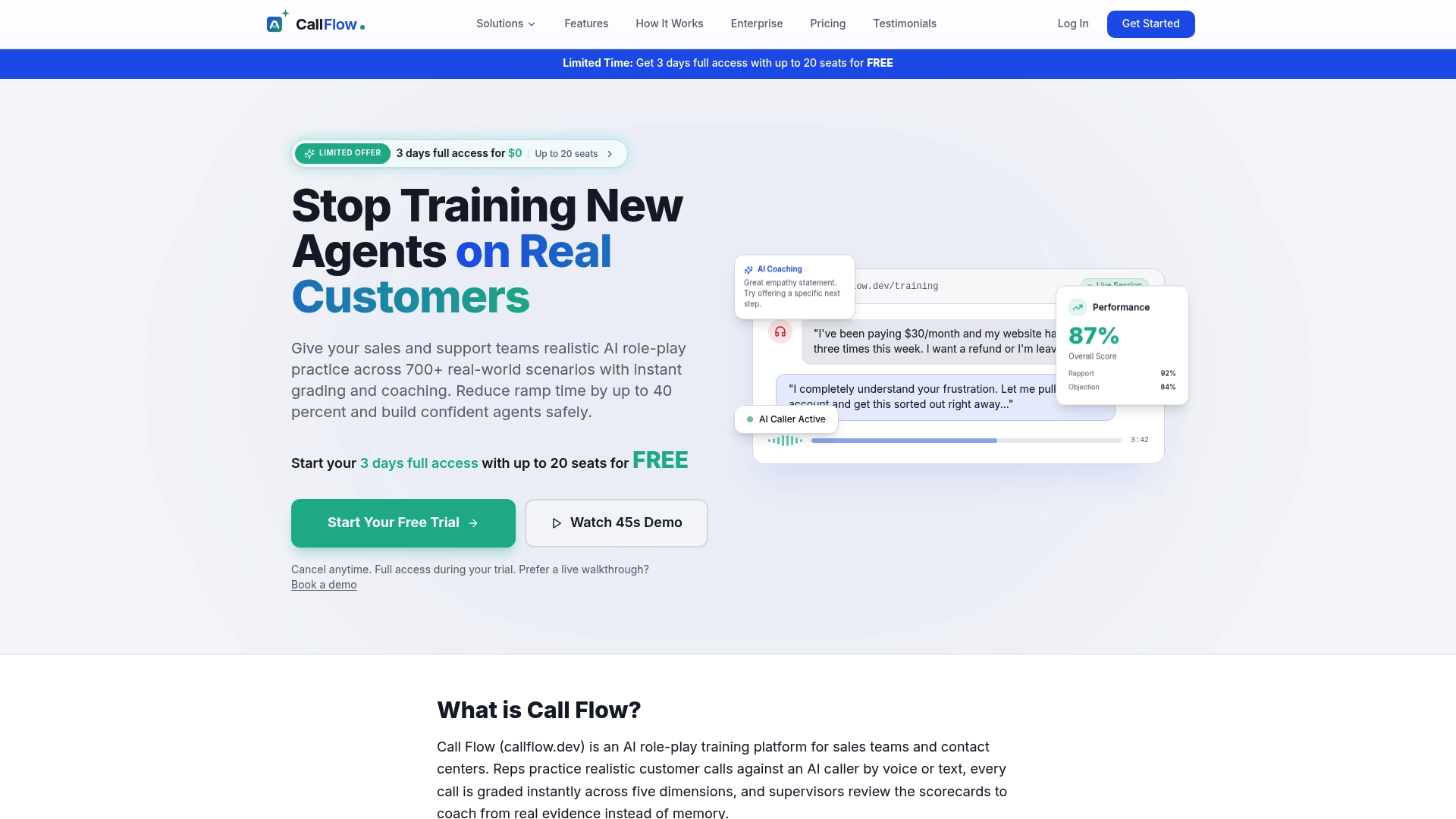
The platform includes a growing scenario library for sales, billing, support, and retention calls, supervisor dashboards to track skill trends across a whole team, and coaching feedback that arrives in seconds instead of after a scheduled debrief. Teams have used it to cut ramp time and improve first-call resolution without adding trainer headcount.
Start with a free mock call practice session and run your first scored round today, no live partner required.
Frequently Asked Questions
What's the difference between a mock call script and a real call script? A mock call script is built for rehearsal, with hidden objections and a scoring layer attached. A live call script or talk track is meant to guide a real customer conversation without the practice scaffolding.
How long should a mock call session last? Keep individual rounds short, 2 to 5 minutes for sales calls and 5 to 10 minutes for service calls, then add 5 minutes for debrief. A full session with 4 to 6 rounds usually runs 45 minutes to an hour.
Can I practice mock calls alone? Yes. Record yourself running a script solo, self-score against the rubric, and re-run only the weakest section. It won't fully replace a partner who can react unpredictably, but it builds real repetition between scored sessions.
How do I customize mock call scripts for a different industry? Keep the rubric structure the same and swap the scenario details, the product, the objection, the regulatory language, so the persona sheet reflects what your reps actually hear on live calls.
Do I need software to run mock calls effectively? No, a partner, a timer, and a scorecard are enough to start. Tools like Call Flow become useful once you need to scale practice volume beyond what live partners and trainer hours can support.