

Run a skills based program built around five core competencies, delivered as short micro-modules plus one or two facilitated workshops. That combination gives you the fastest path to a measurably better hybrid team without overloading anyone's calendar. Expect micro-modules to run 35 to 45 minutes, workshops to fill a half day, and a full certificate-style track to land around 13 hours, mirroring the format Stanford Online uses for its hybrid leadership course.
Here's what this approach gets you inside a single quarter:
- Faster ramp time for new hires and role changes
- Clearer, shorter meetings with real decisions attached to them
- Measurable gains in outcome delivery, not just attendance numbers
Pro Tip: Pilot with one team of six to ten people before rolling anything out wider. You'll catch scheduling and content problems while the stakes are still low.
TL;DR:
- Conduct a pilot with a small team of six to ten members to identify scheduling and content issues before scaling the hybrid training program.
- Use role-play scenarios with instant feedback via Callflow's platform to reinforce core competencies and track progress efficiently.
- Focus training around five specific competencies: communication, inclusion, psychological safety, outcome-based performance, and onboarding.
- Combine microlearning modules of 35 to 45 minutes with half-day workshops, reserving longer courses for first-time hybrid managers.
- Measure success through early indicators like module completion within 30 days and longer-term outcomes such as ramp time and retention at 60 to 90 days.
Table of Contents
- Core Competencies Every Hybrid Team Training Program Needs
- What Training Formats Work Best for Hybrid Teams?
- How Do You Design a Hybrid Training Curriculum?
- Facilitating Hybrid Sessions Without Losing the Remote Half
- How Do You Measure Hybrid Training Impact?
- A 90-Day Hybrid Team Training Plan You Can Run on a Tight Budget
- Why This Approach Has Research Behind It
- Customizing Training for Different Roles, Locations, and Time Zones
- What Successful Hybrid Training Programs Actually Look Like
- Put Hybrid Training Into Practice With Real Role-Play Reps
- Key Takeaways
- Sources
Core Competencies Every Hybrid Team Training Program Needs
Hybrid leadership training that sticks tends to organize itself around five competencies, not a grab bag of soft skills. Each one needs its own objective, not a vague mention.
- Clear communication. Set documentation-first rules: every decision gets a written record, and async updates replace status meetings wherever possible.
- Deliberate inclusion. Redesign meetings so remote voices get equal airtime, not leftover minutes at the end.
- Psychological safety and trust. Build in regular feedback routines and low-stakes "safe failure" exercises where mistakes get discussed openly.
- Outcome-based performance. Train managers to set outcome targets instead of tracking hours or logins.
- Onboarding and access. Give new hires full tool access and a low-risk first task on day one, paired with a buddy system.
That last point matters more than most managers assume. Teams that delay full access and a real first task push meaningful contribution back by weeks, according to reWork's research on hybrid team leadership.
Pro Tip: Write your outcome-based objectives before you build a single training module. If you can't state what "good" looks like in one sentence, the module will drift.
What Training Formats Work Best for Hybrid Teams?
Microlearning suits quick, single-skill bursts, usually 35 to 45 minutes, and works well for topics like async communication norms or feedback phrasing. Half-day workshops, like PMC Training's 3-hour Leading Hybrid Work Teams session, fit denser topics such as inclusive meeting design where people need to practice, not just watch. Full certificate courses, closer to Stanford's 13-hour model, make sense for managers taking on a hybrid team for the first time.
- Use synchronous sessions for practice, role-play, and group problem solving
- Use asynchronous modules for concept delivery, reading, and self-paced skill checks
- Blend both: a short live workshop followed by asynchronous micro-practice locks in behavior change far better than either alone
Budget accordingly. A single half-day workshop costs less in disrupted work hours than three scattered one-hour sessions, and it produces more usable practice time per dollar spent.
How Do You Design a Hybrid Training Curriculum?
A workable curriculum follows a simple arc: diagnose gaps, teach core skills, practice them, coach on the practice, then apply what's learned to a real task.
-
Diagnostic module (20 minutes). A short self-assessment against the five competencies, scored by the manager and the team member together.
-
Communication module (35 minutes). Teaches documentation-first habits and async decision records, closing with a written practice artifact.
-
Inclusion module (45 minutes). Covers meeting redesign and equitable participation, practiced live in a mixed in-person/remote session.
-
Trust and safety module (30 minutes). Includes a structured feedback exercise and a "safe failure" role-play.
-
Performance module (30 minutes). Walks through setting outcome-based goals instead of activity metrics.
-
Application sprint (one to two weeks). Participants apply one module directly to a live project, then report results.
Role-play and peer feedback belong inside nearly every module rather than tacked on at the end. Pairing a short live scenario with a written artifact, like a decision record or a meeting agenda, gives you something concrete to coach against later.
Facilitating Hybrid Sessions Without Losing the Remote Half
Proximity bias is the quiet killer of hybrid workshops. In-room participants dominate discussion by default unless the facilitator actively counters it.
- Require cameras on for anyone who can support it, and set explicit turn-taking rules before the session starts
- Assign a dedicated remote moderator whose only job is watching the chat and pulling remote voices into the spoken conversation
- Put a laptop or dedicated camera at eye level in the room so remote participants see faces, not the backs of heads
- Open every session with stated norms and a short agenda that names the outcome, not just the topic
Center for Creative Leadership frames this as human-centered leadership: explicit norms, shared context, and relationship-building treated as scheduled work rather than something that happens by accident.
Pro Tip: Rotate the remote-moderator role each session. It keeps the skill spread across the team instead of resting on one person.
How Do You Measure Hybrid Training Impact?
Track leading indicators early and lagging indicators later. Participation rates, practice-module completion, and manager observation scores tell you whether the training is landing within the first two weeks.
- Leading indicators: module completion, role-play participation, manager spot-check scores
- Lagging indicators: ramp time, outcome delivery rate, meeting length and effectiveness, voluntary turnover
Expect early signals, like completion and confidence self-ratings, within 30 days. Ramp-time and outcome-delivery shifts usually show up by day 60, with retention effects visible closer to day 90. A short five-question survey, covering confidence, clarity of expectations, and meeting quality, run at day 0 and day 60 gives you a clean before-and-after without building a research project.
A 90-Day Hybrid Team Training Plan You Can Run on a Tight Budget
You don't need a big L&D budget to run this well. A phased plan spreads cost across the quarter and lets you course-correct early.
- Weeks 1 to 2: Run the diagnostic, set outcome targets, and publish written team norms.
- Weeks 3 to 6: Deliver the core modules, communication, inclusion, trust, and performance, with live practice built into each.
- Weeks 7 to 9: Launch application sprints where each person applies one module to real work, coached by their manager.
- Weeks 10 to 12: Re-run the survey, compare ramp time and outcome data, and decide what to repeat or cut.
Keep costs low with peer role-plays, recorded practice sessions reviewed asynchronously, and template-driven documentation instead of custom materials. Pilot with a single cohort of six to ten people before scaling to the rest of the organization. If ramp time or outcome delivery hasn't moved by day 60, adjust the module mix before you expand.
Why This Approach Has Research Behind It
The five-competency model isn't a guess. It draws on frameworks used in Stanford Online's hybrid leadership curriculum and CCL's human-centered leadership research, both of which put psychological safety, trust, and clear communication at the center of hybrid effectiveness.
Role-play practice with instant feedback is where most of this training either sticks or fizzles.
Structured role-play tied to instant, multi-dimension coaching feedback closes the gap between knowing a skill and actually performing it under pressure, which is where most hybrid training programs quietly fail.
- Role-play practice directly reinforces the communication and onboarding competencies covered above
- Instant grading gives managers the observation-score data needed for the leading-indicator tracking in your 90-day plan
- PMC Training's short-workshop model and Stanford's competency structure both validate the module lengths used in this curriculum
Customizing Training for Different Roles, Locations, and Time Zones
A single curriculum rarely fits every hybrid team member the same way, and treating it like it does is the fastest way to lose half your audience. A frontline sales rep and a finance manager need different application sprints even if they sit through the same trust-building module. Adjust the practice scenario and the written artifact to match the role, not the content itself.
Time zones create a harder constraint. If your team spans more than a four-hour spread, live workshops become exclusionary by default. Record every synchronous session and pair it with a written summary so no one's learning depends on being awake at the wrong hour. Rotate meeting times across weeks if a stretched team truly needs live discussion, rather than always favoring the time zone where headquarters sits.
Location matters beyond time zone math, too. Team members working from home with unreliable connectivity face a different kind of access gap than someone in an office with dedicated infrastructure. Guidance on flexible connectivity options for remote workers, like the overview from Lumo eSIM Store, is worth sharing with managers whose teams include frequent travelers or rural remote workers, since a dropped connection during a live practice session undermines the whole point of equitable participation.

Role seniority shifts the coaching, too. New managers need more structured scripts and closer observation during role-play modules. Experienced leads can handle more ambiguous scenarios and less hand-holding. Building two tracks, one scaffolded and one open-ended, off the same five-competency base costs little extra design time and keeps both groups genuinely engaged instead of bored or overwhelmed.
What Successful Hybrid Training Programs Actually Look Like
The strongest hybrid training rollouts share a pattern: a short, focused workshop followed by structured micro-practice and a real application sprint, rather than a single long session that tries to cover everything at once. PMC Training's customizable half-day format reflects this, giving teams a concentrated block of live practice they can immediately apply, rather than spreading thin content across multiple disconnected sessions.
Programs that skip the application step tend to see skills fade within weeks. The ones that hold up combine a workshop, a written artifact like a decision record or meeting agenda, and a follow-up coaching touchpoint two to three weeks later. That third step, the follow-up, is the piece most budget-constrained programs cut first, and it's usually the one that determines whether the training produces lasting behavior change or just a pleasant afternoon.
Teams that build async-first habits into their sprint also see fewer meetings and more autonomous output. Practitioner guidance on managing remote teams consistently points to documented, async-first communication as the difference between a hybrid team that runs smoothly and one that burns hours in status meetings. Pairing that habit with a single source of truth for decisions and project context, an approach detailed in EasyFlow's guide to collaborative workflows, gives teams a concrete structure to adopt rather than a vague instruction to "communicate better."
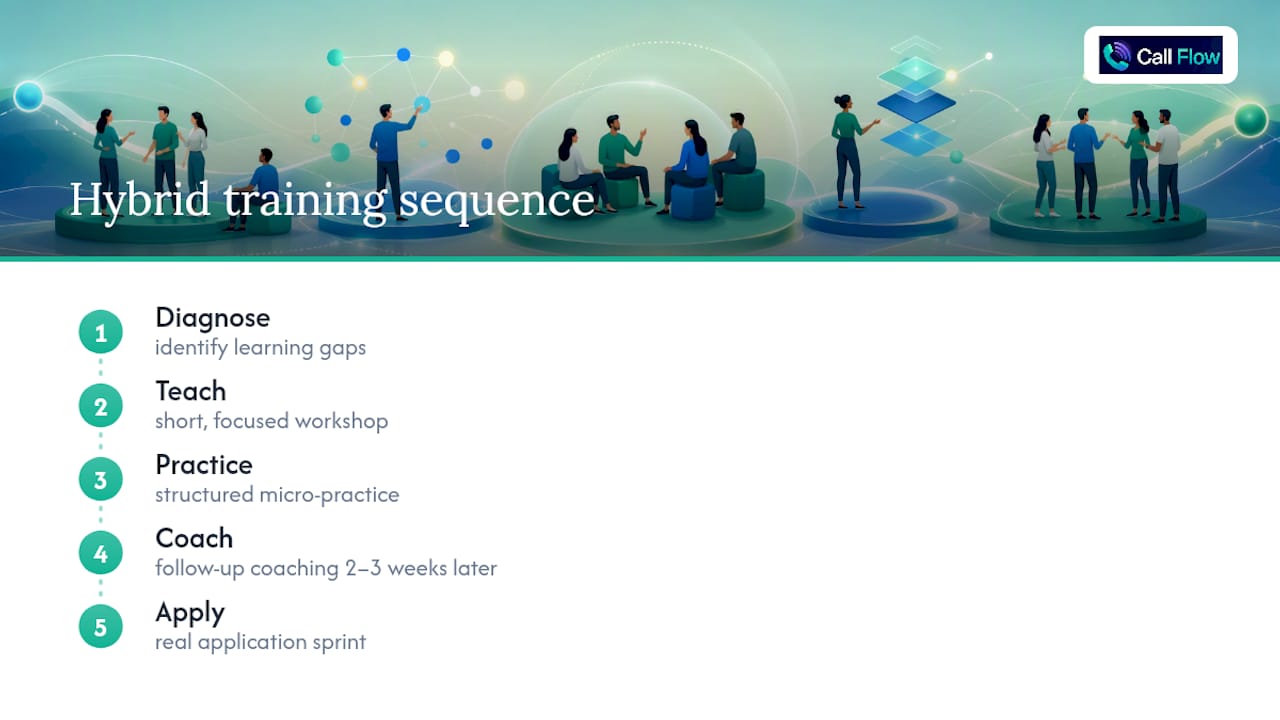
The common thread across these examples isn't scale or budget. It's sequencing: diagnose, teach, practice, coach, apply.
Sustaining Learning Through Leadership Practice
Training only sticks when leaders model the behavior themselves and schedule reinforcement instead of hoping it holds. Run the diagnostic, pick one pilot module, and measure what changes.
— Costa
Put Hybrid Training Into Practice With Real Role-Play Reps
Most of the curriculum above depends on one thing: quality practice reps with feedback attached. Callflow gives hybrid teams a way to run that practice without scheduling another live workshop every time someone needs a rep. The platform runs realistic role-play scenarios, voice or text, and grades each one instantly across five performance dimensions, so managers get observation-score data without sitting in on every session personally.
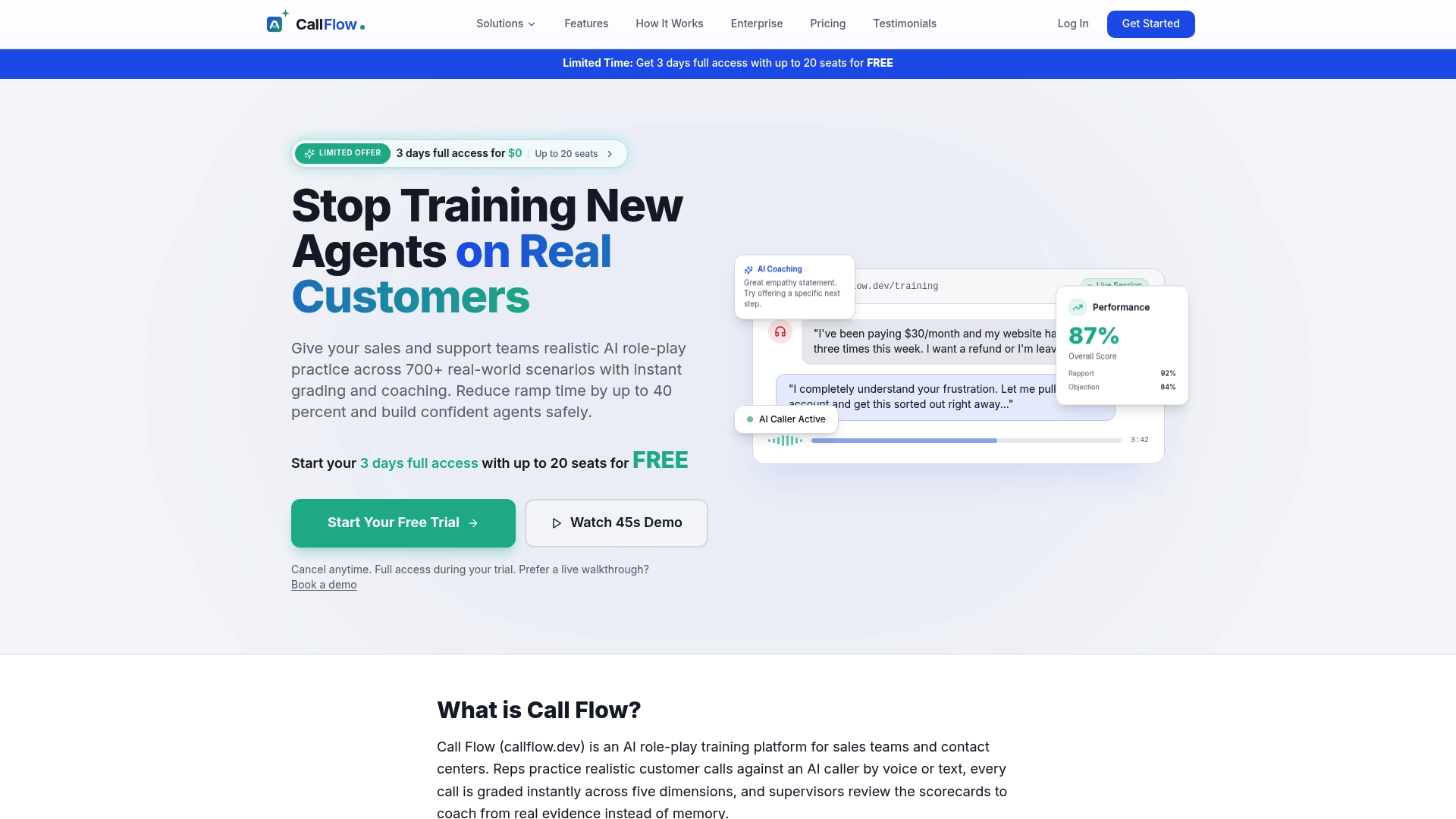
A small pilot works best here. Pick your six to ten person cohort from the 90-day plan above and run their application sprint through Callflow's role-play scenarios instead of unscripted peer practice. Callflow's free mock call practice trial lets you run that pilot at no cost before committing to anything wider. If your team handles customer-facing calls specifically, the AI mock call practice page walks through how the grading dashboards map onto the outcome metrics from your measurement plan. Start the pilot alongside week 7 of your training plan and compare the numbers by week 12.
Key Takeaways
Hybrid team training works best when it pairs a five-competency framework with short, blended delivery and disciplined 30/60/90-day measurement.
| Point | Details |
|---|---|
| Build around five competencies | Train communication, inclusion, psychological safety, outcome-based performance, and onboarding as distinct objectives. |
| Blend formats deliberately | Combine 35 to 45 minute microlearning with half-day workshops and reserve longer certificate courses for new hybrid managers. |
| Facilitate for equity | Assign a remote moderator and enforce turn-taking so proximity bias doesn't drown out remote voices. |
| Measure on a 30/60/90 timeline | Track completion and confidence early, ramp time and outcomes by day 60, retention by day 90. |
| Pilot role-play practice with Callflow | Use Callflow's instantly-graded scenarios for a small cohort pilot, where internal data shows faster ramp time and better first-call resolution. |