

The most reliable way to lift upsell performance is a short, process-driven training sequence anchored to realistic role-play and an 8 to 12 week reinforcement cadence. Role-play with instant feedback produces measurable skill gains, and platforms like Callflow's AI role-play tool now make that practice available on demand. Skip the reinforcement piece, though, and most of the gain disappears within three months.
TL;DR:
- Role-play with real scenarios and instant AI feedback significantly improves upselling skills, but reinforcement is essential to prevent skill decay within three months.
- Timing, discovery, and pricing are critical; post-purchase offers with a 15% to 25% conversion rate are most effective, especially when aligned with customer satisfaction signals.
- Custom scenario design based on recent objections and industry context enhances relevance, while continuous reinforcement over 8 to 12 weeks sustains behavioral change.
- Ethical upselling requires identifying genuine customer needs and avoiding pressure tactics, with scoring systems including customer fit to support trust-based selling.
- AI-enabled tools streamline ongoing practice, providing rapid feedback, progress tracking, and faster ramp times, shown by reported improvements of 147% in ramp speed and 129% in resolution rates.
Table of Contents
- What Upselling Training Actually Needs to Cover
- Why Role-Play Practice Beats Lecture-Style Training
- Building an 8 to 12 Week Reinforcement Cadence
- Measuring Whether Upselling Training Is Actually Working
- A Ready-to-Run 45 to 60 Minute Training Session
- Adjusting Your Approach by Industry and Product Type
- Keeping Upselling Ethical and Trust-Based
- Author Perspective: Lessons From Scaling Upsell Practice
- Give Your Team Realistic Practice Without the Scheduling Headache
- Sources
What Upselling Training Actually Needs to Cover
Before you build a single scenario, get your team clear on the difference between upselling and cross-selling. Upselling moves a customer to a higher tier or larger version of what they already want, like a bigger service plan or a premium feature set. Cross-selling adds a separate but related product. The distinction matters because the sales motion is different. Upselling requires understanding why the current option falls short; cross-selling requires spotting an unmet adjacent need. Train reps to recognize which situation they're in before they open their mouths.
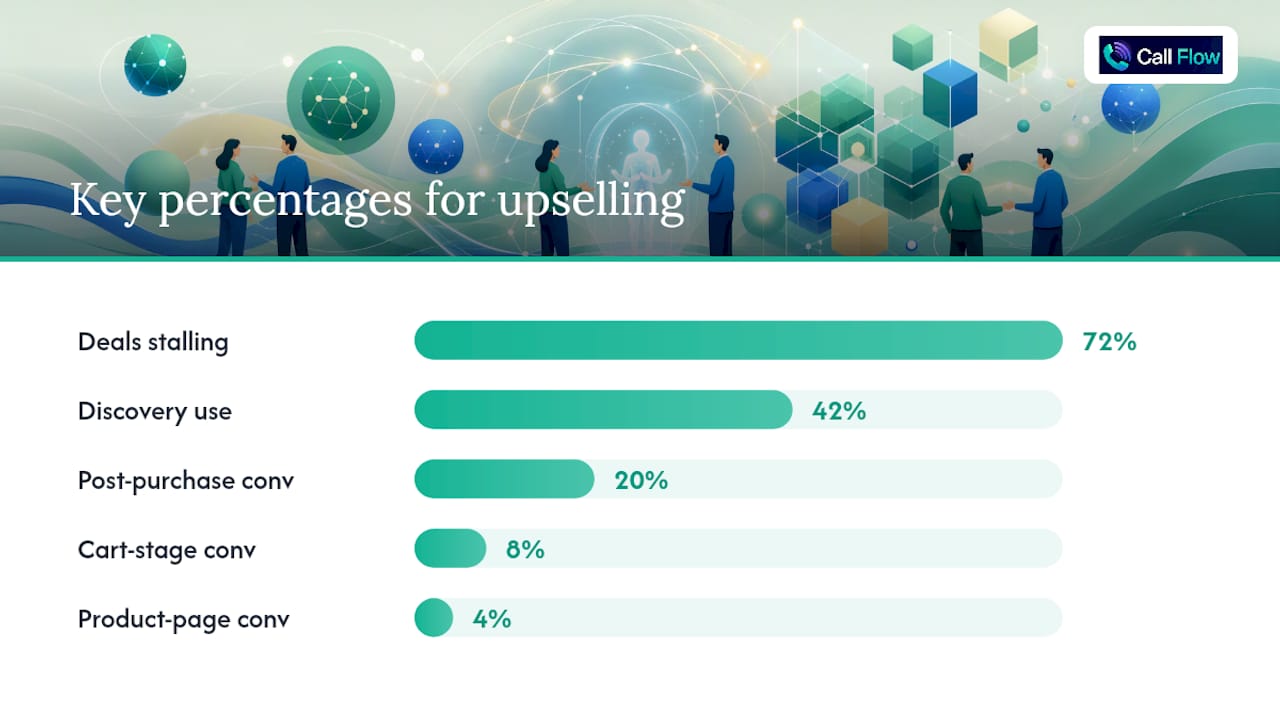
Discovery comes first, every time. Data from HubSpot shows 42% of high-performing sales professionals name deep discovery as their primary upselling approach, and the same research found 72% of deals stall because buyers never see the value. That means your training has to teach probing, not pitching. Good scripts sound like: "What's the biggest limitation you're running into with your current setup?" or "If cost weren't a factor, what would you add?" These questions surface upgrade fit without sounding like a sales tactic.
Timing changes everything about acceptance rates. Post-purchase upsell offers, made after a customer has already committed, convert at 15% to 25%, while product-page upsells land closer to 2% to 6% and cart-stage offers sit at 4% to 12%. Teach reps to wait for a signal of satisfaction or commitment before introducing the upgrade. A customer who just solved one problem is far more receptive to solving the next one than a customer still deciding whether to buy at all.
Pricing guidance belongs in every training session. Keep upgrade offers within 20% to 30% of the original price. Go higher and acceptance drops sharply because the ask starts to feel like a different purchase decision entirely, not a natural next step.
- Paired role-play — two reps alternate customer and rep roles using a real deal script.
- Group role-play — one rep handles the scenario while the team observes and scores.
- Observer drills — reps watch recorded calls and flag missed upgrade windows.
Each format should end with a scored debrief covering discovery quality, timing, and language. For phrasing, train reps to lead with value, not price: "This tier would cut your turnaround time in half" beats "Would you like to upgrade?" every time. Layer in short microlearning modules between live drills, five minutes, one skill, so reps get repetition without dedicating a full afternoon to it.
Pro Tip: Record every role-play, even the informal ones. A rep who hears their own hesitation on playback fixes it faster than one who just gets verbal feedback.
Why Role-Play Practice Beats Lecture-Style Training
Role-play tied to real scenarios can lift sales ability by up to 25%, according to research on upselling training methods. The same research found that training without reinforcement loses roughly 80% of its impact within 90 days. That's the core tension every sales manager faces: practice works, but only if it doesn't stop after week one.
Design matters as much as frequency. The strongest scenarios come from live deals and conversation intelligence data, not generic scripts written in a vacuum. Pull actual objections your team has heard this month and build role-play prompts around them. A rep who practices against a fabricated objection learns to handle a fabricated objection. A rep who practices against last Tuesday's real pushback learns to handle Tuesday.
This is where AI-enabled role-play tools change the math. Callflow's platform grades practice calls instantly across multiple performance dimensions, discovery quality, objection handling, timing, and closing language, which means reps get feedback in minutes instead of waiting for a manager's calendar to open up.
- Instant grading shortens the feedback loop from days to minutes.
- Multi-dimension scoring shows exactly which skill is lagging, not just a pass or fail grade.
- Supervisor dashboards let managers spot team-wide patterns without sitting in on every call.
A typical drill runs 10 to 15 minutes: one scenario, one objection, one upsell attempt. The manager debrief that follows takes five minutes and covers three things: what worked, what missed, and one specific commitment for the next call.
Pro Tip: Don't grade every role-play the same week you introduce a new scenario type. Let reps run it twice ungraded first so the score reflects skill, not unfamiliarity.
Building an 8 to 12 Week Reinforcement Cadence
Skills fade fast without structure. That 80% drop-off in training impact within 90 days isn't a fluke, it's the forgetting curve doing what it always does when there's no follow-up plan. A single workshop, no matter how good, cannot compete with a follow-up schedule.
Here's a cadence that works for most team sizes:
- Weeks 1 to 2: Kickoff training, baseline role-play, and scenario scoring to identify gaps.
- Weeks 3 to 4: Weekly micro-lessons (5 to 10 minutes) paired with one focused role-play per rep.
- Week 4: First milestone review, compare scores against baseline.
- Weeks 5 to 8: Manager 1:1s every other week, role-play frequency increases for reps still below target.
- Week 8: Second milestone review.
- Weeks 9 to 12: Reinforcement tapers to biweekly, with role-play focused on edge cases and harder objections.
- Week 12: Final review and certification against your sales competency benchmarks.
- Embed upsell prompts directly into CRM opportunity fields so reps see the reminder at the moment it matters.
- Fold role-play review into existing pipeline meetings instead of adding a separate calendar event.
- Stretch the cadence toward 12 weeks for long sales cycles; compress toward 8 weeks for high-velocity, short-cycle teams.
Training that integrates with CRM and pipeline workflows sticks better than training that lives in a separate binder nobody opens again, a point echoed in B2B sales training research on reinforcement.
Measuring Whether Upselling Training Is Actually Working
Track outcome metrics and behavior metrics separately, then connect them. Outcome metrics tell you if revenue moved. Behavior metrics tell you why.
- Upsell acceptance rate by placement — segment by post-purchase, cart, and product page so you know where coaching is paying off.
- Average order value (AOV) lift — a well-run program can lift AOV by 10% to 30%, with placement and relevance driving most of the difference.
- Discovery depth scores — pulled from role-play grading, this shows whether reps are asking the right questions before pitching.
- Time-to-ramp — how long it takes a new rep to hit target upsell performance.
Build a simple dashboard that pairs each rep's role-play scores against their live acceptance rate. If the scores climb but acceptance doesn't, the gap is usually timing or placement, not skill. Run an A/B test: put half your team through structured coaching and leave the other half on standard onboarding, then compare 60-day acceptance rates. Report results monthly during the first cadence, then quarterly once the program stabilizes.
A Ready-to-Run 45 to 60 Minute Training Session
Skip the theory-heavy kickoff. Managers get better results from a session built around live practice from minute one.
Pre-work (before the session):
- Pull two or three live deals with real upgrade opportunities from your CRM.
- Write success criteria for the session (e.g., "every rep identifies one upgrade trigger correctly").
- Draft scenario scripts from actual objections logged in the last 30 days.
Session agenda:
- Framing (5 minutes): State the goal and the price-delta guideline for the week.
- First role-play (15 minutes): Paired practice, rotate roles halfway through.
- Debrief (10 minutes): Score against a simple rubric, discovery, timing, phrasing, close.
- Second role-play (15 minutes): Same scenario, harder objection.
- Commitments (5 to 10 minutes): Each rep states one specific change for their next real call.
Follow-up: Log commitments in the CRM, schedule a manager check-in within a week, and assign a five-minute micro-lesson tied to whatever skill scored lowest.
Pro Tip: Use the same scoring rubric across every session for at least eight weeks. Changing the rubric midstream makes it impossible to tell if reps are improving or you're just measuring something different.
If you want a head start on scenario design, a ready-to-run role-play library can save the pre-work step entirely.
Adjusting Your Approach by Industry and Product Type
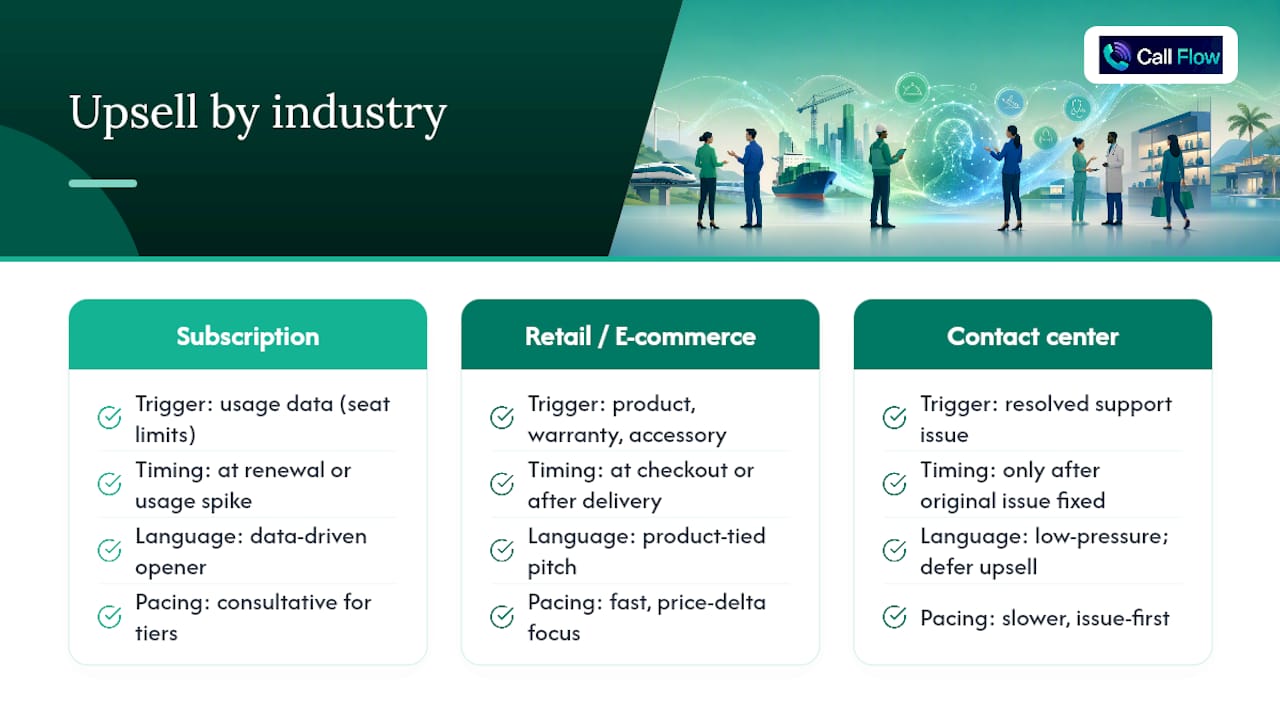
A SaaS team upselling a higher subscription tier faces a different conversation than a retail rep upselling a warranty add-on. The mechanics of discovery and timing hold steady, but the language and pacing need to shift.
In subscription businesses, the upsell conversation usually centers on usage data: "You've hit your seat limit twice this quarter" is a stronger opener than a generic feature pitch. In retail and e-commerce, upsells work better tied to the product itself, warranty, accessory, or extended service, offered at checkout or shortly after delivery. Contact centers handling support calls need a different rhythm entirely: the upsell has to wait until the original issue is resolved, or it reads as tone-deaf.
High-consideration purchases, like enterprise software or financial services, need longer discovery windows and more consultative framing. Low-consideration purchases, like retail add-ons, can move faster and rely more on price-delta guidance than deep needs analysis.
The training implication is straightforward: don't run one generic script across every product line. Build separate scenario sets for each major product category your team sells, then use the same role-play and scoring structure across all of them. The cross-sell playbook is a useful reference point when a product line blurs the line between an upgrade and an adjacent add-on.
Keeping Upselling Ethical and Trust-Based
Upselling that damages trust costs more than it earns. A rep who pushes an upgrade the customer doesn't need might close one extra sale, but the churn and negative reviews that follow usually cost more than the upsell was worth.
Train reps to ask one question before every upsell attempt: does this upgrade genuinely solve a problem the customer has? If the answer is no, the pitch should stop there. Teach reps to disclose pricing clearly and avoid vague framing that makes the upgrade sound included or optional when it isn't. Transparency about what changes, and what it costs, is what separates a helpful recommendation from a manipulative one.
Set a hard rule against pressure tactics: no artificial urgency, no implying the current plan is inadequate when it isn't, no burying the price difference. Reps should be able to explain, in one sentence, why the upgrade helps this specific customer. If they can't, they shouldn't be making the offer.
Bake this into your role-play scoring. Add a column for "customer fit" alongside discovery and timing, and dock points when a rep pushes an upgrade that doesn't match the customer's stated need. Ethical upselling isn't a separate training track, it's a scoring criterion inside the training you're already running.
Author Perspective: Lessons From Scaling Upsell Practice
The programs that work aren't the ones with the cleverest scripts. They're the ones that treat upselling as a repeatable process, not a talent some reps have and others don't.
What surprises most managers is how much of the gain comes from reinforcement, not the initial training itself. A single strong workshop feels productive, but it fades. A structured 8 to 12 week cadence, backed by role-play and instant feedback, is what actually changes behavior on live calls.
— Costa
Give Your Team Realistic Practice Without the Scheduling Headache
Running an 8 to 12 week reinforcement cadence by hand means booking manager time for every role-play, every debrief, every scoring session. Callflow removes that bottleneck by putting realistic AI role-play, instant grading, and multi-dimension coaching feedback directly in reps' hands, available whenever they have five minutes to practice, not just when a manager's calendar opens up, leveraging AI customer support for SaaS companies to enhance training efficiency.
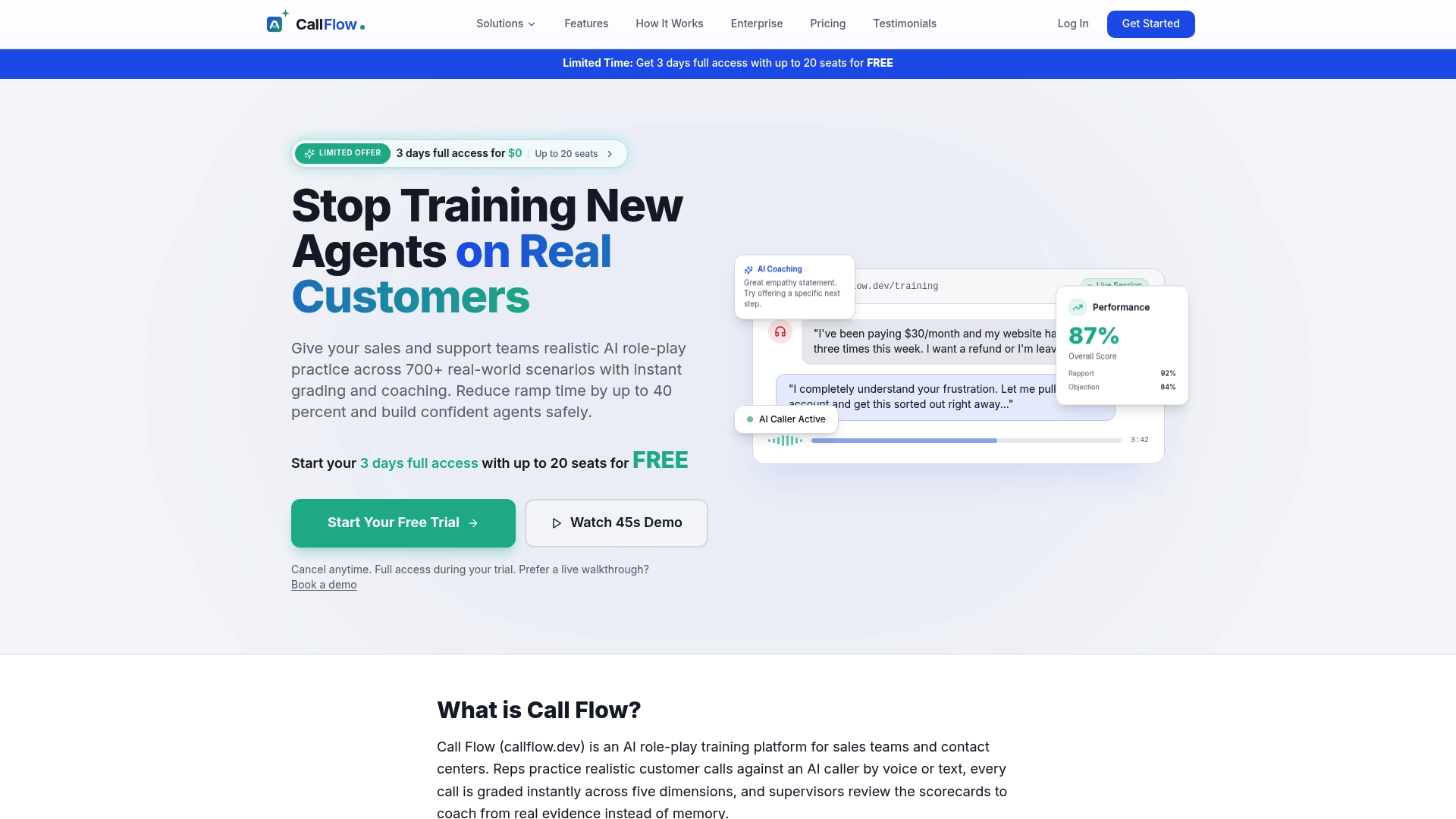
Teams using the platform have reported 147% faster ramp time and a 129% improvement in resolution rates, proof that consistent, feedback-rich practice moves the numbers that matter to your pipeline. Supervisor dashboards let you track discovery scores, timing, and closing language across your whole team without sitting in on every call. If your objection-handling drills need a boost alongside upsell practice, pair this with structured objection-handling scenarios for a fuller coaching loop.
Callflow offers full access during a risk-free trial period. Start your trial and run your first scored role-play this week.
Sources
- 5 Essential Upselling Training Techniques to Boost Sales
- Upselling tips and benchmarks
- Upselling data and strategies (HubSpot)