

The single highest-impact habit on any sales call is securing a specific, calendar-bookable next step before you hang up. Beyond that, the techniques that consistently convert are the Direct Ask, Summary Close, Assumptive Close, Alternative Close, and Question Close. Use the Next-Step Close on every call regardless of outcome. Layer one of the others based on where the buyer stands.
Gong data synthesized by itsconvo found that sellers who close fastest discuss next steps 53% more often than average reps, and missing that conversation drops close rates by 71%. That insight should reset your priorities.
Two quick scripts to use now:
When the buyer is clearly ready: "Based on everything we've covered, it sounds like this fits what you need. Can we move forward today?"
When you need a mutual next step: "I want to make sure we keep momentum. Can we put 30 minutes on the calendar for [specific date] to confirm the final details?"
Try these on your next call:
- Ask for a specific next step out loud, with a date, before the call ends.
- Use the Summary Close to recap the buyer's own words before asking.
- Send a follow-up email within 24 hours that restates the agreed next step.
Key Takeaways
| Point | Details |
|---|---|
| Next-step rate is the top metric | Sellers who close fastest discuss next steps 53% more often; target most calls ending with a booked step. |
| Match technique to the moment | Use the Direct Ask when fit is confirmed, the Summary Close after long demos, and the Assumptive Close on strong buying signals. |
| Prepare before every close | Confirm the decision-maker is present, know your bottom-line terms, and choose your technique before dialing. |
| Practice with feedback, not just scripts | Roleplay twice a week with real scenarios and immediate scoring to close the gap between knowing and doing. |
| Callflow accelerates the learning curve | AI role-play with instant grading helps teams cut ramp time and improve close skills faster than self-study alone. |
Table of Contents
- 1. The best call closing techniques, mapped to the right moment
- 2. How to prepare before a closing call
- 3. Running the closing call step by step
- 4. Ready-to-use scripts and templates for phone closes
- 5. How to practice closing calls and measure progress
- 6. Common call-closing mistakes and quick corrections
- 7. What to do after the call: follow-up and CRM actions
- 8. How to handle no-decisions and stalled deals
- 9. The psychology behind each closing technique
- 10. How to use CRM and digital tools to manage closing calls
- What actually separates great closers from average ones
- Faster closing skills start with better practice
- Sources
1. The best call closing techniques, mapped to the right moment
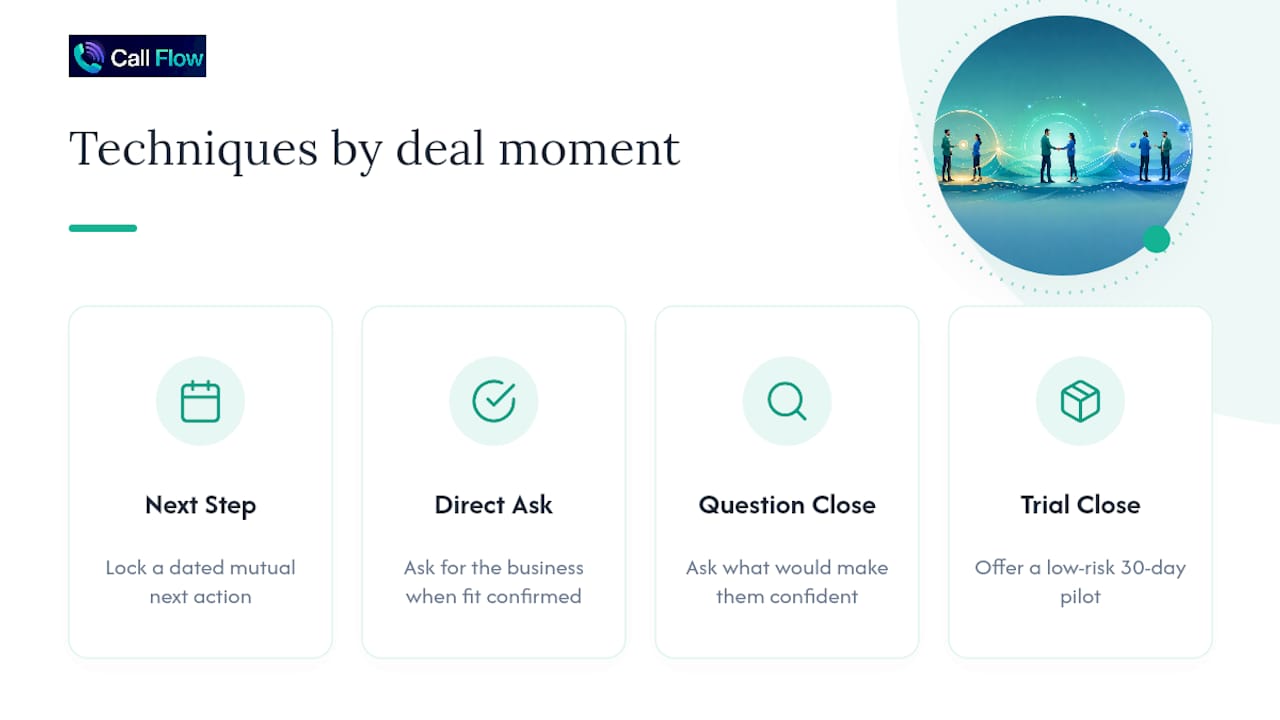
Choosing the right technique depends on where the buyer is in the decision process, not on which close you prefer. Match each method to the deal moment rather than forcing a favorite.
1. Next-Step Close Secure a specific, dated, mutual next action before the call ends. Use it on every call, regardless of outcome. Script: "Before we wrap up, can we lock in [date] for the next conversation?"
2. Direct Ask Ask plainly for the business. Use when the buyer has confirmed fit and raised no unresolved objections. Script: "Are you ready to move forward?"
3. Summary Close Recap the buyer's stated needs and your solution before asking. Use after a long discovery or demo call. Script: "You mentioned [pain point A] and [pain point B]. Our solution addresses both. Does that work for you?"
4. Question Close Ask a question that surfaces the buyer's remaining concern. Use when you sense hesitation but can't identify the objection. Script: "What would need to be true for you to feel confident moving forward?"
5. Assumptive Close Speak as if the decision is made. Use when the buyer has given multiple strong buying signals. Script: "Let's get your onboarding scheduled. Does Tuesday or Thursday work better?"
6. Alternative/Choice Close Offer two options, both of which move the deal forward. Use when a buyer is stuck between yes and not yet. Script: "Would you prefer the monthly plan or the annual plan?"
7. Calendar Close Propose a specific date and time for the next step or signature. Use when the buyer agrees in principle but hasn't committed. Script: "I have Thursday at 2 PM open. Can we confirm the paperwork then?"
8. Now-or-Never Close Introduce a genuine, time-bound reason to decide. Use only when the urgency is real, not manufactured. Script: "Our current pricing locks in at the end of this quarter. Signing today keeps that rate."
9. Takeaway/Sharp-Angle Close Acknowledge that the deal may not be the right fit, or match a concession with a condition. Use when a buyer pushes back hard on price or scope. Script: "If I can get that discount approved, can you sign by Friday?"
10. Scale/Score Close Ask the buyer to rate their readiness on a scale of 1–10. Use when you need to surface hidden objections before asking. Script: "On a scale of 1–10, how ready are you to move forward? What would get you to a 10?"
11. Puppy-Dog/Trial Close Offer a low-risk trial or pilot. Use when the buyer is interested but risk-averse. Script: "Why not run a 30-day pilot? If it doesn't deliver, you walk away with no obligation."
12. Ben Franklin/Pros-and-Cons Close Walk through the advantages and disadvantages together. Use when a buyer is analytical and needs to feel they've thought it through. Script: "Let's list out the pros and cons together so you can see the full picture."
Stat: Sellers who close fastest discuss next steps 53% more often than average reps. Missing that conversation drops close rates by 71%.
Pro Tip: Watch for the buyer's language. A buyer who says "when we start" instead of "if we start" is already using assumptive language. Match it and move directly to the Calendar or Assumptive Close.
2. How to prepare before a closing call
Preparation is where most reps lose the close before the call even starts. A pre-call checklist that covers attendees, prospect needs, collateral, and bottom-line limits consistently produces faster closes and fewer follow-up loops.
Pre-call checklist:
- Confirm who will be on the call and whether the decision-maker is present.
- Review the prospect's stated pain points, objections from prior calls, and any open questions.
- Prepare the relevant collateral: proposal, case study, pricing sheet, or contract draft.
- Set your bottom-line terms before the call. Know your floor on price, timeline, and scope.
- Map the decision process: who signs, who influences, and what internal approvals are needed.
- Choose your primary closing technique based on the deal stage and the buyer's known signals.
Short agenda template:
- Restate the purpose of the call (2 minutes).
- Recap agreed-upon fit from prior conversations (5 minutes).
- Address any remaining questions or objections (10 minutes).
- Present the proposal or next step (5 minutes).
- Close and confirm next steps (5 minutes).
Reserve the last five minutes specifically for the close. Announce this at the start: "I want to make sure we leave the last five minutes to agree on next steps." That framing makes the close expected rather than abrupt.
Knowing your bottom line before the call prevents reactive concessions. Write it down: "I will not go below $X or extend the timeline past [date]." That decision, made in advance, keeps you calm when the buyer pushes back.
Pro Tip: If the decision-maker won't be on the call, reschedule. Closing with an influencer who can't sign wastes both parties' time and resets your timeline.
3. Running the closing call step by step
A closing call has a predictable shape. Follow it and the close feels natural. Skip steps and you'll hit resistance you could have avoided.
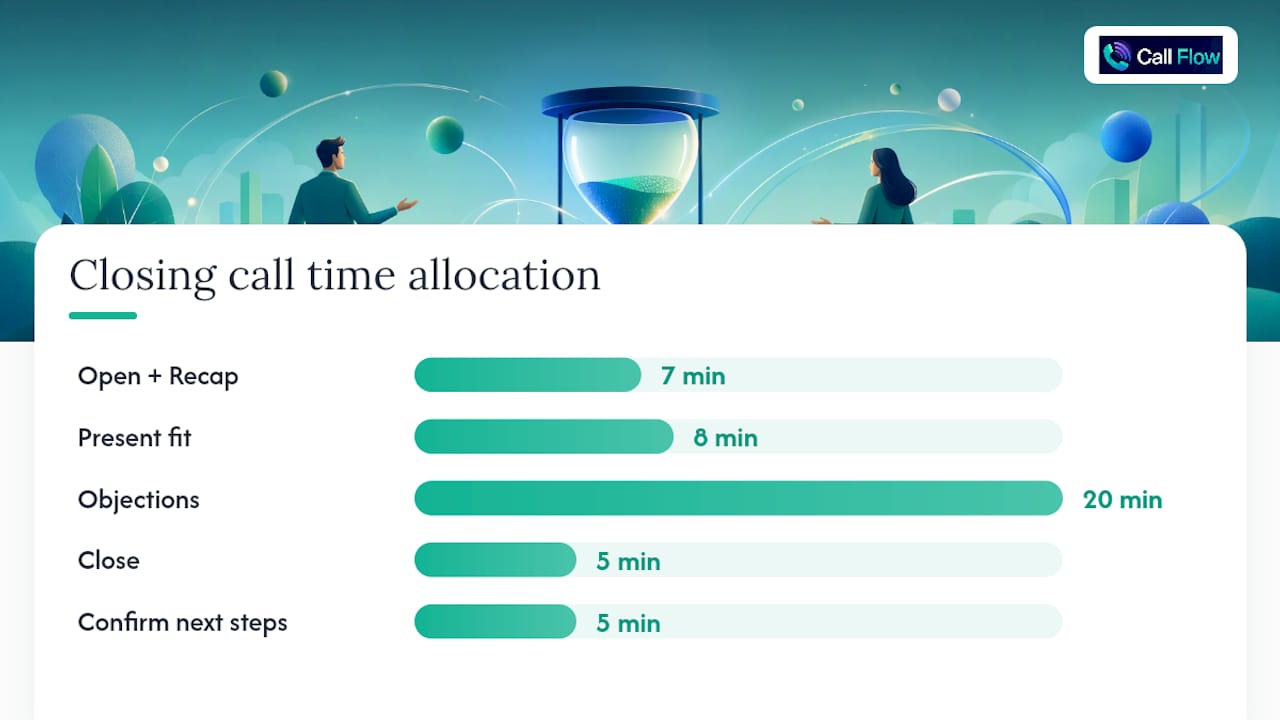
Minute-by-minute flow:
- Open (0–2 min): State the call's purpose. "Today I'd like to recap what we've discussed and, if everything lines up, agree on next steps."
- Recap (2–7 min): Summarize the buyer's pain points in their own words. This builds trust and sets up the Summary Close.
- Present fit (7–15 min): Connect your solution to each pain point. Keep it short. The buyer already knows the product.
- Surface objections (15–25 min): Ask directly: "Is there anything that would prevent you from moving forward today?"
- Handle objections (25–35 min): Use the formula below.
- Close (35–40 min): Apply your chosen technique.
- Confirm next steps (40–45 min): Book the next action live, with a date and owner, before hanging up.
Objection-handling formula: Acknowledge, Isolate, Respond, Check.
- Acknowledge: "That's a fair concern."
- Isolate: "Is that the main thing holding you back, or are there others?"
- Respond: Address the specific objection with a fact, case study, or concession.
- Check: "Does that address your concern?"
Example: Buyer says, "The price is too high." You say: "That's a fair concern. Is price the only thing holding you back, or is there something else? [Pause.] If I can work with you on the investment, would you be ready to move forward today?"
Buying signals to watch for:
- Asks about implementation timelines or onboarding.
- References internal stakeholders by name.
- Asks about payment terms or contract length.
- Repeats a benefit you mentioned back to you.
- Uses "when" instead of "if."
When you spot two or more of these, move to the Direct Ask or Assumptive Close immediately. Don't wait for a perfect moment.
Pro Tip: Time-box the last five minutes explicitly. Say: "We have about five minutes left. I want to use that to agree on a next step." This signals urgency without pressure and makes the close feel collaborative.
4. Ready-to-use scripts and templates for phone closes
Positive tone, clear offer, and prospect involvement are the three constants in effective phone closes. Scripts give you a starting point. Personalize them to the buyer's language before you dial.
Phone script pack:
Demo close: "Based on what you saw today, does [Product] solve the problem you described? [Pause.] Great. Let's talk about getting you started."
Direct ask close: "We've covered a lot of ground. Are you ready to move forward with [specific offer]?"
Assumptive close: "I'll send over the agreement this afternoon. Does [Name] or [Name] need to co-sign?"
Alternative/choice close: "Would you prefer to start with the [Plan A] or go straight to [Plan B]?"
Negotiation script (sharp-angle pattern):
You: "If I can get that approved, can you sign the agreement by [specific date]?"
Follow-up email template 1: Signed/confirmed
Subject: Next steps from today's call
Hi [Name],
Great talking today. As agreed, [specific next step] is scheduled for [date/time]. I'll send [document or action] by [date].
Let me know if anything changes before then.
[Your name]
Follow-up email template 2: Buyer needs more time (24-hour check-in)
Subject: Following up from our call
Hi [Name],
Thanks for the time today. You mentioned you'd have a decision by [date]. I'll check back then, but feel free to reach out sooner if questions come up.
In the meantime, I've attached [relevant resource] in case it helps.
[Your name]
Send the first email within two hours of the call. Send the check-in email the morning of the agreed decision date, not the day after.
Avoid sounding scripted by swapping in the buyer's exact words from the call. If they said "we're drowning in manual work," use that phrase in your follow-up, not a generic "operational inefficiency."
5. How to practice closing calls and measure progress
Reading scripts improves familiarity. Roleplay with immediate feedback improves performance. The difference shows up in close rates within weeks, not quarters.
Roleplay schedule:
- Two sessions per week, 20–30 minutes each.
- Rotate roles: one rep plays the buyer, one plays the seller, one observes and scores.
- Use a real recent call as the scenario at least once per week.
- Rotate the closing technique practiced each session so reps build range, not just comfort with one method.
Simple feedback template (peer or manager):
- Did the rep secure a specific next step? (Yes/No)
- Which technique did they use, and was it the right fit for the moment?
- Did they handle the objection with Acknowledge, Isolate, Respond, Check?
- One thing they did well. One thing to change next time.
Key metrics to track:
AI-assisted mock call practice lets reps run scenarios between live calls, get scored across multiple dimensions, and review coaching notes immediately. That feedback loop is faster than waiting for a manager's weekly review.
Pro Tip: Run micro-batches: three 10-minute roleplay rounds back to back, each with a different objection. Short, dense repetition builds recall faster than one long session. Use a real call recording as the scenario source so the language stays authentic.
6. Common call-closing mistakes and quick corrections
Most failed closes trace back to a small set of repeatable errors. Spot them early and fix them before they become habits.
Robotic scripting. Reading a script word-for-word kills trust. Fix: customize your closing language to mirror the buyer's own words and tone from earlier in the call.
Failing to confirm next steps. Ending a call with "I'll follow up soon" is not a next step. Fix: before hanging up, say the date, time, and owner of the next action out loud and confirm the buyer agrees.
Overselling feature lists. Buyers who are ready to close don't need more features. They need confidence. Fix: stop presenting after you've confirmed fit. Ask for the business.
Ignoring buying signals. Waiting for the buyer to say "I'm ready" means you'll wait too long. Fix: when you see two or more buying signals, move to the close immediately.
Not logging notes immediately. Memory degrades fast. Fix: spend five minutes after every call logging the outcome, the agreed next step, and any objections raised. Do it before your next call.
When to back off: If the buyer says they need to consult a board, wait for a budget cycle, or review with a partner, don't push. Convert that into a dated check-in. "Understood. Let's put 15 minutes on the calendar for [specific date] so I can answer any questions that come up." That check-in is now the next step.
7. What to do after the call: follow-up and CRM actions
The close doesn't end when the call does. What you do in the next 24 hours determines whether momentum holds or fades.
Follow-up sequencing by outcome:
- Deal confirmed: Send the signed-confirmation email within two hours. Attach the contract or agreement. CC the relevant internal owner.
- Buyer needs time: Send the 24-hour check-in email the morning of the agreed decision date. No earlier, no later.
- Buyer declined: Send a brief, professional close-out email. Leave the door open without pressure.
CRM entry checklist (complete within 30 minutes of the call):
- Call outcome: confirmed, pending, declined, or no decision.
- Agreed next step: specific action, date, and owner.
- Decision process notes: who else is involved, what approvals are needed.
- Objections raised and how they were handled.
- Tags: deal stage, close technique used, follow-up type required.
Follow-up cadence:
- Yes/confirmed: contract sent same day, onboarding intro within 48 hours.
- Needs time: one check-in on the agreed date, one reminder three days later if no response.
- Rejected: one close-out email, no further outreach for 90 days unless the buyer re-engages.
Effective follow-up is specific, owned, dated, and mutual. "I'll follow up" is not a plan. "I'll send the contract by 5 PM Thursday and you'll review by Monday" is.
8. How to handle no-decisions and stalled deals
A no-decision is not a no. It's a signal that something is unresolved, and your job is to find out what.
When a buyer goes quiet after a closing call, the first move is a direct question, not another pitch. "When we last spoke, you were planning to decide by [date]. Has anything changed?" That question surfaces the real blocker without pressure.
Stalled deals usually fall into three categories. The first is internal: the buyer needs sign-off from someone who wasn't on the call. The fix is to ask for a brief call with that person, or to provide a one-page summary they can share internally. The second is competitive: the buyer is evaluating another option. The fix is to ask directly what the other option offers that yours doesn't, then address it specifically. The third is timing: the buyer's budget cycle or priorities have shifted. The fix is to agree on a future date and make that check-in the next step.
What doesn't work is a generic "just checking in" email. It signals that you have nothing new to offer. Every follow-up on a stalled deal should include one new piece of information: a relevant case study, a data point, or a change in your offer.
If a deal has been stalled for more than 30 days with no response after two follow-ups, tag it as dormant in your CRM and set a 60-day re-engagement reminder. Don't let it sit in your active pipeline and distort your close-rate metrics.
9. The psychology behind each closing technique
Every closing technique works because it activates one or more predictable human tendencies. Understanding the mechanism helps you choose the right technique and deliver it more naturally.
Reciprocity drives the Puppy-Dog Close and the sharp-angle concession. When you offer a trial or match a discount request with a condition, the buyer feels an obligation to respond in kind. The concession creates social pressure to commit.
Commitment and consistency power the Assumptive Close and the Summary Close. Once a buyer has agreed that your solution fits their needs, they feel internal pressure to act consistently with that agreement. Summarizing their own words back to them reinforces the commitment they've already made.
Scarcity is the engine behind the Now-or-Never Close. Genuine time limits or limited availability create urgency. The word "genuine" matters here: manufactured scarcity backfires when buyers discover it's false, and they often do.
Social proof supports the Ben Franklin Close and the Question Close. When you walk through pros and cons together, you're implicitly referencing what other buyers have concluded. Mentioning a relevant customer outcome during this process amplifies the effect.
Loss aversion is the most powerful lever in the Takeaway Close. Buyers respond more strongly to the prospect of losing something than to gaining something of equal value. Suggesting that the offer may not be available, or that the fit may not be right, activates this tendency more reliably than any benefit statement.
Autonomy is what makes the Alternative Close effective. Giving the buyer two options, both of which move the deal forward, preserves their sense of control while eliminating the option of not deciding.
10. How to use CRM and digital tools to manage closing calls
A CRM is only as useful as the data you put in it. Most reps log the outcome and skip the detail. That gap is where deals get lost.
The minimum viable CRM entry after a closing call includes the outcome, the agreed next step with a specific date and owner, the objections raised, and the decision process. Tags matter too: knowing which close technique you used and what the buyer's response was lets you analyze patterns across your pipeline over time.
Beyond logging, CRM tools can automate the follow-up sequence. Set a task trigger: if a deal moves to "pending decision," a follow-up task auto-creates for the agreed date. That removes the cognitive load of remembering who needs what and when.
Call recording and conversation intelligence tools let you review your own closing calls and identify patterns. Where did you lose momentum? When did the buyer's tone shift? Did you ask for the business, or did you circle back to features? Reviewing two or three calls per week with those questions in mind accelerates improvement faster than any training module.
For team leaders, pipeline dashboards filtered by deal stage and next-step date give a real-time view of which deals are at risk. A closing call with no logged next step is a red flag. A deal that's been in "closing" stage for more than two weeks without a dated action is a stall.
What actually separates great closers from average ones
Most sales training focuses on the close itself. The reps who consistently outperform focus on everything that happens in the 48 hours before and after the call.
The best closers I've observed share one habit: they treat the next step as non-negotiable. Not "I'll follow up" but "We're locked in for Thursday at 2 PM." That specificity is what separates a pipeline that moves from one that stalls. The technique matters less than the discipline of securing a concrete, mutual commitment before the call ends.
What's underestimated is the role of rehearsal. Reps who practice objection handling out loud, with a real person playing the buyer, respond faster and more naturally on live calls. The hesitation that kills a close often isn't a lack of knowledge. It's the gap between knowing what to say and being able to say it under pressure without thinking. That gap closes with repetition, not reading.
Callflow's AI role-play platform addresses exactly this. Teams using scenario-first onboarding with instant feedback loops have seen 147% faster ramp time and 129% improvement in resolution rates. Those numbers reflect what happens when practice is structured, frequent, and tied to measurable feedback rather than left to chance.
The metric I'd track first if I were leading a sales team today: next-step rate.
Faster closing skills start with better practice
Knowing the techniques is step one. Getting fast and natural with them under pressure is where most reps stall. Callflow gives sales teams a way to practice realistic closing scenarios with instant AI grading across five performance dimensions, so reps get coaching after every rep, not just after every manager review.
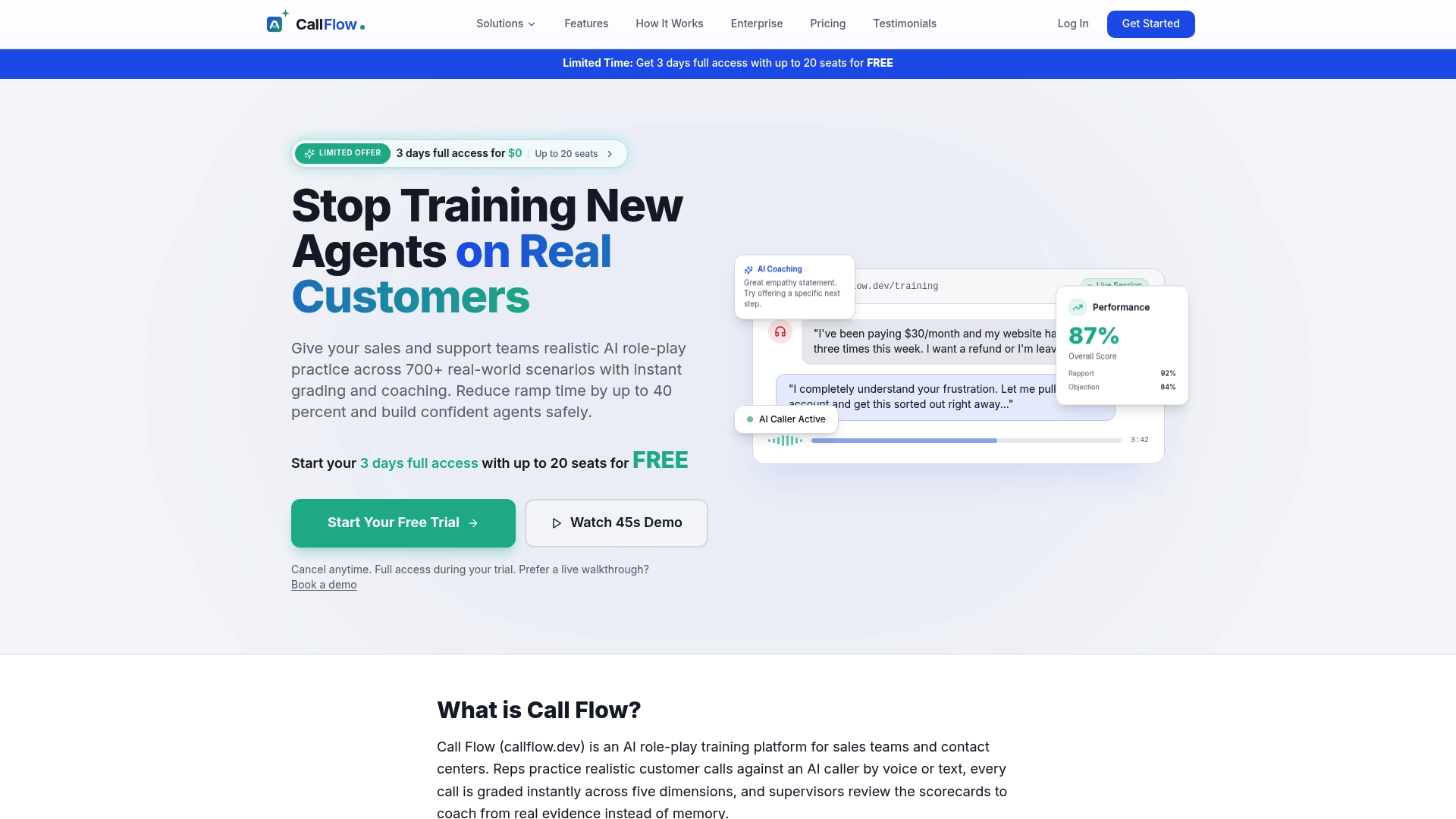
The platform runs voice and text simulations, scores each attempt, and delivers specific coaching notes immediately.
- Faster ramp: New reps reach full productivity in days, not weeks.
- Instant grading: Every practice call is scored across five dimensions with specific feedback.
- Measurable skill analytics: Team leaders track next-step rate, close rate, and coaching progress in one dashboard.
Start practicing closing calls free or explore Callflow's sales coaching tools to see how the platform fits your team's workflow.