

To reduce your transfer rate, find out why calls move, then fix the cause. Most avoidable transfers come from skill gaps, knowledge gaps and weak routing. Agents fix skill gaps with repeated practice on the exact calls they pass on today. Cut only the transfers a first agent could have resolved. Keep the ones that need a specialist. Then check that first-call resolution (FCR) and customer satisfaction (CSAT) hold or improve.
This guide shows how to measure the rate, sort transfers, train agents and track results. It also shows where role-play practice fits. Callflow is an AI role-play platform for sales and contact center teams, built for that last step.
TL;DR
- Transfer rate is transferred calls divided by calls handled, times 100. Count it by call reason, not only as one number.
- Separate necessary transfers from avoidable ones. Only avoidable ones belong in your reduction target.
- Listen to transfer calls first. The cause is usually a skill gap, a knowledge gap or a routing fault.
- Train agents on the calls they pass on. Practice before live calls is faster than waiting for live calls to teach.
- Watch FCR, repeat calls and CSAT beside the rate. A lower rate with worse resolution is a loss.
Table of Contents
- What transfer rate is and how to calculate it
- Which transfers to cut and which to keep
- Find out why calls are transferred
- Fixes that lower avoidable transfers
- Coach the calls that cause transfers
- Practice the calls agents pass on today
- Handle necessary transfers well
- Measure whether the drop is real
- What to expect from results
- Start with a pilot
- Our view on transfer rates
- FAQ
- Sources
What transfer rate is and how to calculate it
Transfer rate is the share of handled calls passed to another agent, team or department during one contact. The formula is simple: transferred calls divided by total calls handled, times 100. If 150 of 2,000 handled calls were transferred, the rate is 7.5%, as PolyAI's guide works out.
Set the counting rules before you track anything. OpsDog's KPI definition says to leave IVR transfers to agents out of the numerator. It also says a call transferred several times counts once. Platforms differ here, so write down your rule and keep it the same each month.
One number hides too much. Break it down by queue, call reason, time of day and agent team. Contact.io's guide suggests this view, and it also suggests tracking warm and blind transfers separately.

Which transfers to cut and which to keep
Not every transfer is a failure. A caller may need a specialist, another department or someone with different permissions. Those transfers are the job working as designed.
A useful split has four types:
- Routing errors. The call went to the wrong queue.
- Skill gaps. The agent could not handle a topic that a trained agent could.
- Authority limits. The agent lacks the permission to finish the task.
- Planned specialist cases. The issue needs expert handling.
Types 1 and 2 are your target. Type 3 is a policy choice you can review. Type 4 stays. KPI Tree's handoff framework makes the same point: a planned escalation that gets the issue resolved is healthy, and misrouted handoffs are the ones to drive down.
Agree on the list as a team. Write down which call reasons belong with a person. Then measure the rate by call reason against that list. Only transfers outside the list count toward your goal.
Find out why calls are transferred
Start with the calls, not with a guess. ICMI's coaching guide says transfers are either a process issue or a knowledge issue. It recommends listening to a sample of transfer calls to see which one is behind higher-than-average numbers.
A spike also points to a cause. The 2022 US Contact Center Decision-Makers' Guide says a rise can signal an agent training need, a failure in IVR routing or out-of-date website FAQs.
A simple review routine:
- Pull 30 to 50 transferred calls from the last month.
- Tag each one: misroute, skill gap, knowledge gap, authority limit or necessary.
- Group the tags by queue and by call reason.
- Rank the top three call reasons that cause avoidable transfers.
- Assign an owner and a fix to each.
Track the first queue that took the call, not only the last. When a call is measured at the last queue only, the first queue vanishes from the data. AdrenTech's analysis of this problem argues for segment-level attribution before you act on any transfer metric.
Fixes that lower avoidable transfers
Close the knowledge gap
Agents transfer when they cannot find the answer fast. ICMI points to knowledge bases that are hard to search while a caller waits, and to articles that confuse. Fix the top ten call reasons first. Write short answers with a clear first step. Test them by searching as an agent would, mid-call.
Teach agents to finish more call types
Broader skills mean fewer handoffs. In the MIT Sloan case on Quest Diagnostics, the center used spare training hours for uptraining. Reps learned enough to complete any call without transferring it. This came after six weeks of classroom training and time nesting with experienced colleagues.
Quest reduced transferred calls from 12% to 9.5%. Calls solving the customer's problem rose from 94% to 96%, according to the Good Jobs Institute. Those results came with self-service and routing changes too, so treat training as one part of the answer.
Check what your scorecard rewards
Agents do what the scorecard pays for. A bank studied in ICMI's scorecard research changed its productivity score to penalize transfers of short calls. Median transfers in the online banking access queue fell from 13.6% to 8.9% in six months, and the drop held for well over a year.
The academic paper on the same bank adds a warning. Heavy monetary penalties can push rates too low, because agents keep calls they cannot resolve. Penalize avoidable transfers only. Leave planned escalations alone. Our guide on QA scorecard templates shows how to build the form.
Fix routing at the source
If the top cause is misrouting, agent training will not fix it. Review IVR menu wording, queue skills and the website pages that send callers to the phone. Fix the front door, then re-measure.
Coach the calls that cause transfers
Listening to transfer calls tells you what went wrong. Coaching changes what happens next time. ICMI recommends building a library of exemplary calls and writing clear hold and transfer guidelines. Agents then hear what a resolved call sounds like for the same topic.
Coaching works best when it is regular and tied to specific call reasons. Our call center coaching plan template lays out the cadence. For the manager's side of the work, this insurance agent call coaching playbook shows how metrics and coaching fit together without discouraging real escalations.
Coaching on live calls has a limit. A new agent meets a rare topic once a week at best. Practice removes that limit. You can run the same hard call ten times in an afternoon.
Practice the calls agents pass on today
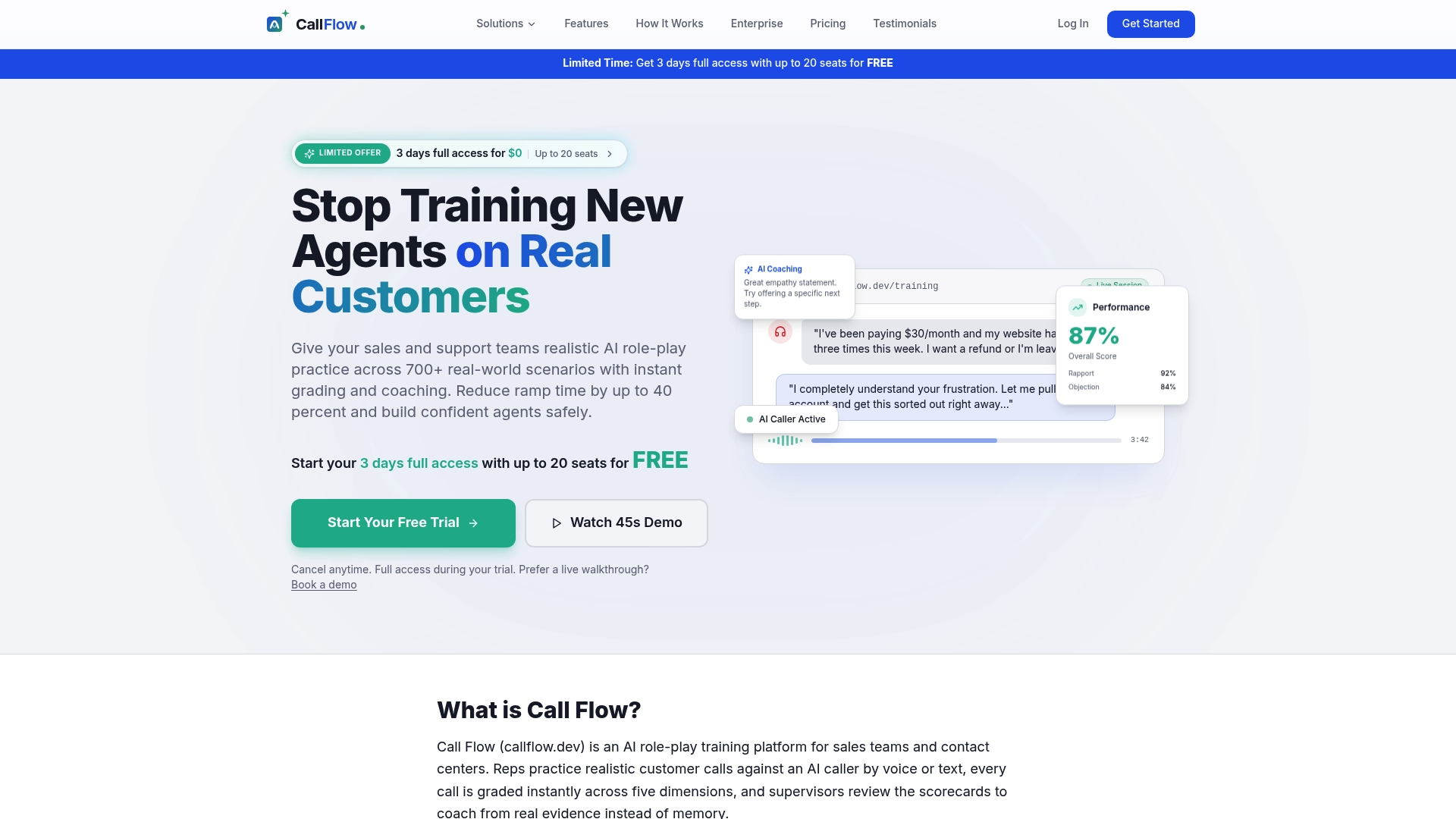
This is where Callflow fits. It is an AI role-play platform. Agents practice realistic customer calls in voice or text, and each run is graded at once across five performance dimensions. They get coaching feedback right away.
A simple routine for transfer reduction:
- List the top three avoidable transfer reasons from your call review.
- Build one scenario for each. Callflow lets you create custom scenarios, so you can mirror the exact call your agents pass on.
- Have every agent run each scenario until the graded result meets your standard. The instant grading and coaching feedback show an agent what to fix without waiting for a supervisor.
- Review results on the supervisor dashboard. See who still struggles with which call type, and focus coaching there.
- Re-measure the transfer rate for those call reasons after a few weeks.
Agents learn the topic before a real caller depends on them. Supervisors spend time on the agents who need it. Callflow also provides skill analytics for tracking progress over time.
For scoring that matches your standards, read how to align quality scores with scorecards and use AI role play. Calibration-aligned scoring is part of how Callflow is designed.
Handle necessary transfers well
Some transfers must happen. Make them painless. SQM Group's study of more than 500 North American call centers found 19% of callers were transferred. Transferred callers had 12% lower top-box CSAT and 14% lower FCR. SQM also found that warm transfers beat cold transfers on both measures, because customers did not repeat their information.
A warm transfer routine, based on Zoho's warm transfer guidance:
- Tell the customer why the transfer is needed.
- Brief the next agent on the customer and the issue.
- Pass a verified customer identifier, a short problem statement and the steps already tried, with their results.
- Stay on the line to introduce both parties when it helps.
This is a skill. Agents can rehearse the handoff in a role-play scenario, including the explanation to the customer, before they do it live.
Measure whether the drop is real
A lower transfer rate is good only if resolution holds. PolyAI warns that a low rate can hide trouble. If callers cannot reach a person, you may see fewer transfers but more hang-ups and repeat calls. Contact.io gives the same advice: read the rate beside FCR, repeat contacts and customer feedback.
Track these together each month:
| Metric | What it tells you | Warning sign |
|---|---|---|
| Transfer rate by call reason | Whether avoidable transfers are falling | Planned escalations dropping too |
| First-call resolution | Whether callers get done in one contact | Flat or falling while transfers fall |
| Repeat calls within days | Whether issues are really solved | Rising repeat contacts |
| Abandonment | Whether callers give up | Rising while transfers stay flat |
| CSAT on handled calls | Whether callers are satisfied | Dropping on calls marked resolved |
Brad Cleveland's contact center metrics guide defines FCR as contacts resolved on the first contact divided by total contacts. It says FCR is most useful as a relative measure over time, because definitions vary. So pick one definition and stay with it. Add a customer question, such as whether the issue was resolved, in a post-call survey, as ICMI recommends.
For more on this balance, see our guides on improving first call resolution and protecting FCR and CSAT.
What to expect from results
Results vary by center and by what you change. These published cases give a range:
| Case | Change | Source |
|---|---|---|
| Quest Diagnostics | Transferred calls 12% to 9.5% | Good Jobs Institute |
| Bank scorecard change | Median transfers 13.6% to 8.9% in six months | ICMI |
Set your goal by call reason, not as one blanket target. Aim to cut the avoidable group, then confirm FCR did not slip.
Start with a pilot
Callflow offers a free, full-feature trial, so a team can run the routine above before it commits. Plans are billed per team, monthly or annually. Starter costs $7.42 per month or $89 per year. Growth costs $14.92 per month or $179 per year. Scale costs $33.25 per month or $399 per year. Business and Enterprise plans have no published price.
Pick your top three avoidable transfer reasons, build a scenario for each and run your team through them. See Callflow pricing for the plans, or the enterprise page for larger teams. You can also start at the Callflow home page.
Our view on transfer rates
Transfer rate is a symptom. Treat it as a pointer to a cause.
Most managers try to push the number down. That is the wrong first move. First sort the calls. Keep the transfers that help the customer. Then look at the rest.
Many avoidable transfers come from agents who have not practiced the call. They saw it once, or never. A coaching note after the fact does not fix that. Repeated practice does.
We built Callflow so agents can run a hard call as many times as they need. Each run is graded across five dimensions. Feedback is instant. Supervisors see who needs help on which call type. Scoring can match your existing QA standards.
Check resolution every time you check transfers. A faster call that fails is still a failed call.
Costa
FAQ
What is a good call transfer rate?
There is no single standard. Rates depend on your industry, your call mix and how you count. The Quest Diagnostics case moved from 12% to 9.5%, and the bank case from 13.6% to 8.9%. Set your own target by call reason and compare it to your own history.
Is a lower transfer rate always better?
No. Some issues need a specialist, and blocking that transfer leaves the caller without an answer. Read the rate beside FCR, repeat calls and CSAT. A drop in transfers is a win only when those hold or improve.
How fast can a team reduce avoidable transfers?
It depends on the cause. A scorecard change in the bank study cut median transfers in six months. Routing fixes can act sooner, and skill training takes weeks of practice. Review the rate by call reason monthly to see which fix is working.
Who should own transfer rate reduction?
One person should own the number, usually the contact center or training manager. Others hold the fixes: routing for IVR, knowledge owners for articles, team leaders for coaching. Review the call sample together each month.
Sources
- Call transfer rate and customer experience, PolyAI
- Call Transfer Rate Definition and Benchmarks, OpsDog
- Contact Center Call Transfer Rate: How to Measure Misroutes, Contact.io
- Conversation Handoff Analysis, KPI Tree
- How to Coach Transfers and Hold Time, ICMI
- The 2022 US Contact Center Decision-Makers' Guide, NICE
- Quest Diagnostics (A), MIT Sloan
- Quest Diagnostics, Good Jobs Institute
- Tackling Transferred Calls Through Your Agent Scorecard, ICMI
- The Gatekeeper's Dilemma, BYU ScholarsArchive
- Call Transfer and Hold Performance Impact on CSAT and FCR, SQM Group
- Warm transfer protocol, Zoho Desk
- Seven Call Center Metrics to Watch for Success, ICMI
- Contact Center Metrics, Brad Cleveland