

Probing questions are focused follow-ups that dig beneath a prospect's first answer to expose the real budget, timeline, or pain behind it. The single change worth making today: ask fewer of them, frame each one with context so it doesn't sound like an interrogation, then stop talking. That pause is where the useful information shows up.
TL;DR:
- Asking fewer, sharper probing questions and actively listening leads to more successful sales outcomes than asking many questions.
- The ideal number of questions per call is 15 to 16, with over 20 questions correlating with lower win rates.
- Proper pacing, framing, and pausing after each probe significantly improve the quality of responses and build trust with prospects.
- Different types of probes, such as implication and confirmation questions, serve specific functions and should be used strategically during various sales stages.
- Rehearsed role-playing with immediate feedback enhances probing skills more effectively than relying solely on training or reading lists.
Table of Contents
- What Are Probing Questions in Sales?
- The 5 Types of Probing Questions Every Rep Should Know
- How to Ask Probing Questions Without Sounding Like an Interrogation
- Which Frameworks Guide Probing, and What Should You Measure?
- Ready-to-Use Probing Questions by Sales Scenario
- Why Probing Turns Into Interrogation (and How to Fix It)
- How to Practice Probing Questions With a Role-Play Drill
- Quick Checklist for Live Calls
- What Coaching Probes Actually Teaches You
- Practice These Probes With Callflow
- Sources
What Are Probing Questions in Sales?
A probing question is a follow-up that deepens an answer you already got. It's not the same as a clarifying question, which just asks for a missing fact ("What's your team size?"), and it's not the same as an open-ended discovery question, which starts the conversation ("Walk me through your current process"). Probing comes after that, when a prospect says something vague and you push gently for the specific, often uncomfortable, detail underneath it, according to Typeform's breakdown of probing versus clarifying questions.
Done well, probing does two things at once. It surfaces the business impact a prospect hasn't articulated yet, and it builds trust, because a good probe signals you're actually listening instead of running through a script. Done poorly, it feels like a deposition.
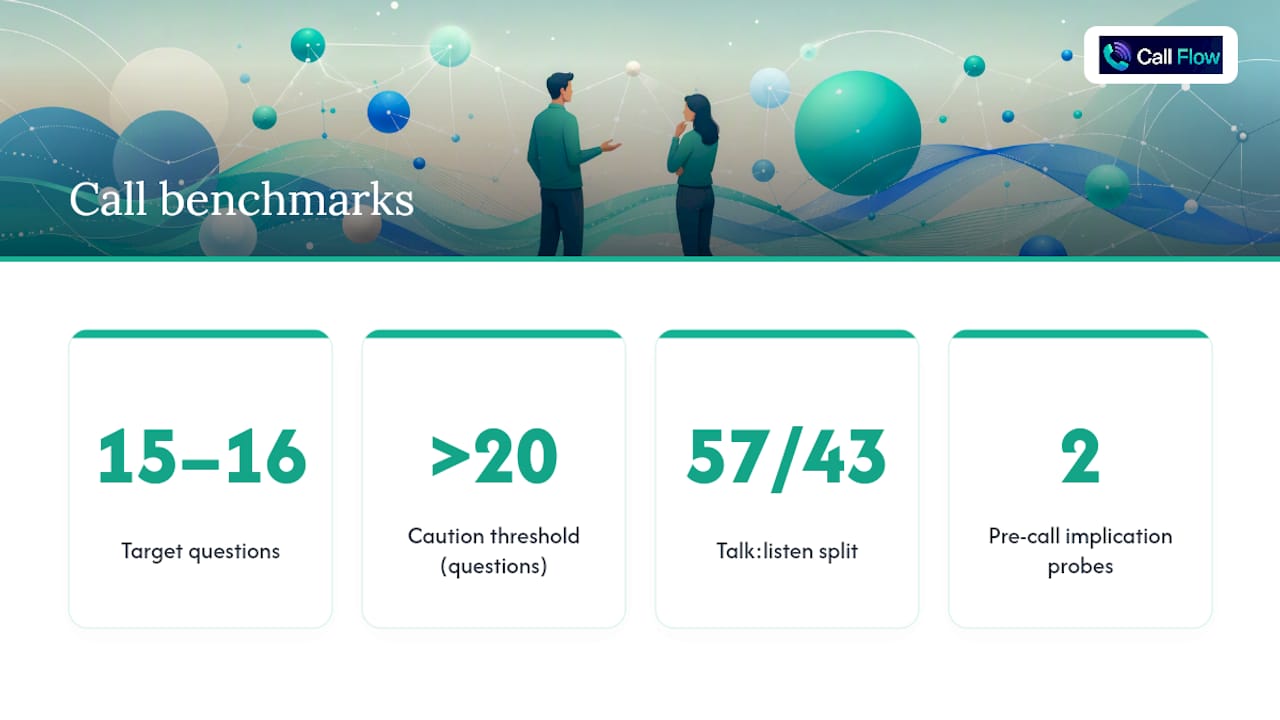
The data backs a lighter touch than most reps assume. An analysis of 326,000 sales calls found won deals average 15 to 16 questions total, while lost deals average around 20, and closed-won calls tend to run a talk-to-listen ratio favoring the buyer, approximately 57/43, according to Prospeo's call-data analysis. Lost calls tend to have a talk-to-listen ratio where the rep talks more, roughly 62/38.
The number that should change your call prep: more questions don't win more deals. The reps who close consistently ask fewer, sharper probes and then listen through the answer instead of loading the next question.
That's a hard habit to unlearn if you were trained to fill every silence with your next line.
The 5 Types of Probing Questions Every Rep Should Know
Not all probes do the same job. Matching the type to the moment is what separates a natural conversation from a checklist read aloud.
Open-ended probes invite a narrative rather than a fact. They work best early in discovery, once a prospect has already given you a surface answer.
- "Tell me more about how that's been playing out for your team."
- "What does a typical week look like when that issue comes up?"
- "How did you end up handling it last time?"
Clarification probes nail down a specific detail that was implied but not stated.
- "When you say it's 'too slow,' what's the actual turnaround time you're seeing?"
- "Who signs off once the team agrees internally?"
Implication probes connect the problem to a cost, delay, or risk the prospect hasn't priced out loud. These are the hardest to ask well and the ones top performers rehearse instead of improvise, since Prospeo's analysis shows this is where reps most often go generic or skip the question entirely.
- "If this stays unresolved through the next quarter, what does that cost the team?"
- "How does this ripple into other departments when it happens?"
Confirmation probes check that you and the prospect are working from the same facts before you move forward.
- "So the real blocker is approval timing, not budget. Is that fair?"
- "Sounds like the priority is fixing this before renewal season. Did I get that right?"
Nudging and silence probes are the simplest and most underused. Say "Tell me more" or "Go on," then stop talking. A two to three second pause after a probe consistently pulls out extra detail the prospect wouldn't have volunteered, per Harvard's Program on Negotiation.
How to Ask Probing Questions Without Sounding Like an Interrogation
Delivery matters as much as the question itself. The same probe, asked with no setup, lands very differently than one framed with context first.
Give context before you ask. Negotiation researchers at Harvard's Program on Negotiation find that framing a question as collaborative, and explaining briefly why you're asking, lowers suspicion and gets more candid answers than firing the question cold, according to PON's negotiation guidance.
Swap "why" for "what" and "how" wherever you can. "Why" tends to sound accusatory, even when you don't intend it that way, according to Harvard Business Review's research on smarter questioning. Compare the two:
- Instead of: "Why hasn't this been fixed yet?" Try: "What's gotten in the way of fixing this so far?"
- Instead of: "Why do you need three approvals?" Try: "How does the approval process usually work on deals like this?"
Do:
- Pause 2 to 3 seconds after every probe before saying anything else.
- Ask one probe, then let the answer run before adding a second question.
- Watch for a prospect leaning in or speeding up. That's usually a sign to keep listening, not to jump in.
Don't:
- Stack two or three questions in one breath.
- Ask something you could have answered yourself with five minutes of research.
- Fill a pause just because it feels awkward.
Tone matters too. A flat, rapid-fire delivery reads as a script even when the words are right; slowing down and lowering your pitch slightly on the actual question signals genuine curiosity. Callflow's guide on active listening techniques covers how nonverbal pacing changes the way probes land, and the coaching notes on active listening for sales calls walk through similar cues worth watching for on video calls.
Pro Tip: *Track your own talk time on your next three calls.
Which Frameworks Guide Probing, and What Should You Measure?
SPIN and MEDDPICC handle probing differently, and knowing which one fits the deal in front of you saves a lot of wasted questions.
SPIN maps probes to four stages: Situation questions establish the facts, Problem questions surface pain, Implication questions connect that pain to cost or risk, and Need-payoff questions get the prospect to state the value out loud. Most reps handle Situation and Problem probes fine and stumble on Implication, which is exactly the stage Prospeo's data flags as the one worth planning in advance rather than improvising.
MEDDPICC works better for enterprise or multi-stakeholder deals, since it forces probes toward Metrics, Economic Buyer, Decision Criteria, Decision Process, Paper Process, Identified Pain, Champion, and Competition. Each element needs its own probe. "Who besides you touches this decision?" maps to Decision Process. "What's the metric this needs to move to justify the spend?" maps to Metrics.
Two benchmarks worth writing on a sticky note near your desk: aim for 15 to 16 total questions per call, and get uneasy past 20, since call-data across won and lost deals shows that's where outcomes start slipping. Target a 57/43 talk-to-listen split, prospect favored. And before the call, write down two implication probes you plan to ask.
Ready-to-Use Probing Questions by Sales Scenario
Different stages call for different probes. Here are compact, scenario-specific lists you can drop straight into a call script.
1. Discovery
Start light with open-ended probes, then move into implication once the prospect is talking freely.
- "Walk me through what prompted you to look into this now."
- "What have you already tried, and how did that go?"
- "If nothing changes here, what happens to the team six months from now?"
- "How is this showing up for other people on your team, not just you?"
- "What would 'solved' actually look like?"
2. Qualification
These probes surface budget, timeline, and decision-maker details without sounding like a checklist.
- "How does budget for something like this usually get allocated?"
- "What's driving the timeline you mentioned?"
- "Besides you, who else weighs in before this moves forward?"
- "What's happened on similar decisions in the past, timeline-wise?"
3. Objection Handling
The goal here is uncovering the real concern, which is often not the one stated first.
- "When you say the price is a concern, is it the number itself or how it compares to what you budgeted?"
- "What would need to be true for this to feel like an easy yes?"
- "Is there a tradeoff you're weighing that I'm not seeing?"
4. Negotiation
Keep these interest-focused rather than positional, so the prospect doesn't get defensive about a number.
- "What matters most to you in how this gets structured, beyond price?"
- "If we could solve for that, would the rest of this move forward?"
5. Follow-Up
Confirm timing, next steps, and permission to keep the conversation going.
- "What's the best way to check in without getting in the way of your process?"
- "Who should I loop in for the next conversation?"
- "Is it alright if I follow up with a summary of what we covered?"
Notice none of these read like a form. Every one assumes an answer already happened and pushes one layer deeper.
Why Probing Turns Into Interrogation (and How to Fix It)
Most rough probing isn't a phrasing problem. It's a sequencing and pacing problem.
Frontloading the checklist. Firing five qualification questions in the first three minutes feels efficient to the rep and exhausting to the prospect. Spread probes across the whole call instead of clearing them all upfront.
Leading and loaded questions. "Don't you think this would save you time?" isn't a probe, it's a pitch wearing a question mark. Rewrite it neutral: "How would saving time here change things for your team?"
Skipping silence. Jumping straight to your next question the instant a prospect stops talking kills the extra detail that a 2 to 3 second pause usually pulls out.
Asking what you could've found yourself. "What does your company do?" when the answer is on their homepage signals you didn't prep. Save probes for what research can't tell you.
- Rewrite: "Why is your close rate so low?" becomes "What's been the biggest sticking point in getting deals across the line?"
- Rewrite: "Don't you need this by year end?" becomes "What's driving your timeline for this?"
How to Practice Probing Questions With a Role-Play Drill
Reading a list of good questions doesn't make you good at asking them under pressure. That takes repetition with feedback, which is exactly what most sales floors skip.
Here's a 20-minute drill a manager can run with any two reps:
- Setup (2 minutes): Assign one rep as seller, one as a skeptical prospect with a specific, written objection.
- Round one (8 minutes): Seller runs discovery using at least two implication probes and one silence probe.
- Scoring (5 minutes): Manager or peer scores talk/listen ratio, number of implication probes used, and whether the seller paused after nudging probes.
- Feedback and rerun (5 minutes): Give one specific fix, then run the same scenario again immediately.
Score three things every time: talk/listen ratio, implication probes actually used (not just planned), and silence discipline. Immediate, structured feedback like this builds skill faster than a monthly coaching call, which is the logic behind role-play training with instant grading.
Teams using structured role-play with instant feedback report 147% faster ramp time and a 129% improvement in resolution rates, based on Callflow's platform data.
Run this drill weekly and track the same three scores across sessions. The trend line matters more than any single run.
Quick Checklist for Live Calls
Keep this near your screen during calls.
- Target 15 to 16 total questions, not more.
- Save implication probes for the middle of the call, once trust is built.
- If your talk time creeps past 50%, ask a probe and stop.
- Swap "why" for "what" or "how" every time.
- Pause 2 to 3 seconds after nudging probes.
- Confirm understanding before moving to the next topic.
| Metric | Target | Watch for |
|---|---|---|
| Questions per call | 15 to 16 | Past 20 signals overquestioning |
| Talk/listen ratio | 57/43 (prospect favored) | 62% rep talk time on lost calls |
| Silence after probe | 2 to 3 seconds | Filling the gap too early |
What Coaching Probes Actually Teaches You
The mistake I see most often isn't a bad question. It's a good question asked at the wrong moment, usually because the rep never rehearsed the pause that comes after it. Reps default to filling silence because silence feels like failure, when it's actually the moment doing the work.
What changes that habit isn't more scripts. It's immediate, specific feedback on the exact behavior, run enough times that the pause stops feeling unnatural. Score it, fix one thing, run it again. That loop is worth building into a weekly habit, not a once-a-quarter training day.
— Costa
Practice These Probes With Callflow
Reading a list of great probing questions and actually asking them under pressure, without rushing past the pause, are two different skills. Callflow closes that gap with realistic voice and text role-play scenarios that mimic a real discovery call, objection, or negotiation, then grades your delivery across five performance dimensions the moment the call ends.
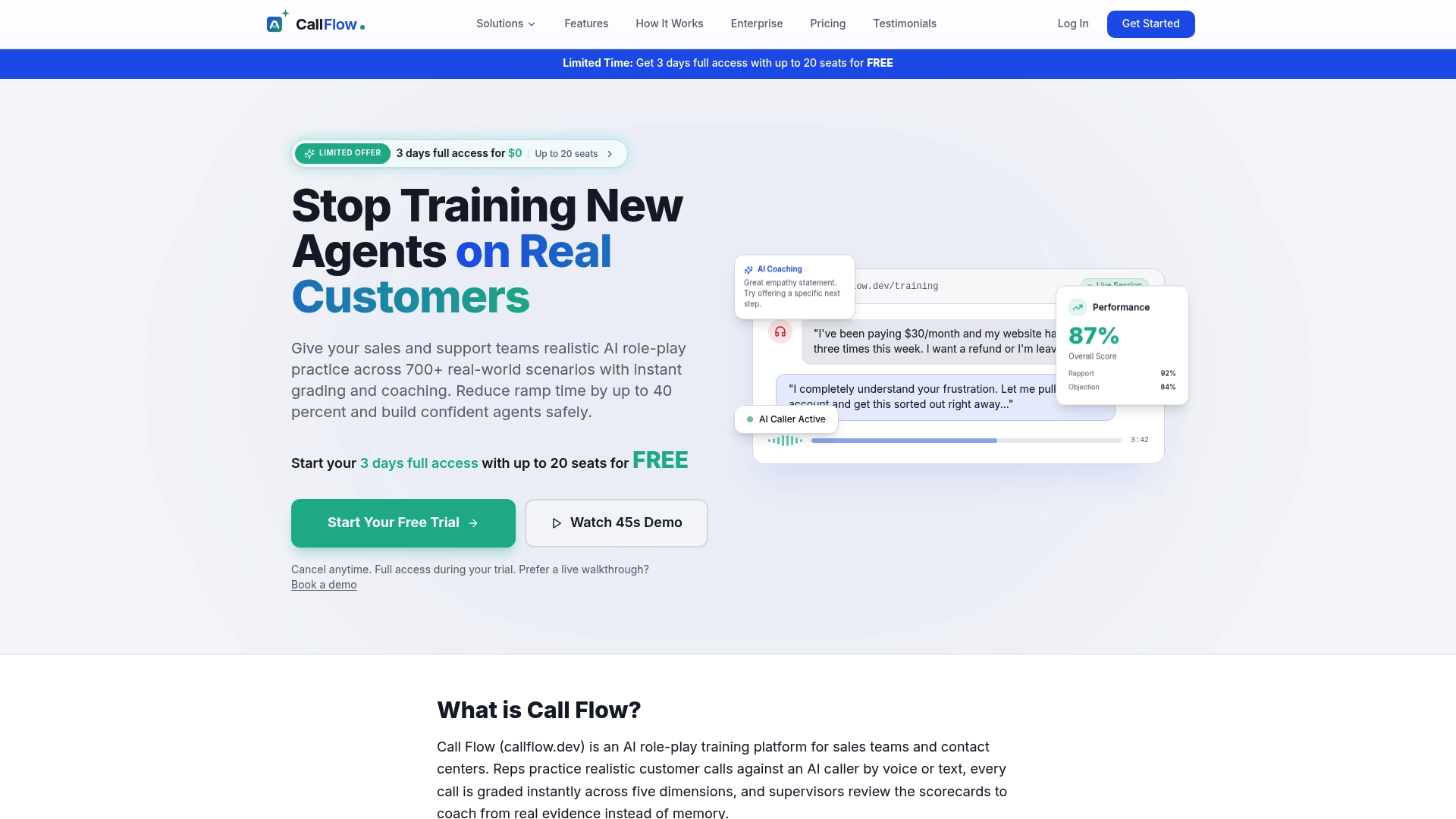
Instead of waiting for a manager's monthly review, reps get instant coaching on talk/listen ratio, question pacing, and whether they actually paused after a probe instead of rushing to fill it. Managers get a dashboard showing the same metrics across the whole team, which turns "ask better questions" from vague advice into something you can actually track session over session. The platform scales from a single rep to a full contact center floor, and every plan includes a risk-free trial period to test it on your own scenarios before committing. Start a free trial at Callflow and run your team's first scored role-play this week.
Sources
- Sales Probing Questions: 60+ Data-Backed Examples (2026)
- Negotiation Questions: How Asking Better Questions Leads to Better Deals - PON
- Probing questions: Definition, examples and 4 tips to use - Typeform
- The art of asking smarter questions - HBR