

Instant feedback training gives learners immediate, actionable information they can use to correct behavior now. The core method is simple: targeted, behavior-focused, frequent feedback cycles built on the SBI model and a strict actionability test. A 2020 randomized trial backs this approach, and platforms like Call Flow show how it scales across teams.
TL;DR:
- Instant feedback is most effective for beginner learners and highly specific skills, while delayed feedback can foster deeper understanding for complex tasks.
- Automated quizzes suit knowledge-based skills, whereas simulation grading addresses judgment-based behaviors like tone and pacing.
- Feedback should follow the SBI format and pass the actionability test, delivering clear, behavior-focused, and timely guidance.
- Frequent, small feedback sessions are better for habit formation, with early training requiring dense and immediate notes that taper as skills develop.
- Tools like Call Flow provide AI-driven, multi-dimension coaching that can accelerate ramp-up time and resolution rates in contact centers.
Table of Contents
- What instant feedback is and why the evidence supports it
- Types and examples of instant feedback used in training
- Design principles and best practices for effective instant feedback
- Tools and technical approaches for delivering feedback fast
- A stepwise plan for rolling out instant feedback training
- Measuring impact: metrics, timelines, and evidence collection
- How Call Flow puts multi-dimension instant feedback into practice
- When instant feedback helps most, and when delayed feedback wins
- Try Call Flow's instant feedback training platform
- Sources
- FAQ
What instant feedback is and why the evidence supports it
Instant feedback is information about a specific action, given right after that action happens, so the learner can adjust before moving on. It differs from praise, which is general and emotional. It differs from coaching, which is a longer conversation about goals. It differs from a performance review, which looks back over months. Instant feedback looks at one moment and tells the learner what to do differently next time.
A 2020 randomized controlled trial tested this directly. Researchers ran 243 high school math students through ASSISTments, comparing a mode with immediate computer feedback and hints against a practice-only mode. The immediate feedback group scored higher on the posttest, and the gain was larger for students who started with less prior knowledge. This matters for trainers: newer employees benefit most from tight feedback loops, while advanced performers may need less.
The randomized trial found immediate feedback improved posttest scores over practice-only conditions, with the biggest gains among low-prior-knowledge learners. That single result does not mean immediate is always better. A learning-science review found that delayed feedback sometimes produces stronger long-term transfer, even though students say they prefer getting feedback right away. The lesson is not "always instant." It's "instant for skill-building, delayed for deeper synthesis."
Good feedback, instant or not, shares a few traits. Practitioner guidance on the SBI model lists them clearly:
- It stays behavior-focused, not personality-focused.
- It stays non-evaluative, describing what happened rather than judging the person.
- It arrives close to the action, while the memory is fresh.
- It targets one specific skill or moment, not a general impression.
Types and examples of instant feedback used in training
Instant feedback shows up in four broad forms across training environments, and most programs end up blending them.
- Automated correctness and hints: Digital quizzes and drills flag a wrong answer immediately and offer a hint. A rep answering a product-knowledge quiz sees the correct answer the moment they submit, before moving to the next question.
- AI role-play and simulation grading: A simulated customer call gets scored across several dimensions right after the call ends. A trainee practicing an objection-handling scenario sees a score on tone, accuracy, and closing technique within seconds of hanging up.
- Instructor in-the-moment comments: A trainer sitting beside a new agent points out a missed compliance step during the call itself, not in a review the next week. A short, spoken note during a live shadow session counts as instant feedback if it happens while the behavior is still fresh.
- Peer and gamified signals: A leaderboard update or a peer's thumbs-up after a role-play round gives a quick signal without formal grading. A team chat that flags "fastest resolution today" right after a shift works the same way.
Dictionary and technology references note that instant feedback spans many modalities, from code editors to games to simulation software, and the common thread is a quick, direct response to an action. In training environments the choice between these types usually comes down to what skill is being built. Automated correctness suits knowledge checks. Simulation grading suits complex behaviors like tone and pacing. Instructor comments suit compliance and nuance. Peer and gamified signals suit motivation and consistency, not depth.
Design principles and best practices for effective instant feedback
Two frameworks turn instant feedback into something people actually use, instead of something they tune out.
The first is SBI: Situation, Behavior, Impact. Instead of saying "be more confident on calls," a manager using SBI says: "On the 2:15 call today (situation), you paused for eight seconds after the customer objected (behavior), and the customer started talking over you (impact)." Practitioner guidance on SBI feedback recommends this structure specifically because it removes judgment and gives the learner something concrete to picture.
The second is the actionability test. Before delivering any feedback, ask one question: can the learner name a clear next step from this? A gating checklist based on this test treats vague feedback as unfinished. "Good job" fails the test. "Next call, wait three seconds after an objection before responding" passes it.
A short sequence keeps both frameworks working in daily practice:
- Capture the moment right after it happens, using notes or a recording.
- Write the feedback in SBI format before delivering it.
- Run the actionability test and rewrite until it passes.
- Deliver the feedback within the same shift or session.
- Confirm the learner can repeat the next step back to you.
Frequency matters as much as structure. Too little feedback wastes the method. Too much creates fatigue and makes each note feel less important. Practitioner guidance on manager training recommends small, frequent, behavior-focused notes over long, infrequent sessions, since regular practice is what actually builds the habit on both sides.
Scaffolding also matters. Early in training, feedback should be dense and immediate, almost after every attempt. As the learner improves, space it out and shift some of it to delayed review, so the learner starts self-correcting instead of waiting for a note. This fading approach protects long-term transfer while still using instant feedback where it helps most.
Pro Tip: Write the feedback sentence before the call ends if you can. Waiting until later almost always softens the behavior detail out of it.
Tools and technical approaches for delivering feedback fast
Choosing the right tool depends on what behavior you're trying to change, not on which platform has the most features.
- Quiz and knowledge-check engines grade objective answers instantly and work well for product knowledge, compliance rules, and scripted steps.
- Simulation and role-play platforms score subjective, multipart behaviors like tone, pacing, and objection handling right after a practice call ends.
- Microlearning apps deliver short prompts and quick checks between work sessions, useful for reinforcing a single skill without a full training block.
- Supervisor dashboards aggregate scores across a team so a manager can spot a pattern, like a whole cohort struggling with the same objection, and address it before it becomes habit.
Simple automated quizzes make sense when the skill has one right answer: a compliance disclosure, a product spec, a required greeting. Simulation platforms make sense when the skill is judgment-based and hard to score with a single correct answer, like de-escalating an angry customer. Trying to force a judgment-based skill into a simple quiz format usually produces feedback that fails the actionability test, because there's no single "correct" behavior to check against.
Enterprise teams also need to think about integration and privacy before rolling out any tool. Call recordings and performance scores often contain personal data, so training platforms should fit inside existing data-handling policies rather than create a separate, unmanaged pool of recordings. A tool that connects to the systems trainers already use, like a learning management system or a CRM, cuts down on duplicate data entry and keeps scores in one place managers actually check. Related feedback-loop practices from the broader software world apply here too: a feedback loop only works if the data flows back to the person who can act on it, quickly and in one place.
A stepwise plan for rolling out instant feedback training
A pilot program can run in a matter of weeks if the scope stays narrow.
- Pick one team and one skill. Choose a group small enough to manage closely and a single behavior, like objection handling, to measure cleanly.
- Record a baseline. Score a handful of calls or exercises before any change, using whatever scale you plan to use going forward.
- Build SBI templates. Write three or four example notes in advance so trainers aren't improvising the structure under time pressure.
- Train the trainers first. Have managers practice writing feedback on recorded calls and get their drafts reviewed before they deliver anything live, since manager training built on role-play and repeated practice produces better feedback skills than a single workshop.
- Calibrate scoring. Have two managers score the same call independently and compare, adjusting the rubric until their scores land close together.
- Run short cycles. Deliver feedback after every attempt for the first week, then start spacing it out as scores stabilize.
- Set a scale threshold. Decide in advance how many calls or reps justify moving from manual review to an automated or simulation-based system, since manual review doesn't scale past a certain team size.
Staffing is the usual bottleneck. One manager can give detailed, timely feedback to a handful of reps. Beyond that, either add reviewers or shift part of the load to automated grading for the more repetitive, checkable parts of the skill.
Measuring impact: metrics, timelines, and evidence collection
Instant feedback training needs a small, consistent set of numbers, tracked the same way every cycle.
| Metric | What it shows | Typical measurement point |
|---|---|---|
| Accuracy or score on target skill | Whether the specific behavior is improving | Weekly, per rep |
| Time to proficiency | How fast a new hire reaches a set score threshold | From hire date to threshold |
| Retention of skill | Whether gains hold after feedback frequency drops | 30 days after peak feedback frequency |
| First-call resolution (FCR) | Business impact of the skill on real calls | Monthly, team-level |
| Customer satisfaction (CSAT) | Whether the skill change reaches the customer | Monthly, team-level |
Three measurement designs work well without requiring a research team. A pre and post comparison scores the same group before and after a feedback change. A randomized pilot splits a larger team into two groups, one getting the new feedback cadence and one continuing as before, so you can see the difference without other variables shifting at the same time. A within-subject counterbalanced design has the same reps alternate between conditions across weeks, which controls for individual skill differences.
A simple reporting cadence keeps this manageable: a weekly scorecard per rep, a monthly rollup per team, and a quarterly check against the business metrics like FCR and CSAT. Tie the timeline to the skill: simulation-based training tied to ramp time usually shows movement within the first few weeks, since ramp is a short-term metric by design, while retention and CSAT need a longer window to read clearly.

How Call Flow puts multi-dimension instant feedback into practice
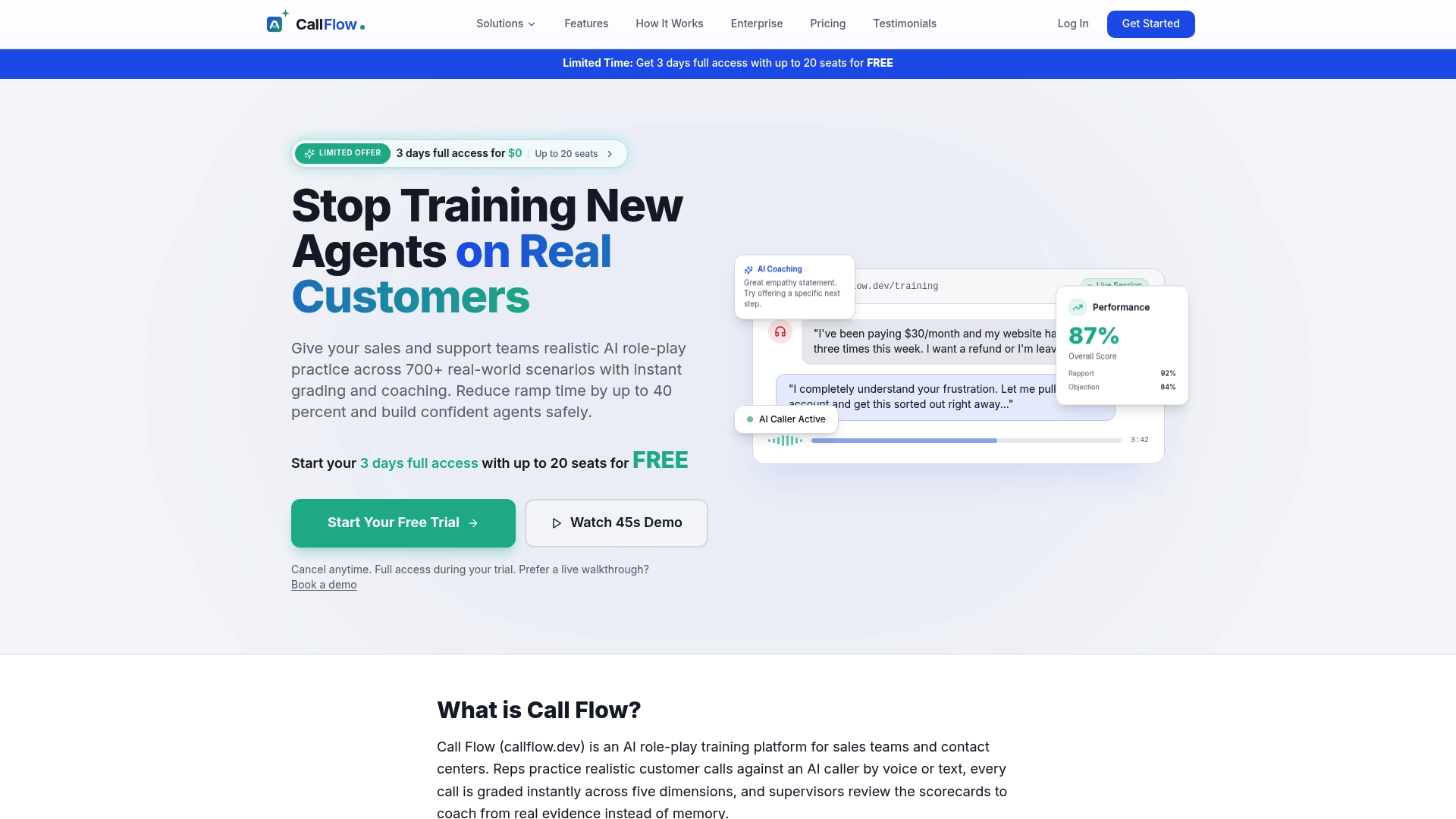
Call Flow is an AI role-play platform built for sales and contact center teams. Agents run practice calls against configurable scenarios, and the system grades each attempt across five performance dimensions right after the call ends, then delivers coaching notes on what to fix next.
- Voice and text simulation modes let teams practice the format their reps actually use on the job.
- Supervisor dashboards let managers review and override AI scores, keeping a human check on the automated grading.
- A large scenario library covers both sales and support conversations, so teams don't need to build every drill from scratch.
Call Flow states that teams using the platform have seen 147% faster ramp time and a 129% improvement in resolution rates, figures the company reports from its own customer data rather than an independent study. A role-play platform like this fits teams running enough call volume that manual review can't keep pace. Smaller teams or single-skill fixes may do fine with a simpler automated quiz loop instead.
When instant feedback helps most, and when delayed feedback wins
Instant feedback earns its place in drills: repetitive, narrow skills where the learner needs to correct a habit fast, like a script step or a tone slip. Delayed feedback earns its place in synthesis: tasks that ask a learner to combine several skills into judgment, where the learning-science evidence shows a pause before feedback sometimes produces stronger long-term transfer.
A practical mix looks like this: instant grading after each practice call during onboarding, then a delayed, weekly review once a rep is handling live calls independently. The nuance isn't a contradiction. It's a reminder that timing is a design choice, not a fixed rule, and the choice should follow the type of skill being built.
— Costa
Try Call Flow's instant feedback training platform
Call Flow gives sales and contact center teams instant, multi-dimension grading on practice calls, without months of setup or a long-term contract to start. Teams get full access during a risk-free trial, so a manager can test the actionability of the feedback before committing.
- Plans run from a low monthly starting price to higher monthly starting prices, billed monthly or annually.
- Business and Enterprise plans are available for larger teams, priced on request.
Check current plans and start a trial at Callflow.
Sources
- Effect of Immediate Feedback on Math Achievement at the High School Level
- Delayed and Immediate Feedback in the Classroom: The Results Aren’t What Students Think!
- Importance of SBI when giving feedback in workplace
- Most Manager Training Doesn’t Improve Feedback Quality. Here’s What Does.
FAQ
What does "instant feedback" mean?
Instant feedback means information about a specific action, delivered right after that action happens, so the learner can correct it before repeating the mistake. It differs from praise or a performance review because it targets one behavior in the moment rather than a general impression over time.
What are the three C's of good feedback?
Definitions vary across sources, but a common version calls for feedback to be clear, concise, and constructive. In practice this overlaps heavily with the SBI model covered above: describe the situation, behavior, and impact without judgment.
What are the five R's of feedback?
There is no single, widely agreed definition of the "five R's" in the sourced research here, so treat any list you find under that name with caution. The behavior-focused principles covered in this guide, timely, specific, actionable, and non-evaluative, cover the same ground regardless of the label used.
How do I know if feedback is actionable enough?
Ask whether the learner can state a clear next step immediately after hearing it. This actionability test treats any feedback that doesn't produce a next step as unfinished, no matter how detailed it sounds.
Does immediate feedback always work better than delayed feedback?
No. A 2020 randomized trial found immediate feedback improved posttest scores, especially for learners with less prior knowledge, but a separate learning-science review found delayed feedback sometimes produces better long-term transfer. The right choice depends on whether you're building a narrow skill or a synthesized judgment call.