

Gamified sales onboarding works when the game rewards real call skills, not clicks. Points, levels and leaderboards are the wrapper. The core is repeated practice on realistic customer conversations, with instant feedback and a score the new hire can beat next time. Callflow is built around that core: AI role-play with instant grading, so every new rep gets reps, feedback and a visible score from week one.
This guide is for sales managers, contact center leaders, training directors, HR teams and team leaders. It shows how to build a gamified onboarding program, what to reward, what to measure and what to avoid.
TL;DR
- Gamified onboarding uses game mechanics, such as points, levels, quizzes and leaderboards, to move new hires through training and toward full productivity.
- Reward the skill you want, not module completion. Rewarding completion alone rewards clicking, not learning.
- Put realistic role-play at the center. Practice on simulated calls is the game that changes how reps perform on live calls.
- Track competency, first-call resolution, customer satisfaction and early attrition against your own baseline.
- Keep rules visible and fair, and tie scores to growth, not only to ranking.
Table of Contents
- What gamified sales onboarding is
- Why most gamified programs fall short
- How to build a gamified onboarding program, step by step
- What to measure
- Keep the program fair and focused on learning
- Start gamified onboarding with Callflow
- Our view on gamified onboarding
- FAQ
- Sources
What gamified sales onboarding is
Gamified onboarding takes the usual new-hire tasks and adds game mechanics. A new rep earns points for finishing a task. They unlock a level by passing a quiz. They see where they stand on a board. They get another try when they miss.
The goal is not fun for its own sake. The goal is to get new reps to the behaviors that matter faster: knowing the product, handling objections, following compliance rules, using the CRM and staying calm on a hard call.
One academic case study looked at gamified onboarding from the new hire's side. Participants in the Association for Information Systems case study preferred levels and quiz-style games, and most reported more engagement and motivation than in their earlier onboarding. They also named quizzes, videos, leaderboards and progress through levels as features to prioritize, partly so they could check their own learning progress. The study reports how participants felt. It does not prove a business result, so treat it as a design guide, not a promise.
For you, the lesson is practical. New hires want to see progress and know where they stand. Game mechanics give them both.
Why most gamified programs fall short
The common failure is simple. The program rewards the wrong thing.
A research paper on the unintended consequences of gamification warns that rewarding module completion alone can reward clicking through content rather than learning it. It recommends measuring learning, for example with post-tests after modules, and aligning the game design with the training objectives. It also notes that game elements can distract from the training itself.
Three rules follow.
- Reward outcomes, not activity. A badge for finishing a video says little. A badge for scoring above a set mark on a simulated objection call says a lot.
- Match every game element to a training goal. If a leaderboard does not push a skill you care about, drop it.
- Check acceptance. Ask new hires whether the game helps them. If they feel it is a gimmick, change it.
How to build a gamified onboarding program, step by step
Step 1: Define what full competency means
Start with the end state. Write down what a ramped rep can do. Keep the list short and testable.
A useful list covers product knowledge, the systems and tools your team uses, communication and listening, call handling, and regulatory and compliance requirements. These are the areas a Florida Blue onboarding case study published by ATD used as its goals. It paired them with knowledge assessments, performance gates, weekly individual goals and performance data to track improvement.
Where it goes wrong: vague goals such as be confident on calls. A game cannot score confidence. It can score whether a rep handled a pricing objection, stayed within compliance language and confirmed next steps.
What Callflow does here: it grades each practice call across five performance dimensions, so your goals turn into scores from the first session.
Step 2: Build gates, not just points
A gate is a pass mark a new hire must reach before moving on. It turns a game level into a real checkpoint.
The Florida Blue program is a good example of structure. Its training included instructor-led sessions, virtual classes, e-learning, call observation and role-play, with performance gates that required trainees to pass knowledge assessments before advancing.
Set one gate per stage. For example:
- Week 1: product and policy quiz.
- Week 2: a scored role-play on the most common call type.
- Week 3: a scored role-play on the hardest common objection.
- Week 4: supervised live calls.
Where it goes wrong: gates that managers score differently. One manager passes a call and another fails the same call. Calibrate scoring against your existing QA standards before launch. Callflow offers calibration-aligned scoring that matches existing QA standards, plus supervisor review and override, so a manager can adjust a grade when needed.
Step 3: Make role-play the main game
Quizzes test what a rep knows. Role-play tests what a rep can do. Selling and service are spoken skills, so the game should be spoken or typed practice on a realistic conversation.
The reasons are simple. A rep can replay a call many times. A rep can fail without a real customer on the line. A rep can see a score and try again right away.
A Spring Venture Group case study from 2025 describes the shift in training design: lecture time of 3 to 5 hours per session was replaced with interactive activities, including small-group discussion and scenario role-play. The direction is the same. Less listening, more doing.
Human role-play has limits you know well. It needs a partner, a manager's time and a quiet room. It is hard to repeat the same scenario ten times. Callflow runs the practice as AI role-play with voice and text modes, so a new hire can run a scenario at any hour. You choose from a large library of sales and support scenarios or build your own with custom scenario tools.
Where it goes wrong: scenarios that are too easy or too generic. Build them from your real calls: your top five objections, your most common complaint, your hardest escalation.

Step 4: Give feedback at once
Feedback delayed by a week teaches little. A new hire has already forgotten the call.
Instant grading closes that gap. In Callflow, each practice call is graded right away across five performance dimensions, with coaching feedback that says what to fix. The rep sees what went well and what to change, then runs the scenario again.
This is the loop that makes the game work: attempt, score, fix, retry. It also matches a simple tip from onboarding practitioners: when a new hire gets something wrong, set a goal and give another chance, perhaps with minor changes to the task.

Step 5: Add levels, streaks and a fair leaderboard
Now add the game layer. Keep it light.
- Levels. Unlock harder scenarios as a rep clears gates. This follows what participants in the academic case study preferred.
- Streaks and badges. Reward repeat practice and real improvement, such as raising a score from one attempt to the next.
- Leaderboards. Use them with care. Rank improvement, not only raw score, so a hire who started low can still win. Show rules and rankings openly, not in a manager-only spreadsheet.
Where it goes wrong: a board that always shows the same top three names. New hires at the bottom stop trying. Add a progress board, such as most improved this week, next to the total board.
Callflow includes gamification features alongside its grading and supervisor dashboards, so the game layer sits on top of real skill scores.
Step 6: Link practice to live calls
The game is not the end point. It prepares reps for real customers.
Florida Blue added a four-week nesting period. New hires handled live calls and received just-in-time coaching after each call. Use the same idea. After a rep clears the role-play gates, move them to live calls with a coach who reviews each one. Bring the weak spots back into the next role-play.
For a deeper plan on this stage, see our guide to real-time call coaching in a pilot and our call center coaching plan template.
Step 7: Review the data every week
A supervisor dashboard turns scores into decisions. Look for three things each week:
- Who has not practiced. Low activity in week one predicts trouble.
- Which scenario has the lowest average score. That is a gap in your training, not only in your reps.
- Which dimension is weakest across the cohort. Train it live in your next team session.
Callflow gives supervisors dashboards and skill analytics, so team leaders can track performance without building reports by hand.
What to measure
A game that cannot show results will lose budget. Pick a small set of numbers before launch and record your baseline.
| Metric | What it tells you | How to use it |
|---|---|---|
| Time to full competency | How fast reps ramp | Compare cohorts before and after the program |
| First-call resolution | Whether reps solve the issue | Track by week of tenure |
| Customer satisfaction | Whether callers feel helped | Track by new hire and by cohort |
| Practice score trend | Whether skill is rising | Compare first and latest attempt per scenario |
| Attrition in training | Whether hires stay | Compare against your prior cohorts |
Two published examples show the type of numbers to track. They describe other companies and other programs, so use them as a template for your metrics, not as a forecast for your team.
- In the ATD report, the earlier Florida Blue program took 12 weeks, and agents typically needed six to nine months to reach full competency. For the redesigned program, the report states that 86% reached full competency within 60 days, with a 93% customer highly satisfied rate and 77% first-time call resolution.
- A 2025 Spring Venture Group case study reports that average new-agent sales in the first three months rose from 16.9 policies per month in 2022 to 27.0 in 2024, and that attrition during training fell from about 8% in 2021 to 1% in 2024.
Your own baseline is the benchmark that counts. Measure your last two or three cohorts first. Then compare.
For a 30, 60 and 90 day structure around these numbers, read our manager's playbook to shorten sales onboarding. For the results we see from simulation-based practice, read our guide to simulation learning.
Keep the program fair and focused on learning
Games can help or backfire. These habits keep them healthy.
Be open about the rules. Every new hire should know how points are earned, what a pass mark is and how rankings work.
Tie the game to growth. Frame scores as a path to full competency and a stronger career, not only a contest. A short contest with no link to development feels like a gimmick.
Reward the right behaviors. Include early concrete actions, such as completing required security or ethics training and using the CRM correctly, as well as call skills.
Let people retry. Practice should feel safe. A low score on a simulated call costs nothing, and that is the point.
Ask for feedback. After two weeks, ask new hires which parts help and which feel like noise. Remove the noise.
Keep human judgment in the loop. Scores guide coaching. Managers decide. Callflow supports supervisor review and override for this reason.
Start gamified onboarding with Callflow
Callflow is an AI role-play training platform for sales teams and contact centers. It gives new hires realistic practice calls, instant grading across five performance dimensions, coaching feedback, voice and text modes, supervisor dashboards and gamification, all in one place.
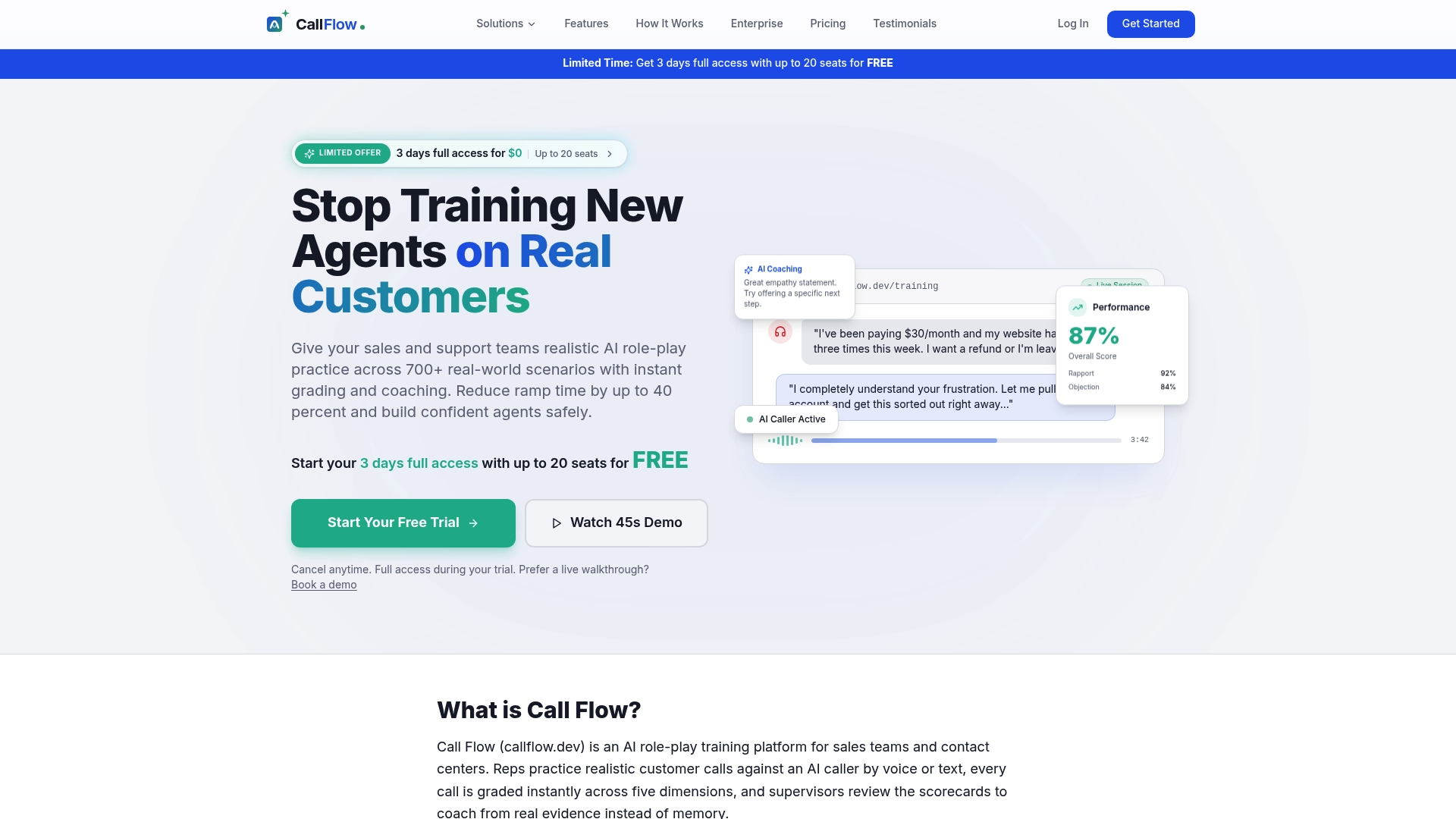
Pricing is flat and published. Plans on the pricing page are Starter at $7.42 per month or $89 per year, Growth at $14.92 per month or $179 per year, and Scale at $33.25 per month or $399 per year. Larger teams can look at the Business and Enterprise plans. Onboarding is self-serve, and the free trial includes all features, so you can run a first scenario with your own team before you commit. You can also see the whole platform at callflow.dev.
Our view on gamified onboarding
Most teams start with the wrong question. They ask which badge to give. We ask which skill the badge proves.
A leaderboard is easy to build. A fair score is harder. That is why we built Callflow around grading first. Every practice call gets an instant score across five dimensions and coaching on what to change. The game layer sits on top of that score.
New hires do not need more content. They need more reps with feedback. Role-play gives them that, and a retry button makes it safe. Managers get dashboards that show who is improving and where the team is weak, and they can review and override a grade when their judgment differs.
Our results point the same way. Teams using our platform have seen 147% faster ramp time and a 129% improvement in resolution rates. Your numbers will depend on your baseline, so measure it first.
Start small. Pick one call type, one gate and one weekly review. Add more once the first loop works.
Costa
FAQ
What is gamified sales onboarding?
It is onboarding that uses game mechanics, such as points, levels, quizzes, leaderboards and retries, to guide new sales or service reps through training. The best programs tie each mechanic to a call skill. Practice on realistic scenarios with instant scores is the strongest version.
How long should a gamified onboarding program run?
Match it to your ramp goal. Many teams use a structure of 30, 60 and 90 days, with a pass mark at each stage and live calls with coaching near the end of the first month. Review your cohort data after each run and adjust the length.
What should we reward in a gamified program?
Reward the outcome you want. Good choices are passing a scored role-play, improving a score between attempts, using the CRM correctly and finishing required compliance training. Avoid rewarding module completion alone, since it can reward clicking rather than learning.
How do we keep competition from discouraging new hires?
Publish the rules, rank improvement as well as total score, and let reps retry. Link the contests to long-term development. Ask new hires for feedback in the first two weeks and change what does not help.
Which metrics show that gamified onboarding works?
Track time to full competency, first-call resolution, customer satisfaction, practice score trends and attrition during training. Set your baseline from earlier cohorts, then compare each new cohort against it.
Sources
- The Use of Gamification to Increase Engagement and Other Outcomes in Onboarding (Association for Information Systems, 2020)
- How to Avoid the Dark Side of Gamification: Ten Business Scenarios and Their Unintended Consequences
- Florida Blue: Improving Business With Onboarding (ATD)