

Chat simulation training works when you build it on scaffolded scenarios and measure results against objective proficiency benchmarks, not just completion rates. The evidence points to lower learner anxiety and measurable skill gains when training follows this structure. The practical next step: run a short pilot with one or two KPIs before you commit to a full rollout.
TL;DR:
- Focusing on measurable proficiency benchmarks rather than scenario volume leads to better skill development and lower learner anxiety.
- A pilot should target one or two KPIs, such as ramp time or first-contact resolution, and last no longer than eight weeks for effective results.
- Designing scaffolded scenarios with clear expected outcomes, mock data, and staged reflection improves learning and evaluates skill range.
- A small, well-structured pilot with a representative cohort is more likely to secure funding than a broad, unmeasured rollout.
- Call Flow's platform supports the outlined approach with instant feedback, proficiency tracking, and a risk-free trial to test scenario creation and reporting.
Table of Contents
- What is chat simulation training and how does it differ from other formats?
- Why scaffolding and proficiency benchmarks matter more than exposure
- How to run a focused pilot for chat simulation training
- Designing effective chat scenarios and scaffolding: templates and examples
- Measurement: KPIs and objective metrics for chat simulation success
- What training leaders should expect from a chat simulation rollout
- Getting started with Call Flow for your pilot
- FAQ
- Sources
What is chat simulation training and how does it differ from other formats?
Chat simulation training places an agent inside a realistic, text-based customer interaction and scores their responses against a defined standard. It usually runs in one of three modes: synchronous chat (real-time back-and-forth), asynchronous messaging (delayed-response threads, closer to email or ticket queues), or scripted text-based role play where a trainer or AI plays the customer.
Most chat simulators use branching scenarios. A customer profile sets the tone (frustrated, confused, price-sensitive), and the agent's response determines which path the conversation takes next. This differs from voice role play, where tone and pacing carry weight, and from static text case studies, where the learner reads a transcript instead of acting inside one.
Chat simulation fits two distinct uses:
- Onboarding: New agents practice common scenarios before they touch a live queue.
- Ongoing coaching: Tenured agents work through edge cases like escalations or policy exceptions that rarely show up often enough in real queues to build confidence.
Both uses depend on the same mechanic: the scenario has to branch, and the branching has to reflect what a real customer would actually say back.
Why scaffolding and proficiency benchmarks matter more than exposure
Giving an agent more scenarios doesn't automatically make them better. What matters is how those scenarios are structured and how success gets measured.
A 2026 study on communication skills training with three-stage scaffolding tested interactive contextual conversation videos against static text case studies with 63 adult learners. The scaffolded group, who worked through a structured before, during, and after framework, showed significantly higher flow and lower anxiety than the control group reading flat transcripts. The staging mattered as much as the content.
A randomized trial on proficiency-based progression found that a substantially higher proportion of learners using PBP reached proficiency in communication tasks compared with those using e-learning or standard simulation. That's a wide gap, and it comes from one design choice: PBP sets a measurable pass or fail bar before a learner advances, rather than counting exposure or time spent as progress. The BMJ Open trial backs this with a controlled comparison, not a self-reported survey.
The practical takeaway for training managers: don't design chat simulations around how many scenarios an agent completes. Design them around a defined proficiency bar, and don't let anyone advance until they clear it. Volume without a benchmark produces practice. A benchmark produces proof.

How to run a focused pilot for chat simulation training
A pilot doesn't need to be large to be useful. It needs a clear goal, a baseline, and a short enough window that you can act on the results.
- Set one goal and pick one or two KPIs. Ramp time, first-contact resolution, and QA pass rate are the three most common choices; picking more than two dilutes the signal.
- Choose a representative cohort. Ten to twenty agents across tenure levels gives you a baseline without needing a large sample.
- Capture a baseline before any training starts. Pull the last four to eight weeks of the same KPI from your existing QA or performance data.
- Build four to eight scaffolded scenarios. Use mock customer values, a clear expected outcome for each, and tag them by skill (de-escalation, troubleshooting, upsell).
- Run the pilot for one to eight weeks. Use instant grading so agents get feedback the same day they practice, and collect short qualitative comments after each session.
- Compare pre and post metrics. If the KPI moved in the right direction, scale the scenario set. If it didn't, check whether the scenarios were too easy, too hard, or poorly matched to the KPI you picked.
Pro Tip: Keep the pilot's scope small enough that one person can own it end to end. A pilot that needs a committee to interpret rarely gets acted on.
Designing effective chat scenarios and scaffolding: templates and examples
Four scenario types cover most contact center and sales needs: billing disputes, troubleshooting, upsell conversations, and escalation or de-escalation. Each one tests a different skill, so mixing all four into a scenario set gives a fuller picture of an agent's range than repeating one type.
The scaffolding pattern that the Springer study found effective runs in three stages: before (a short brief with context and conceptual cues), during (branching decision points with prompts that guide without scripting the exact answer), and after (a reflection step paired with coach feedback).
A usable scenario template needs these fields:
- Name and background: what the customer wants and why.
- Initial prompt: the opening line the agent responds to.
- Expected outcome: the resolution that counts as a pass.
- Mock values: account numbers, order details, or pricing the agent needs to reference.
- Tags: skill area and difficulty level for sorting later.
For trainers who want a starting set rather than building from a blank page, 16 copy-ready customer service role play scenarios cover billing, troubleshooting, and escalation cases that can be adapted by swapping in your own product names and policy details.
Measurement: KPIs and objective metrics for chat simulation success
Three KPIs tell you most of what you need: ramp time reduction, first-contact resolution, and QA scores tied to a proficiency rubric rather than a subjective checklist.
From the simulator itself, capture:
- Pass rate per scenario, so you know which scenarios are too easy or too hard.
- Average proficiency score across the cohort, tracked over time.
- Automated resolution estimate, a proxy for how the scenario would likely play out in a live queue.
Watch operational signals too: completion rates, engagement or flow indicators during the session, and learner-reported anxiety after it. A randomized trial found that proficiency-based progression training produced a substantially higher proficiency rate than e-learning or standard simulation, a gap wide enough to justify setting a hard pass bar rather than a soft one. Set your benchmark before the pilot starts, and use instant grading to shorten the loop between a mistake and the correction, since same-day feedback is what the agent performance dashboard guidance points to as the difference between a scenario that sticks and one that gets forgotten by the next shift.
What training leaders should expect from a chat simulation rollout
A short pilot won't fix ramp time in a week, but it will tell you within a few weeks whether the scenario design and benchmark are working. The most common pitfall isn't the technology, it's weak scenarios: no clear expected outcome, no baseline to compare against, or scaffolding skipped in favor of just throwing agents into a chat window.
Keep the pilot narrow. Use mock data instead of live customer information, calibrate your QA rubric against the same standard your live floor uses, and resist the urge to test ten KPIs at once. A small, well-measured pilot earns the budget for a larger rollout. A sprawling one usually gets quietly shelved.
— Costa
Getting started with Call Flow for your pilot
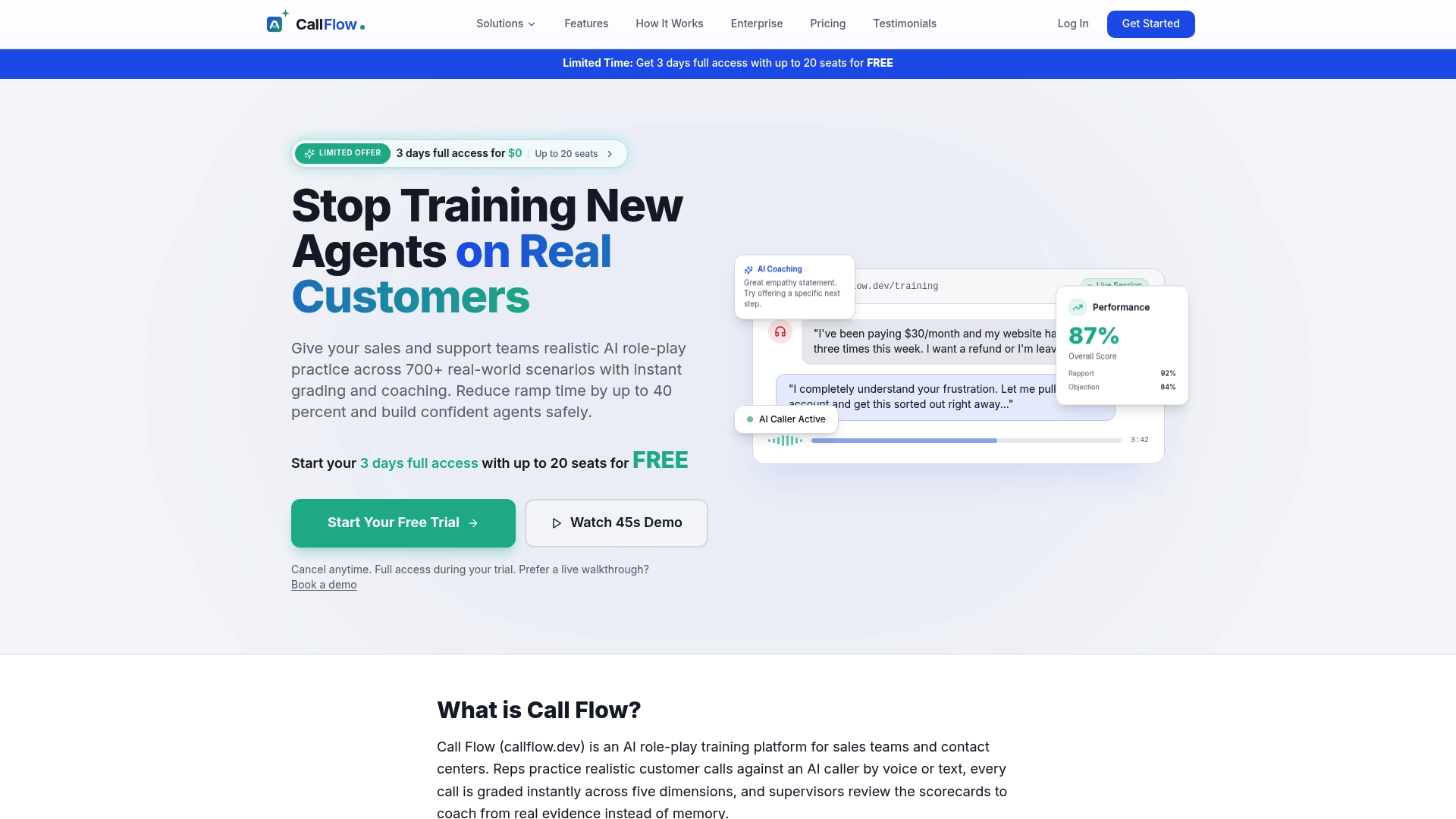
Everything above, scaffolded scenarios, proficiency benchmarks, instant feedback, maps directly onto what Call Flow is built to run. The platform provides AI role play across text and voice modes, grades each session across five performance dimensions instantly, and gives supervisors a dashboard to track proficiency scores against a baseline, which is the exact setup the pilot plan above calls for.
A risk-free trial gives full access, so you can run the pilot we outlined without a separate purchase decision first. During the trial, test:
- Scenario creation, using your own mock values and expected outcomes.
- Instant feedback, checking how fast coaching reaches the agent after a session.
- Reporting, confirming the dashboard shows the KPI you picked for your pilot.
Plans start at $7.42 a month for Starter, with Growth and Scale tiers available as a cohort grows, and Business and Enterprise options available on request for larger teams through the enterprise page.
FAQ
What are some examples of simulation training?
Common examples include chat-based customer service role play, voice call simulations for sales, and branching scenario exercises for de-escalation or troubleshooting. Each type places a learner inside a realistic interaction and scores their response against a defined outcome rather than just testing recall.
What is a simulation training method?
A simulation training method places a learner inside a realistic scenario, often with a customer profile and mock data, and evaluates their decisions against a defined standard. The proficiency-based progression method is one well-studied approach: it requires a learner to meet a measurable pass bar before advancing, rather than counting hours or repetitions as progress.
How can I learn simulation?
Most people learn simulation-based skills by practicing inside a structured scenario with clear before, during, and after stages, then reviewing feedback on what they did well and where they fell short. Starting with a small set of scenarios tied to one or two measurable goals makes the learning process easier to track than open-ended practice.
How long should a chat simulation training pilot run?
A pilot can run anywhere from one to eight weeks, depending on how quickly your team can gather a baseline and complete enough sessions to see a trend. Shorter pilots work well when you're testing a small, representative cohort against one or two KPIs.
Sources
- Designing an online game-based learning framework with three-stage scaffolding interactive mechanism for communication skills training
- Effect of a proficiency-based progression simulation programme on clinical communication for the deteriorating patient: a randomised controlled trial