

AI grading is reliable when you calibrate it against your own scorecard and your own human reviewers before you use it for decisions. A score that comes out the same every time is not proof of accuracy. Agreement with trained evaluators on your call types is the proof. Call Flow grades role-play calls instantly across five performance dimensions, and its supervisor review and override workflow keeps a person in charge of every result that matters.
This guide is for sales managers, contact center leaders, training directors, HR teams and team leaders. It shows what makes a grade dependable, how to test it in a few weeks, and when a human should decide.
TL;DR
- Consistency is not accuracy. A grader can repeat the same wrong score every time, so measure agreement with human evaluators.
- Calibrate first. Use a clear scorecard, real example calls and an agreement statistic such as Cohen's kappa before scores guide training.
- Test the hard calls. Ambiguous conversations are where scoring models usually slip, so put them in your pilot.
- Keep people in the loop. Scores that touch pay, reviews or discipline need human review and a way for agents to challenge them.
- Use AI grades for practice feedback first. Call Flow gives instant scoring on five dimensions, with supervisor override built in.
Table of Contents
- What "reliable" means for an AI grade
- Why human-to-human agreement is your benchmark
- What can make AI scores drift
- A six-week calibration plan
- Where a human should decide
- Practice grading and live-call grading are different jobs
- What the evidence says about training results
- Our perspective
- Try it on your own scorecard
- How to read your results
- FAQ
- Sources
What "reliable" means for an AI grade
Reliability has three parts, and managers often check only the first.
- Consistency. The same call gets the same score on Monday and on Friday.
- Accuracy. The score matches what a trained evaluator, using the same rubric, would give.
- Fairness. The score does not shift because of things that should not matter, such as how long the agent talks, how confident the agent sounds, or who the agent is.
Consistency is the easy one. Software repeats itself. Terri Coles, writing in No Jitter, makes the point that consistent results do not guarantee accuracy: a system can be consistently wrong while still sounding logical. So the question to ask is not "does it give steady scores?" It is "do the scores agree with the people whose judgment we already trust?"
That question has a practical answer. You run a calibration, which means comparing machine scores to human scores on the same calls. Contact centers already do this between human QA analysts. The same habit carries over to AI.
Why human-to-human agreement is your benchmark
Human evaluators do not agree perfectly. Two experienced QA analysts will score the same call a point or two apart. That gap is your yardstick. If your analysts match each other on 75% of scored items, you cannot expect an AI grader to match them on 100%.
The PeerLab audit guide adds a useful warning in the other direction. It says that if human managers agree with each other 75% of the time, an AI that agrees with either of them 82% of the time looks suspiciously smooth rather than accurate. Read that as a prompt to dig into the calls behind the number, not as a reason to distrust the tool.
So set your target like this:
- Measure how often your own evaluators agree with each other on a sample of calls.
- Measure how often the AI agrees with each of them.
- Look for AI agreement that lands near the human range. Then look at the specific calls where it differs.
Our guide on call calibration best practices for QA teams covers the session format for the human side of this comparison.
What can make AI scores drift
Knowing the common failure patterns tells you what to test. The PeerLab guide lists four that appear in AI call scoring:
- Keyword matching. The model rewards the right phrase even when the agent used it at the wrong moment.
- Recency bias. The end of the call counts for more than the middle.
- Length bias. Longer answers score higher than short, correct ones.
- Confidence over content. An assertive but wrong answer outscores a correct but hesitant one. (PeerLab)
These are patterns to check for, and each one has a simple test. Take a call where an agent gives the right answer slowly and politely. Take another where an agent gives a wrong answer smoothly. Run both and see which scores higher.
Fairness testing goes a step further. A study on counterfactual fairness in LLM-based contact center quality assurance changed details in a conversation and measured how often the judgment flipped. It reported flip rates of 5.4% to 13.0% on binary judgments across the systems it tested. The same research found that when the model was shown an agent's past performance, judgments reversed in up to 16.4% of cases.
For a manager, the lesson is concrete: grade the call, not the person. Keep agent history and demographic details out of what the grader sees, and run a few pairs of near-identical calls through your pilot. The approach is the same as testing AI scores for bias in any other scoring workflow: change one detail, hold the rest fixed, and see whether the score moves.
A six-week calibration plan
You do not need a data science team. You need a scorecard, a sample of calls and a spreadsheet.
Week 1: Fix the scorecard
Google's Quality AI documentation recommends clear, specific scorecard questions and instructions, plus real example conversations that show what a good and a poor answer look like. Vague items such as "showed empathy" produce vague scores from people and machines alike. Rewrite them as observable behaviors: "acknowledged the customer's problem in the first 30 seconds," "confirmed the next step before ending the call."
If you do not have a scorecard yet, start with our QA scorecard templates for call centers.
Week 2: Build a mixed sample
Pull 40 to 60 calls. Include easy calls, average calls and at least 10 where reasonable evaluators might disagree. The PeerLab guide argues that these ambiguous calls are the most important part of an audit, because that is where models most often fail and where the human benchmark matters most. Stress-testing AI scoring on calls where the right answer is unclear tells you more than a hundred clean calls.
Week 3: Score by hand
Have two trained evaluators score every call independently, without seeing the AI result. Record every item, not only the total.
Week 4: Compare
Compare evaluator to evaluator first, then each evaluator to the AI. Use item-level agreement and a chance-corrected statistic. Google's guidance points to Cohen's kappa, which measures agreement after removing the agreement you would expect by luck, and suggests aiming for at least 0.2 as a floor. Treat that as a minimum, and push your own target higher once your scorecard is stable.
Week 5: Study the disagreements
Group the calls where the AI and the humans differ. Ask three questions about each:
- Was the scorecard item unclear? Fix the wording.
- Was the call genuinely ambiguous? Decide the rule once and write it down.
- Did the AI reward style over substance? Note the pattern and test it again.
Week 6: Decide the scope
Set where AI grades can be used on their own, such as practice feedback, and where a person signs off. The next section covers that line.
Our guide to piloting automated call scoring in six steps walks through the same sequence from the manager's side.
Where a human should decide
The stakes of the score decide how much review it needs.
| Use of the score | Review needed |
|---|---|
| Practice feedback after a role-play | AI grade is enough; supervisors spot-check |
| Coaching topics for a one-on-one | Supervisor reads the grade and the call before acting |
| Pay, performance reviews, discipline | Human review required, with a path for the agent to challenge |
No Jitter's reporting on AI evaluation is direct on the last row: human review is essential for scores that affect pay, performance reviews or discipline, and agents should be able to challenge an assessment and reach a human review that can change the outcome. Write that into your process before the first score is used. HR will want it, and agents will trust the system more for it.
COPC Inc. makes a related point about calibration. In its 2024 standards update, it notes that AI scores objectively based on its training but can misread nuances of communication, so tools need regular calibration against a set standard. Calibration is not a one-time launch task. Repeat it when you change the scorecard, add a product line or open a new call type.
Practice grading and live-call grading are different jobs
Much of the confusion around AI grading comes from mixing two uses.
In live-call QA, the AI scores real customer conversations, often to evaluate agents. The calls are unpredictable, and the score may feed into employment decisions. That is the high-stakes case above.
In role-play practice, the AI plays the customer and grades the rep right after the session. The scenario is configured by you, so you know what a good answer looks like before the call starts. The grade exists to help the rep improve on the next attempt, and the cost of an occasional off score is a quick supervisor override, not a disciplinary file.

That makes role-play a sound place to start with AI grading. You control the scenario, the rubric and the stakes. You also get a stream of graded attempts you can compare with human reviews while you build confidence. Our overview of AI role play training for sales and contact centers explains how that works day to day.
What the evidence says about training results
COPC reports that AI-powered training platforms can speed up agent proficiency and customize training, and that AI call scoring can point to improvement areas and support a culture of continuous learning. For a sales manager worried about ramp time, the mechanism matters more than the headline: more practice reps, scored the moment they end, with no wait for a coach's calendar.
That is also why reliable grading matters. Fast feedback only helps if it points the rep in the right direction. A rep who gets a wrong score immediately learns the wrong lesson immediately. Calibration protects the speed.
For a closer look at how quality assurance and coaching fit together, read quality assurance vs coaching.
Our perspective
We built Call Flow around one idea: a grade is only useful if the people who use it trust it.
That is why every role-play is scored on five performance dimensions, not a single number. A rep who sees where a call went well and where it slipped can fix one thing on the next attempt. A single score gives them nothing to act on.
It is also why scoring is calibration-aligned. Your QA team already has standards. The scoring is designed to match them, so the grade a rep sees reads like the feedback your best reviewer would give.
And it is why supervisors can review and override. We think an AI grade should be a strong first read, with a person able to change it. That keeps coaching fair and keeps managers in control of anything that affects an agent's career.
Our advice to any team starting out: begin with practice scenarios, compare the AI's grades with your reviewers on a sample, tighten the scorecard where they differ, and widen use from there.
Costa
Try it on your own scorecard
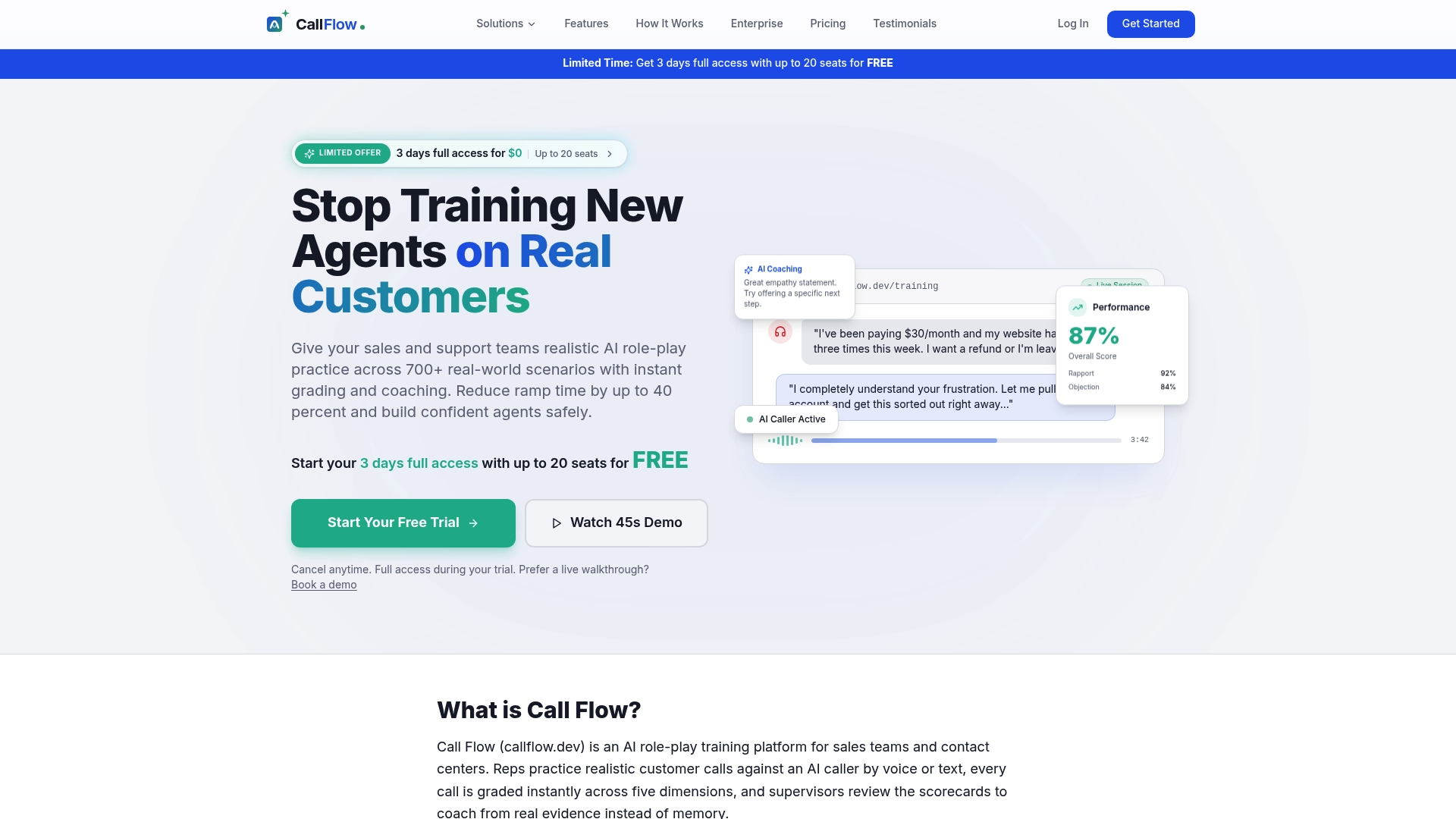
Call Flow is a self-serve platform with a free, full-feature trial, so you can run the calibration plan above on your own scenarios. It offers voice and text simulation, configurable and custom scenarios, supervisor dashboards, skill analytics and instant grading across five dimensions.
Plans are billed per team. Starter is $7.42 per month or $89 per year, Growth is $14.92 per month or $179 per year, and Scale is $33.25 per month or $399 per year. See Call Flow pricing for what each plan includes. Larger organizations can look at the Business and Enterprise plans.
How to read your results
When the pilot ends, you will have a table of agreement figures. Here is how to act on them.
- AI agreement close to human agreement, disagreements explainable. Use AI grades for practice feedback and coaching prompts. Keep spot checks monthly.
- Agreement high overall, low on certain items. Rewrite those scorecard items or add example calls for them. Do not widen use on those items until they improve.
- Agreement low on ambiguous calls only. Set a rule: those calls go to a human. This is normal, and your human reviewers will disagree on them too.
- Scores shift when you change irrelevant details. Remove those details from the input and retest before going further.
For teams that want to connect scoring to a wider quality framework, our guide to aligning MOS 4.0 to scorecards shows how the pieces fit. If your question is about speech recognition rather than scoring, see voice AI accuracy.
FAQ
Are AI grading tools accurate for sales and support calls?
Accuracy depends on your scorecard, your call types and how you calibrate. Compare the AI's scores with trained human evaluators on a mixed sample, including hard calls. Judge the tool by that agreement, not by how steady its scores look.
What is a good agreement score between AI and human graders?
There is no single number. Start by measuring how often your own evaluators agree with each other, then look for AI agreement in that range. Google's Quality AI guidance suggests a Cohen's kappa of at least 0.2 as a floor for annotator consistency, and your team can set a higher bar.
Can an AI grade be used for performance reviews?
Only with human review. Scores that affect pay, reviews or discipline should be checked by a person, and agents should have a way to challenge the result. Call Flow's supervisor review and override workflow supports this.
How often should we recalibrate?
Recalibrate whenever you change the scorecard, launch a new product or scenario type, or notice supervisors overriding grades more often. A light monthly spot check of a small sample keeps drift visible.
Sources
- Who evaluates the AI evaluators? (No Jitter)
- How to Audit an AI Call-Scoring Model Before You Let It Score Your Team (PeerLab)
- Counterfactual Fairness Evaluation of LLM-Based Contact Center QA (arXiv)
- Quality AI best practices (Google Cloud)
- COPC Standards Committee Update: AI in Focus (COPC Inc.)