

Use an observable-behavior analytic rubric with a 4 or 5-point scale to score role-play performances consistently. Score each criterion on its own line instead of giving one overall grade. Put communication clarity, role believability, and task completion at the top of the list. These three cover what raters notice first and what learners improve fastest.
TL;DR:
- Tie each criterion to one learning objective, cap formal rubrics at five to seven rows, and use three to five for frequent drills.
- Choose analytic scoring when coaching, agreement across raters, or formal records matter; use holistic scoring for quick, unrecorded practice or screening.
- Pilot the rubric with two or three raters scoring one recorded clip, discuss gaps, then revise descriptors before live assessment.
- A common analytic format uses five criteria scored from 1 to 5, totaling 25; apply weights only when a scenario prioritizes particular skills.
- Manual scoring suits small groups, but teams running daily drills or needing feedback within minutes can use automated scoring and shared dashboards.
Table of Contents
- What a role play assessment rubric is and when to use one
- Core criteria: observable behaviors and sample rubric items
- Analytic vs. holistic rubrics and scoring scales
- How to build or adapt a rubric, step by step
- Sample ready-to-use rubric templates
- Scaling assessment: when AI-assisted platforms add value
- Quick tips for busy trainers
- Call Flow: scoring role play automatically
- FAQ
- Sources
What a role play assessment rubric is and when to use one
A role-play assessment rubric is a scoring sheet that breaks a performance into specific, ratable parts instead of one gut-feel grade. Trainers use these in classrooms, call center training rooms, and simulation labs where two or more people perform a scenario and someone scores it.
Observable wording cuts down on guesswork. Instead of "shows confidence," a rubric line reads "maintains eye contact and a steady speaking pace." Specific wording like this helps two different raters land on similar scores, which is the core idea behind inter-rater reliability.
Pick your format based on the stakes. A five-minute practice round during a team meeting can use a short checklist. A graded assessment that affects a course grade or a hiring decision needs the full analytic rubric with written descriptors at each level.

Core criteria: observable behaviors and sample rubric items
Good rubric items describe an action a rater can see or hear, not a trait a rater has to guess at. The most common categories across published rubrics are:
- Clarity and volume: speaks at a pace and volume the audience can follow without strain.
- Believability: stays in character and reacts to the scenario the way the role would.
- Task accuracy: completes the steps or objectives the scenario asks for.
- Nonverbal cues: uses posture, gestures, and eye contact that match the role.
- Participation: contributes actively rather than waiting to be prompted.
- Preparation and organization: brings props, notes, or a plan that fits the scenario.
A sample analytic template, the Antiti Role-Play Rubric, scores speech clarity, role consistency, argument fit, props use, and preparation on a 5-point scale, with one row per criterion. A level-5 descriptor for believability might read "stays fully in character, reacts naturally to unplanned moments." A level-2 descriptor for the same row might read "breaks character more than once, reads lines rather than reacting."
To build your own list, take each learning objective from your course or training plan and turn it into one criterion. If the objective is "practice objection handling," the matching criterion becomes "responds to the stated objection with a relevant counterpoint." One objective, one row. This keeps the rubric from growing past the five to seven items a rater can track in a single pass.
Analytic vs. holistic rubrics and scoring scales
Analytic rubrics score each criterion separately and add the rows into a total. Holistic rubrics give one overall score based on a general impression of the whole performance. Analytic rubrics take longer to fill out but give specific feedback a learner can act on. Holistic rubrics work faster for quick, low-stakes checks where you just need a pass or fail call.
Pick analytic when:
- You need to coach the learner on a specific skill afterward.
- Multiple raters need to agree on a score.
- The result feeds into a grade or performance record.
Pick holistic when:
- You are screening a large group quickly.
- The round is practice only, with no record kept.
A typical analytic rubric uses five criteria scored 1 to 5, for a total out of 25. Weighting is simple: multiply a criterion's raw score by its weight if some skills matter more than others, then add the weighted scores for the final total.
How to build or adapt a rubric, step by step
Building a rubric from scratch takes less time than most trainers expect. Follow these steps:
- Map each criterion to one learning objective. Avoid rows that do not tie back to something you are actually teaching.
- Write a short descriptor for each score level. Describe what a rater sees or hears at the top, middle, and bottom of the scale.
- Choose your scale and any weights. A 4 or 5-point scale works for most scenarios; add weights only if some criteria matter more for this specific round.
- Pilot the rubric with two or three raters scoring the same recorded clip. Compare scores, then hold a short calibration meeting to talk through any gaps before using the rubric live.
Revise descriptors for any criterion where raters disagreed, then run the rubric on a live round. A pilot like this, recommended in guidance on reducing evaluator bias through observable criteria, catches wording problems before they affect a real grade.
Sample ready-to-use rubric templates
These three formats cover most role-play scenarios. Adapt the wording to your scenario and keep the scale consistent across rows.
- Analytic classroom rubric: five criteria (clarity, believability, task accuracy, preparation, engagement), each scored 1 to 5, for a total out of 25 plus a comment line, following the structure in the Antiti rubric template.
- Group or ensemble rubric: scores participation, teamwork, coherence of the scenario, and timing, each on the same 1 to 5 scale, for groups performing together.
- Language or fluency rubric: separates communication effectiveness from grammar accuracy, vocabulary, and pronunciation, each scored 5 to 0 and totaled out of a set maximum, as shown in a language-performance rubric sample. Splitting comprehension from correctness keeps feedback clear when a learner is understood but still makes grammar errors.
Scaling assessment: when AI-assisted platforms add value
Manual rubrics work well for small groups and occasional practice. They get harder to run consistently once a team does daily drills or needs feedback within minutes instead of days. Platform-assisted scoring automates the rubric itself: every rep gets the same scenario, the same criteria, and an instant score instead of waiting for a manager's calendar to open up. This matters most for larger cohorts, repeated practice cycles, and any team that tracks scores over time through a shared dashboard rather than a stack of paper rubrics.

Quick tips for busy trainers
Keep your rubric to three to five items if your team practices daily. A longer list looks thorough but slows raters down and adds disagreement, not accuracy. Record a few calibration clips and have every rater score them before the first real session. Revisit the rubric after two or three sessions and cut or reword anything raters keep scoring differently.
— Costa
Call Flow: scoring role play automatically
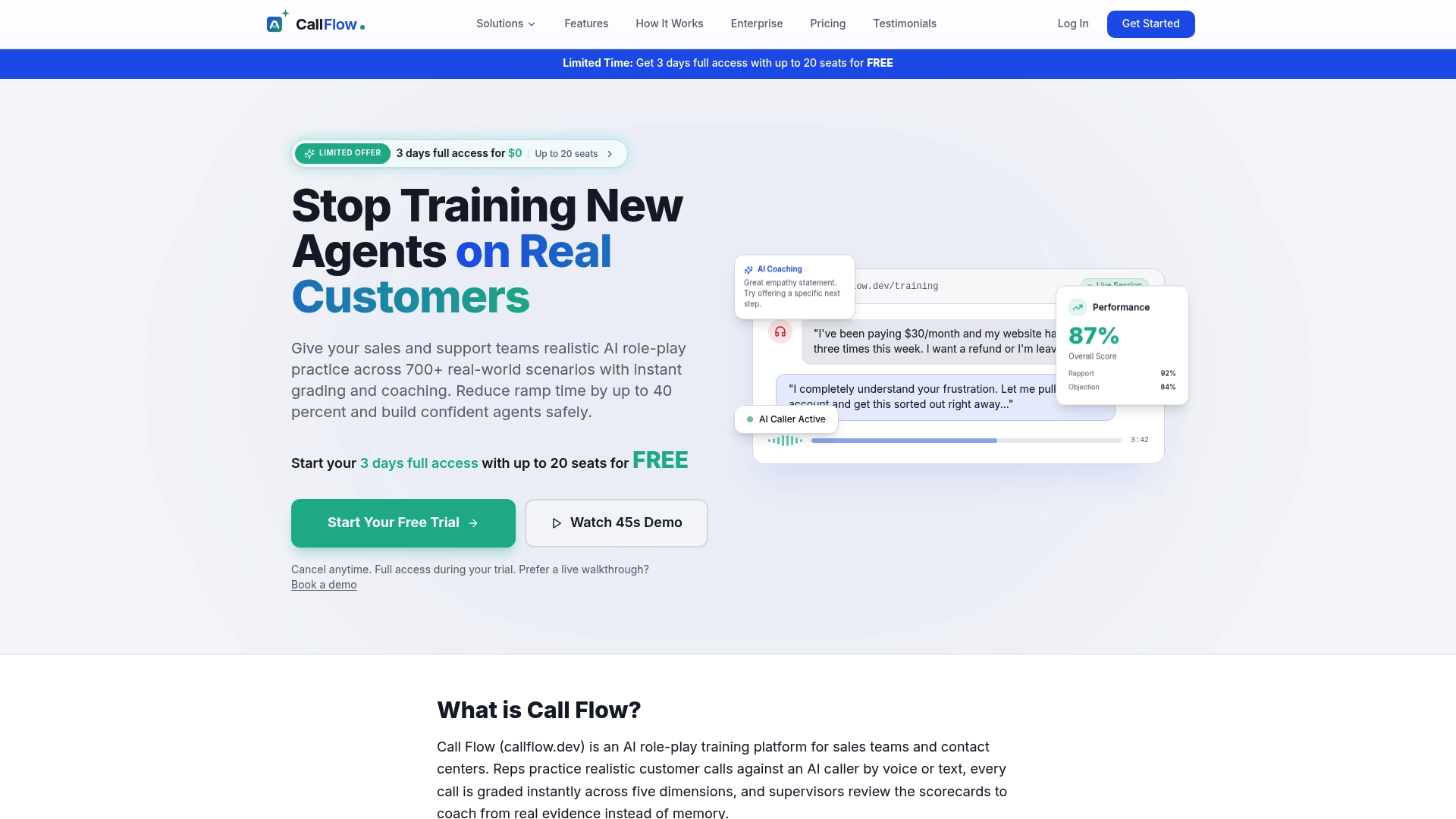
We built a platform for teams that have outgrown manual rubric sheets. The platform scores every practice round instantly across multiple performance dimensions, utilizes a scenario library designed for sales and support calls, and feeds scores into a supervisor dashboard so managers can see trends without reviewing each recording by hand.
- Pilot with one team before rolling out company-wide.
- Start on a full-feature trial with no setup delay.
- Move to Business or Enterprise when you need custom scenarios at scale.
| Plan | Price | Billing |
|---|---|---|
| Starter | $7.42 per month | Monthly |
| Starter | $89 per year | Annual |
| Growth | $14.92 per month | Monthly |
| Growth | $179 per year | Annual |
| Scale | $33.25 per month | Monthly |
| Scale | $399 per year | Annual |
If your team runs frequent drills or needs rapid feedback across dozens of reps, see how AI role-play training compares to manual scoring, then check our pricing page to pick a plan.
FAQ
What is the best scale for a role play rubric?
A 4 or 5-point scale works best for most role-play assessments because it gives enough range to show improvement without forcing raters to split hairs between too many levels. Written descriptors at each level matter more than the number of points on the scale.
How many criteria should a role play rubric include?
Five to seven criteria is the practical limit for a single-session rubric, since each one needs its own descriptor and score. For frequent practice drills, three to five core items keep scoring fast and consistent, as noted in our Quick tips for busy trainers above.
How do you make rubric scoring consistent between raters?
Use observable, behavior-based wording in every criterion instead of vague trait labels, and run a short calibration session where raters score the same clip before using the rubric live. The Play Matrix validation study showed high inter-rater reliability for most indicators when clear definitions and coder training were used.
Can AI tools grade role play performances?
Yes, platforms like Call Flow score role-play rounds instantly across multiple performance dimensions and apply the same criteria to every rep, which removes the delay and inconsistency of manual scoring. This fits teams running frequent practice sessions who need fast, repeatable feedback.
How do you turn a rubric score into useful coaching feedback?
Review the lowest-scoring criterion first and give one specific, actionable note tied to that line rather than commenting on the whole performance. Pairing a rubric with scenario prompts built for the same skill gives the learner a clear next round to practice on.
Sources
- Role-Play Assessment (HKU AIED materials)
- Role-Play Rubric (Antiti BLM G–17)
- Play Matrix validation study (Frontiers in Psychology)
- Project rubric sample (NCSU language rubric)