

Choose AI simulation when you need scalable, repeatable practice with objective scoring and keep human-led role play for calibration, nuance, and manager coaching. Most training programs get the best results from using both methods: simulation for rehearsal volume, and role play for debrief and team norming. We build Call Flow around this split, pairing AI practice with the human judgment that still matters at the finish line.
TL;DR:
- Simulation provides unlimited, consistent practice with instant feedback, making it ideal for onboarding and repeatable tasks, especially as task complexity increases.
- Role play offers nuanced judgment development through live scenario feedback, which is most beneficial for calibration, high-stakes negotiations, and tasks requiring real-time decision-making.
- Combining both methods—using simulation for volume and role play for judgment—yields the best training outcomes across different skill levels and task complexities.
- Pilots show that practice frequency and AI scoring improvement strongly correlate with faster ramp times and higher call accuracy, often leading to measurable revenue gains.
- The platform Call Flow supports scalable AI training with zero setup costs, offering flexible plans suitable for small teams or enterprise-wide rollouts.
Table of Contents
- Simulation vs role play at a glance
- Why simulation and role play produce different results
- When to use simulation and when to use role play
- What to measure to prove the pilot worked
- Running a low-risk pilot in six steps
- A straight read on what the evidence supports
- Start a Call Flow pilot without the setup cost
- FAQ
- Sources
Simulation vs role play at a glance
Each method wins on different axes. Simulation scales without limit, scores consistently, and removes the social pressure that makes some trainees freeze. Role play builds judgment that a script cannot predict, but it costs trainer time and produces feedback that varies session to session.
- Scalability: Simulation runs unlimited reps at once; role play needs one trainer per pair.
- Feedback speed: Simulation scores instantly; role play feedback depends on the trainer's schedule.
- Psychological safety: Simulation lets reps fail privately; role play adds peer pressure, which can help or hurt depending on the trainee.
- Trainer time: Simulation needs setup only; role play needs a trainer present for every run.
- Best-fit complexity: Simulation handles repeatable scripts well; role play still wins for live judgment calls.
- Repeatability: Simulation lets a rep run the same scenario ten times before lunch; role play rarely allows more than one or two passes.
A new hire practicing objection handling benefits from ten quick simulated reps before ever facing a live customer. A team calibrating how to handle an angry, high-value client is better served by a live role play with a manager watching and correcting in the room.
One finding stands out: traditional role-plays often take 15 to 20 minutes per performance to grade, while AI-driven role-plays grade instantly and scale across a whole team at once.
Why simulation and role play produce different results
The two methods teach through different mechanisms, which explains why they show up differently in outcome data.
Simulation relies on repetition paired with objective feedback. A rep runs a scenario, gets scored across set dimensions, adjusts, and runs it again within minutes. Role play relies on social modeling and reflective debrief: a trainee watches a peer or manager handle a moment, tries it themselves, and talks through what worked afterward. Both are legitimate learning mechanisms, but they serve different goals.
The technical gap matters too. AI-driven simulation uses branching scenario logic, instant scoring, and full data capture on every attempt. Human role play depends on whoever is playing the customer that day, which means quality and consistency shift from pair to pair.
- Simulation scores every rep the same way, every time, which makes comparison across a team possible.
- Role play adapts in the moment to whatever a trainee actually says, which simulation branching can only approximate.
- Scaffolding, such as short reflection prompts after a run, increases how well either method transfers to real calls.
Field research backs the complexity point directly. A study conducted with Fortune 50 call centers found that simulation training outperformed role-play training on call accuracy and speed, with the gap widening as task complexity increased. That is the clearest signal in the research: simulation is not just a cheaper substitute for role play, it can outperform it on harder tasks, provided the scenario design has enough fidelity to matter.
When to use simulation and when to use role play
A simple rule cuts through most of the decision: if the goal is repeat practice with objective scoring, use simulation; if the goal is calibration, nuance, or team norming, use role play.
- Low-complexity tasks (opening a call, confirming account details): simulation alone is usually enough.
- Medium-complexity tasks (standard objection handling, upsell pitches): run simulation first for volume, then one live role play to confirm tone and delivery.
- High-complexity tasks (de-escalating an angry customer, negotiating a contract renewal): lean on live role play for judgment, but use simulation beforehand so reps arrive with the basics already automatic.
Alternate the two rather than picking one permanently. A common cadence is daily or weekly simulation reps paired with a live role play every two weeks for calibration, where a manager checks that the team is applying the same standards. Escalate to human-led calibration whenever scores drift across the team or a new product launch changes what "good" sounds like. The goal is not to replace judgment with software. It is to spend scarce manager time on the moments that actually need it.
What to measure to prove the pilot worked
Pick a short list of metrics before the pilot starts, not after.
Primary metrics worth tracking:
- Ramp time: how long until a new hire hits full productivity.
- Practice frequency: how often reps voluntarily run extra sessions.
- AI-scoring improvement: the trend in scores across repeated attempts.
- First-call resolution, call accuracy, and average handling time once reps are live.
Enterprise pilots have linked practice frequency and AI scoring gains to measurable revenue uplift, which makes those two numbers worth watching closely rather than treating training completion as the finish line.
Set a baseline before the pilot: record current ramp time and call metrics for a comparison group that trains the old way. Run the simulation group alongside it for four to six weeks, then compare. Pro tip: review the dashboard weekly rather than waiting for the pilot to end. Trends show up early, and small adjustments to scenario difficulty matter more than a long pilot window.
Running a low-risk pilot in six steps
- Define the objective: pick one skill (for example, objection handling) and one success metric.
- Select 3 to 5 representative scenarios that reflect real calls, not edge cases.
- Recruit a cohort: 10 to 20 reps is enough to see a trend without disrupting the whole team.
- Capture a baseline on your chosen metric before anyone starts practicing.
- Run the pilot for 4 to 6 weeks, checking dashboards weekly.
- Hold a calibration role play at the midpoint and the end, with a manager reviewing scores against live performance.
The most common pitfall is treating the pilot as a one-time event instead of a habit. Reps who only practice once rarely improve enough to show up in call metrics.
Pro tip: Add a light gamification layer, like a leaderboard or streak counter, to push practice frequency up without adding mandatory training hours.

A straight read on what the evidence supports

Simulation wins the volume argument. It lets a rep fail quietly, try again in minutes, and build the kind of automatic response that only comes from repetition. Role play still wins the judgment argument. No branching script fully replaces a manager correcting tone, pace, or word choice in real time.
The mistake most training leaders make is treating this as a replacement decision. It is not. Pilot simulation first for anything repeatable or complex enough to need many reps, and keep live role play for the calibration sessions where a manager's ear catches what a score cannot. Case studies and platform metrics make the pilot easier to justify to finance, but the method choice itself should follow the task, not the budget.
— Costa
Start a Call Flow pilot without the setup cost
We built Call Flow around the split this article describes: fast, scalable AI practice for the reps you can't get in a room every week, plus the scoring data your managers need to know where to spend live coaching time. Every plan includes instant grading across five performance dimensions, a configurable scenario library, supervisor dashboards, and both voice and text practice modes, so a pilot can start without weeks of setup.
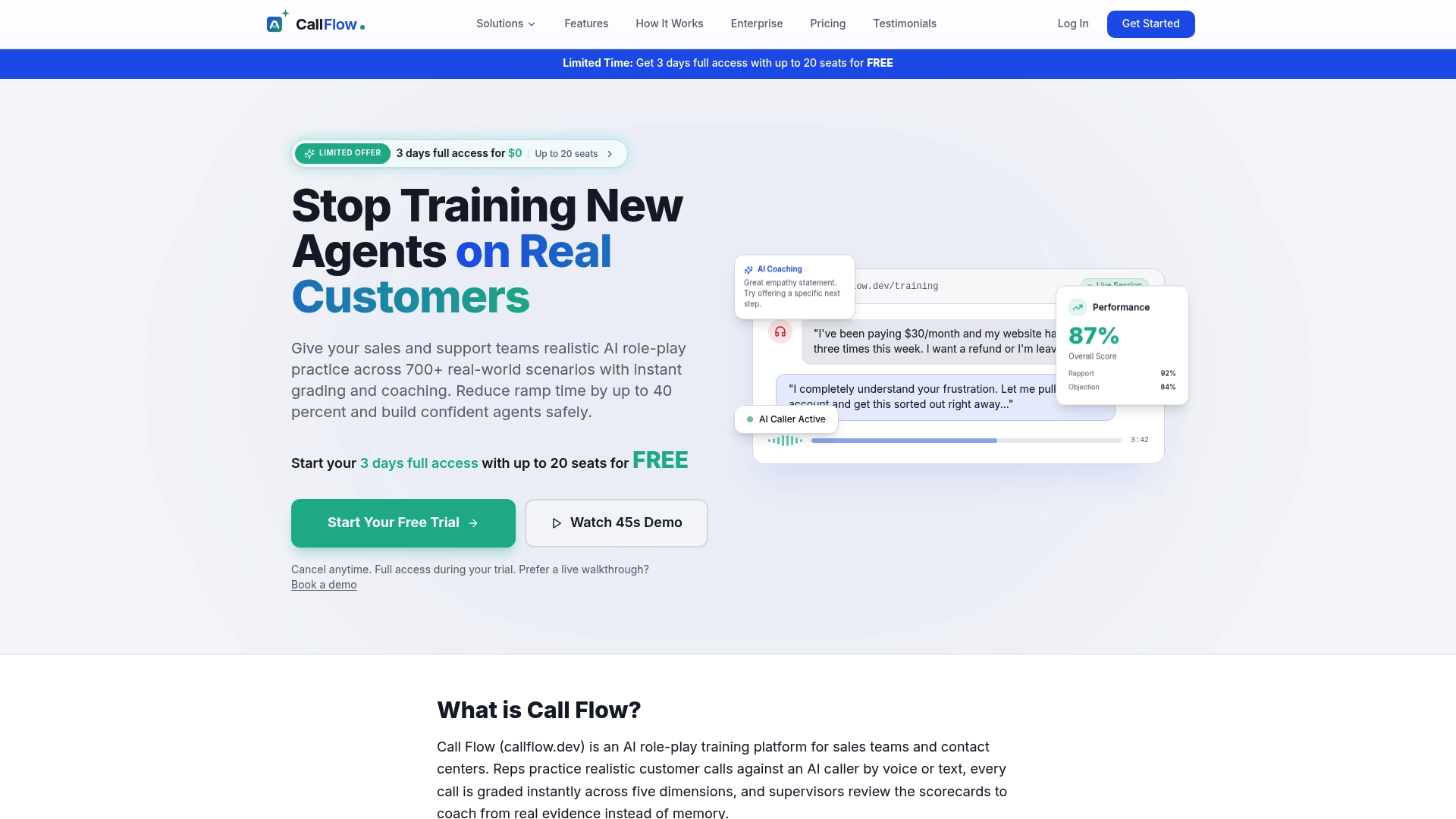
Teams using our platform report faster ramp time and improvement in resolution rates, figures we track through our own case studies rather than third-party audits, but ones worth testing against your own baseline during a trial.
| Plan | Price |
|---|---|
| Starter | $7.42/month or $89/year |
| Growth | $14.92/month or $179/year |
| Scale | $33.25/month or $399/year |
Every plan includes full feature access during the trial period, so you can run the six-step pilot above before committing. Check pricing to pick a seat tier, or reach out through our enterprise page if you're scoping a rollout across multiple teams.
FAQ
What is the main difference between simulation and role play?
Simulation uses AI to run and score practice conversations automatically, while role play uses a human partner, usually a peer or manager, to play the customer. Field research shows simulation can outperform role play on accuracy and speed, with larger relative gains at higher task complexity.
When should a team use simulation instead of role play?
Use simulation when you need high-volume, repeatable practice with consistent scoring, such as onboarding new hires on standard call openers or objection responses. Keep role play for calibration sessions where a manager needs to confirm the team is applying standards the same way.
Can simulation and role play be used together?
Yes, and most effective programs combine them: simulation for daily or weekly rehearsal, live role play every couple of weeks for calibration and debrief. Scaffolding, like short reflection prompts after practice, improves how well either method transfers to real calls.
What should we measure during a simulation pilot?
Track ramp time, practice frequency, AI-scoring trends, and once reps go live, first-call resolution and call accuracy. Enterprise pilots have tied practice frequency and scoring improvement to measurable revenue gains, which makes those numbers worth prioritizing over simple completion rates.
How much does Call Flow cost to try?
Current prices are on the pricing page, with full feature access during the trial period. Larger teams can request custom pricing through our enterprise page.
Sources
- When AI joins your teaching team: integrating Yoodli AI role-plays (Georgia Southern proceedings, 2026)
- The Impact of Simulation Training on Call Center Agent Performance: A Field-Based Investigation (Management Science / APA)
- How AI role play boosts revenue for B2B leaders (The Emblazers Show podcast, 2026-01-13)