

Privacy in AI training is about one question: what happens to personal and confidential data when it is used to build or improve an AI model. The data can include customer details, employee records and internal documents. The risks are real, but you can manage them. Limit what goes in, set clear purposes, control access, and get written commitments from every vendor.
This guide explains how training data is used, which risks matter, which U.S. rules apply, and what to check before you buy any AI tool for your team.
TL;DR
- AI training needs large volumes of data. That data can include personal data, which raises issues of transparency, consent and purpose.
- The U.S. has no comprehensive federal privacy law. Sector laws and state laws apply depending on the data and the use.
- The FTC says a vendor's promise not to use your data for training can be enforceable. Get that promise in writing.
- Reduce risk by minimizing data, restricting access, documenting where data came from, and de-identifying where you can.
- Before you buy, check the vendor's data use, retention and training settings, and make sure its marketing matches its terms.
Table of Contents
- What privacy in AI training means
- Two different things: training data and everyday use
- The main privacy risks
- Which U.S. rules apply
- How to reduce privacy risk in AI training data
- What to check in an AI vendor's terms
- Perspective
- Why practice scenarios help with privacy
- Keep records you can show an auditor
- Try Call Flow with your team
- FAQ
- Sources
What privacy in AI training means
An AI model learns from examples. The more examples, the better it tends to perform. Generative AI in particular needs very large volumes of data. NIST's generative AI risk profile notes that this data may include personal data, and that using it raises risks to transparency, individual participation (including consent) and purpose specification.
In plain words, privacy in AI training asks four things:
- What data went in? Public web text, licensed data, customer records, call recordings, employee files?
- Why was it collected? Was the person told that it could be used to train a model?
- Who can see it? Staff, contractors, human reviewers, other customers?
- Can it be removed? If someone asks, can the data be deleted, and can its effect on the model be undone?
The last point is hard. The FTC's 2023 report on generative AI and the creative economy records that effective machine unlearning was still a research problem. So the safest moment to protect data is before it enters training, not after.
Two different things: training data and everyday use
Teams often mix up two situations.
Building a model. The developer collects data and trains the model on it. The questions here are about sources, consent and purpose.
Using a model. Your team types, uploads or speaks to an AI tool. The question is whether the vendor keeps that input and uses it to train or update its models.
For most buyers, the second situation is the one that matters. When you use a hosted AI service, you may hand over sensitive material. The FTC warns that customers of model-as-a-service companies may reveal sensitive or confidential information, including internal documents and their own users' data. So the answer to "does AI keep your data private?" is: not necessarily. It depends on the vendor's terms and on how you set up the tool.
The main privacy risks
NIST lists several risks when personal data is used in AI systems. Here they are in practical terms.
Weak transparency, consent and purpose
People gave data for one reason. The data then gets used for another. If a customer shared a call recording for quality assurance, they did not necessarily agree to have it train a model.
Leakage and memorization
A model can sometimes reproduce parts of the data it learned from. NIST flags leakage or memorization of sensitive training data as a risk. A name, an account number or a confidential figure can surface in an output.
Inference from scattered data
A model can infer personal or sensitive information by combining pieces from different sources. NIST notes that this can happen even when the inference is wrong. A wrong inference about a person can still do harm.
Human review
Some companies use people to tag or annotate training data. The FTC's guidance on Alexa and Ring says such companies should use strict access controls for sensitive data and limit employee access to what is necessary.
Opt-out systems that put the burden on people
Many vendors offer an opt-out. The FTC's creative-economy report records concerns that opt-outs shift the burden to individuals, are hard to use, and do not fix the lack of transparency about which data entered a model. Participants preferred opt-in consent. If you run a program that uses employee or customer data, opt-in is the stronger design.
Which U.S. rules apply
There is no single federal AI privacy law. The Congressional Research Service states that the U.S. has no comprehensive federal data-privacy law. Federal laws instead address particular sectors and data types.
Per the same CRS primer, these may apply depending on context, developer, data type and purpose:
| Law | Covers | When it may matter for AI training |
|---|---|---|
| GLBA | Financial institutions | Customer financial data used in models |
| HIPAA | Health information | Patient data in healthcare settings |
| COPPA | Children under 13 online | Any data from young children |
| State privacy, biometric and AI laws | Varies by state | Residents' data, voiceprints, automated decisions |
The CRS notes that state privacy, biometric and AI laws may also have implications. If your agents or customers are in several states, check each one. Voice data deserves extra care, because some states treat voiceprints as biometric data. Ask your counsel which state rules cover your calls and your staff.
The FTC angle
The FTC has said two things worth knowing:
- Promises matter. AI companies' promises not to use customer data for secret purposes, including training or updating models, can be enforceable under laws the FTC administers.
- Remedies can be heavy. Companies that unlawfully obtain consumer data may be required to delete products, including models and algorithms built with that data.
For a buyer, the second point is a business risk. If a vendor built its model on unlawfully obtained data, you may depend on a product that has to be deleted.
How to reduce privacy risk in AI training data
NIST's guidance lists the controls below. Use them whether you build a model or only configure a tool.
- Minimize data. Collect and keep only what the purpose needs.
- Define purpose and legal basis. Write down why you use the data and under what authority.
- De-identify where suitable. Use de-identified, aggregated or synthetic data, or differential-privacy techniques, when they fit the task.
- Document provenance and retention. NIST recommends recording the origin and history of training data, while balancing transparency with proprietary concerns.
- Exclude unnecessary sensitive records. If a field is not needed, leave it out.
- Restrict and log access. Know who touched what, and when.
- Prohibit unapproved training by contract. Ban training and onward use that you have not approved.
- Test for leakage. Check for memorization, extraction, re-identification and sensitive inference.
- Offer real choices. Give meaningful consent, withdrawal, deletion or opt-out processes where they apply.
A worked example: call recordings
Say a contact center wants to use real call recordings to train agents with AI.
- Real recordings hold names, addresses, card numbers and health details. That is a lot of sensitive data.
- A safer route is to use scripted or synthetic scenarios that mimic real calls, so no real customer data is needed.
- If recordings must be used, strip identifiers first, limit who can listen, set a retention period and record the purpose.
The less real data you use, the less you have to protect.
What to check in an AI vendor's terms
The FTC's guidance gives a clear starting list. Check:
- Does the vendor promise not to use your data to train or update its models?
- How does it collect and use customer data?
- Do its promotional materials, website terms and marketplace commitments match its actual practices?
Turn that into a checklist for your buying process:
| Question | What a good answer looks like |
|---|---|
| Is my data used to train shared models? | A clear written commitment, in the contract |
| How long is data kept? | A stated retention period and a deletion process |
| Who can access it? | Role-based access, with logs |
| Do humans review inputs? | Limited, controlled access, stated in the terms |
| Can I export or delete my data? | A documented process |
| Do the marketing claims match the terms? | Yes, on every page |
Get the answers in writing. A sales call is not a contract.
Security matters too. A vendor can have good privacy terms and still be breached. If your team handles confidential or competitively sensitive information in model-as-a-service tools, read up on securing AI at the enterprise level and involve your security team early.
Perspective
We build AI role-play training for sales teams and contact centers. So we think about this topic every day.
Our view is simple. Training works best when agents practice on realistic scenarios, not on live customers. A practice call has no real customer on the line. That is a privacy advantage in itself.
Call Flow is designed around configurable scenarios, voice and text simulation, instant grading across five performance dimensions, and supervisor dashboards. Teams can build custom scenarios from their own call types without putting real customer details into the exercise.
We also believe buyers should expect transparent terms. That is why we publish flat-rate plan pricing and offer a free full-feature trial. You can see how the platform works before you commit your team.
Our scoring is calibration-aligned, so it matches your existing QA standards. Supervisors can review and override grades. People stay in control of how skills are judged.
Costa
Why practice scenarios help with privacy
Role-play training gives you a way to build skill without leaning on live customer data. Compare two approaches.
Approach A: train on real calls. You pull recordings, redact them, restrict access and track retention. It takes effort, and risk remains if a redaction fails.
Approach B: train on simulated calls. Agents practice scripted customer situations. You write the scenarios, so they hold the details you choose and nothing more.
Approach B does not remove every question. You still review the vendor's terms. But it reduces the amount of real personal data in the training loop, which matches NIST's first control: minimize data.

For more on how this works in practice, see our guides to AI role play training and AI contact center training.
Keep records you can show an auditor
Privacy is easier to defend when you can show what you did. Keep:
- the purpose of each training program,
- the data categories used,
- who had access,
- the retention period,
- the vendor terms in force at the time.
If you run a pilot, build these records from day one. Our guide on running a sales training compliance pilot shows how to set up audit-ready records over four to six weeks. To track results without exposing individual data more than needed, see our training metrics dashboard guide.
Try Call Flow with your team
Call Flow gives sales and support teams realistic practice calls with instant grading and coaching. Plans are billed per team. Starter is $7.42 per month or $89 per year. Growth is $14.92 per month or $179 per year. Scale is $33.25 per month or $399 per year. See the details on the pricing page.
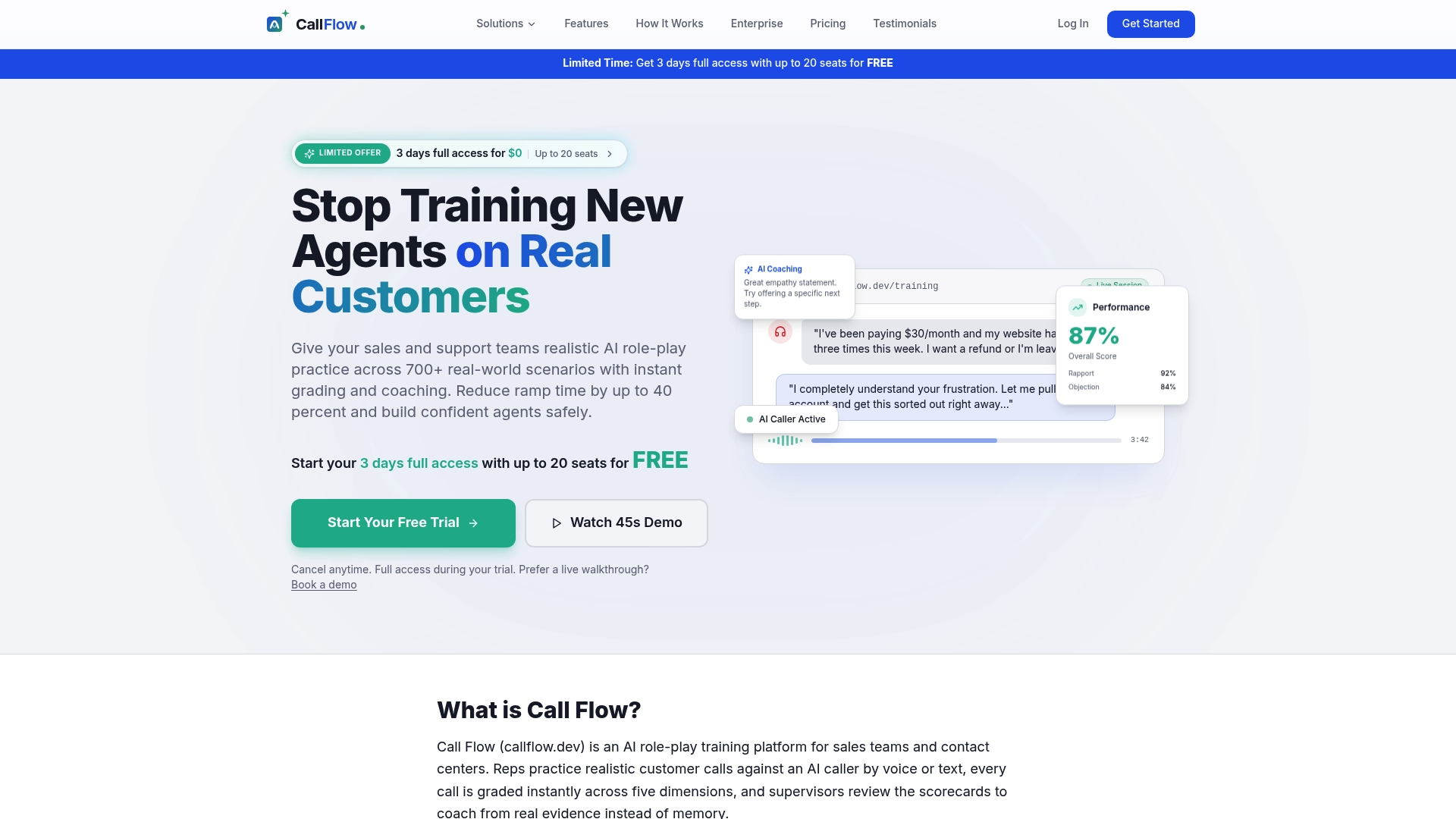
Larger organizations can look at Business and Enterprise plans on the enterprise page. A free full-feature trial lets you test the platform with your team. During any trial, review the terms the way this guide describes.
FAQ
Does AI keep your data private?
Not automatically. It depends on the vendor's terms and your settings. The FTC notes that customers of model-as-a-service companies may share sensitive information, so check whether the vendor commits not to use your data for training.
Are there any federal laws against AI?
The U.S. has no comprehensive federal data-privacy law. Instead, sector laws such as GLBA, HIPAA and COPPA may apply, and state privacy, biometric and AI laws may also matter. Which ones apply depends on the data and the use.
Can a company be forced to delete an AI model?
Yes, in some cases. The FTC says companies that unlawfully obtain consumer data may be required to delete products built with it, including models and algorithms. This is a reason to ask vendors where their data came from.
How can I reduce privacy risk when training staff with AI?
Use less real data. Prefer simulated scenarios, de-identify any records you must use, limit access and keep a log. Put a ban on unapproved training and onward use into your vendor contract.
Is opt-out enough?
It is weaker than opt-in. The FTC's report records concerns that opt-outs put the burden on individuals and are hard to use. Where you control the program, ask for consent up front.
Sources
- NIST: Artificial Intelligence Risk Management Framework, Generative AI Profile
- FTC: AI Companies, Uphold Your Privacy and Confidentiality Commitments
- FTC: Hey, Alexa! What are you doing with my data?
- FTC: Generative Artificial Intelligence and the Creative Economy staff report
- Congressional Research Service: Generative Artificial Intelligence and Data Privacy
- NullVector: Securing AI at the Enterprise Level