

The fastest way to improve NPS is to close the feedback loop within 48 hours and fix the root causes detractors name in their "why" answer. Start by measuring a real baseline, capturing open-text reasons behind every score, and routing detractors to a named owner immediately. Teams that do this consistently see retention gains within one or two quarters, not years.
TL;DR:
- Closing the feedback loop within 48 hours and addressing specific detractor reasons can significantly improve retention and NPS scores.
- Establish a reliable baseline by conducting representative surveys, separating relationship and transactional NPS, and tracking exact survey details for consistency.
- Keep surveys simple with two questions, match their cadence to customer interaction frequency, and personalize channels to maximize response rates.
- Use AI tools to analyze response themes, prioritize fixes for common issues, and focus on moving passives into promoters to boost overall scores.
- Respond to detractors swiftly with clear ownership and concrete next steps, integrating ongoing team reviews and targeted training to improve frontline handling.
Table of Contents
- How Do You Establish a Baseline NPS Score?
- What's the Best Way to Design an NPS Survey?
- How Do You Analyze NPS Feedback at Scale?
- How Fast Should You Respond to Detractors?
- How Do You Get the Whole Team Behind NPS?
- How Do You Know If a Fix Actually Moved NPS?
- What Can You Fix This Month to Improve NPS Fast?
- How Training Speeds Up Detractor Recovery
- A Practitioner's Note on Operationalizing NPS
- Train Your Team to Turn Feedback Into Faster Fixes
- Sources
How Do You Establish a Baseline NPS Score?
You can't improve what you haven't measured honestly. Before chasing a higher number, run an initial survey across a representative sample of your customer base, not just the accounts most likely to respond. A skewed sample, one that overrepresents happy long-term customers or excludes recent churners, produces a baseline you can't trust. Survey validity depends on sampling that reflects your actual customer mix, a point research on survey methodology backs up directly.
Decide first whether you're measuring relationship NPS (a periodic pulse on the overall relationship) or transactional NPS (triggered right after a specific interaction, like a support ticket close or a purchase). They answer different questions, and mixing them into one number muddies your trend line.
Once you have a number, resist the urge to obsess over how it stacks up against a published industry average. Your own historical trend, quarter over quarter, matters more than a cross-industry comparison, because customer expectations and survey methods vary too much between sectors to make those comparisons meaningful.
Set a realistic target window. A jump of 5 to 10 points over six months is an achievable goal for a team that's closing the loop and fixing real problems, not a team hoping the number drifts up on its own.
Practical steps for a clean baseline:
- Sample across new, mid-tenure, and long-term customers, not just your most engaged segment.
- Separate relationship and transactional surveys so you're not averaging two different metrics.
- Log the exact survey date, channel, and question wording so future comparisons are apples to apples.
- Set a six-month checkpoint with a specific point target, not a vague "improve over time" goal.
What's the Best Way to Design an NPS Survey?
Keep the survey down to two questions: the 0 to 10 score, then one open-text "why did you give that score?" follow-up. Anything longer drives down completion rates and adds noise you'll never act on. Survey design guidance from AskNicely recommends cascading follow-ups, a second short prompt that appears only after certain scores, to get detractors talking about specifics without slowing down promoters who are happy to move on.
Cadence needs to match how often customers actually interact with you, not a calendar habit. High-volume consumer businesses get more signal from transactional triggers, a survey fired right after a support call closes or an order ships, than from a quarterly blast that catches people out of context. B2B teams with longer sales cycles typically do better with quarterly relationship surveys tied to renewal or check-in cycles. Sending surveys on a rigid schedule regardless of interaction frequency is one of the fastest ways to trigger survey fatigue and tank your response rate.
Channel choice and personalization move the needle more than most teams assume:
- Email still works for relationship surveys, but a generic "no reply" sender address kills open rates compared to a real name your customer recognizes.
- SMS and in-app prompts fit transactional surveys well because they catch the customer while the interaction is still fresh.
- Clean your list before sending. Bounced or outdated contacts distort your response rate and make your data noisier than it needs to be.
Pro Tip: Test two subject lines on a small segment before a full relationship-survey send. A subject line that names a specific product or team ("How was your onboarding with the Support team?") consistently outperforms a generic "We'd love your feedback" line.
How Do You Analyze NPS Feedback at Scale?
Segmenting responses is the first move, and it sounds obvious until you realize most teams still treat every response the same way. Split feedback by promoter, passive, and detractor, then cross that against account value, tenure, and lifecycle stage. A detractor response from a customer six months from renewal deserves faster attention than the same score from someone who just signed up.
Once you're past a few hundred responses a quarter, reading every open-text comment by hand stops scaling. AI-assisted text analysis can group comments into themes, flag urgent language, and surface how often a specific complaint shows up, work that industry guidance on NPS analysis points to as increasingly standard practice for teams handling volume.
When a theme repeats, don't stop at the symptom. Run the Five Whys on it: ask "why" five times in sequence until you land on the actual process or policy failure, not just the customer's description of what went wrong. A comment like "support was slow" might trace back to an understaffed queue, a broken escalation path, or agents who weren't trained to handle a specific scenario.
Prioritize fixes with a simple rule: address the issues that show up most often and hit your highest-value accounts first.
- Tag every open-text response with a theme and a sentiment before it reaches a human reviewer.
- Cross-reference themes against account value to spot which fixes protect the most revenue.
- Track theme frequency week over week to catch a new problem before it becomes your top complaint.
One underrated insight here: passives are a bigger lever than most teams treat them as. Moving a small share of passives into promoter territory often produces a bigger score swing than chasing already-vocal detractors, because passives are closer to the tipping point and usually cite smaller, more fixable friction.
How Fast Should You Respond to Detractors?
Speed is the whole game here. CustomerGauge's research found that closing the loop within 48 hours drives a 12% increase in retention compared with slower or no follow-up. That's not a rounding error, and it's the single clearest reason to build a real SLA around detractor response instead of leaving it to whoever happens to see the survey result first.
A workable SLA structure:
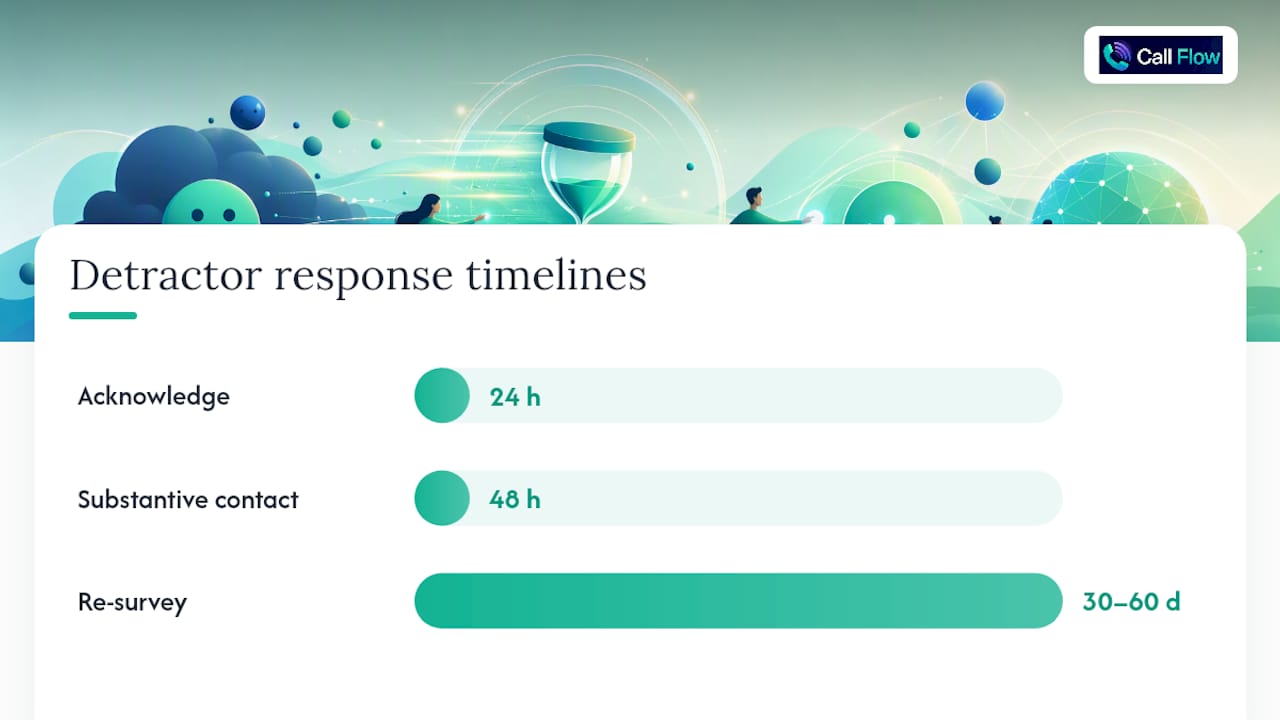
- Acknowledge every detractor within 24 hours, even if it's a short message confirming their feedback landed and someone is looking into it.
- Make substantive contact within 48 hours, meaning a named person reaches out with a specific plan or resolution, not a form email.
- Route by urgency, so a detractor at a high-value account with a billing complaint jumps ahead of a low-severity comment from a low-tenure account.
- Document the outcome and set a re-survey date, usually 30 to 60 days out, to confirm the fix actually landed.
Objectives shift by segment. A detractor outreach should acknowledge the specific complaint and offer a concrete next step, not a generic apology. A passive contact works better as a light-touch question: "What would have made this a 10?" A promoter contact is different entirely, it's a chance to ask for a referral or a review while goodwill is high, not a support interaction.
Pro Tip: Give every escalated detractor case a named owner and a required next action inside your CRM or helpdesk tool. An effective triage workflow with clear ownership is often the difference between a team that tracks NPS and one that actually improves it.
How Do You Get the Whole Team Behind NPS?
A score that only lives in a dashboard never improves. Set up a short NPS huddle, 15 minutes, weekly, where the team reviews recent detractor and passive responses and assigns an owner to each open issue on the spot. This kind of operational rhythm keeps feedback from piling up unread between quarterly reviews.
Ownership needs to be explicit and tied to something people are already measured on. If a support team's fix for a recurring complaint doesn't connect to an OKR or a KPI someone owns, it competes for attention with everything else on their plate and usually loses.
Internal communication matters more than most CX programs admit. Share a promoter's specific comment in a team channel next to the fix that earned it. That kind of visible cause-and-effect does more for morale, and for buy-in on the next round of fixes, than any dashboard update.
- Run a 15-minute weekly huddle focused only on recent detractor and passive feedback.
- Assign a named owner and a deadline to every open issue that comes out of the huddle.
- Tie at least one NPS-related metric to an existing team OKR so it's not competing for attention.
- Circulate specific promoter quotes alongside the fix that prompted them, not just the aggregate score.
How Do You Know If a Fix Actually Moved NPS?
Before rolling a change out to everyone, test it on a smaller cohort first. VWO's guidance on NPS improvement recommends structuring these as real experiments, a control group that doesn't see the change and a test group that does, so you can tell whether the score shift is the fix or just normal variation.
Monetizing NPS is the next step for teams ready to prioritize by dollars instead of instinct. Mapping promoter, passive, and detractor groups to actual retention and revenue data, an approach CustomerGauge outlines in its practitioner guidance, tells you which detractor segment is worth fixing first: the one with the most complaints, or the one sitting on the most renewal revenue.
- Run every meaningful process or product change through a control/test cohort split before full rollout.
- Track each score change against the specific fix that preceded it, not just the calendar quarter.
- Map promoter, passive, and detractor segments to revenue so prioritization follows dollars, not volume alone.
- Review a rolling trend line monthly and a deeper cohort analysis quarterly, so short-term noise doesn't drive overreaction.
Build a dashboard that separates the rolling trend from quarter-over-quarter swings. A single bad week from one large account can distort a monthly view; a rolling average smooths that out while still catching a real shift early.
What Can You Fix This Month to Improve NPS Fast?
You don't need a six-month roadmap to see movement. Start here:
- Pull every detractor response from the last 30 days and personally follow up within 48 hours, even the ones your team assumed were already resolved.
- Identify your top three recurring complaints from open-text themes and assign an owner to each one this week.
- Set up an automated alert that flags any score of 0 to 6 the moment it's submitted, so no detractor sits unnoticed for days.
- Simplify one workflow step customers repeatedly call out as frustrating, a confusing cancellation form, a slow callback process, whatever shows up most in your theme tags.
- Pick one or two experiments, not ten, to test this month. Spreading effort across too many fixes at once makes it impossible to tell which one actually worked.
A short follow-up script helps agents move fast without sounding scripted: acknowledge the specific score and comment, state what you're doing about it, and give a real timeline. That structure works whether it's a phone call or an email, and it beats a generic "we're sorry" template every time.
How Training Speeds Up Detractor Recovery
Fast, consistent follow-up depends on agents who already know how to handle a tense detractor call without freezing or improvising badly. Role-play training built around real customer scenarios helps close that gap before a live call goes wrong. Callflow's platform, used for exactly this kind of readiness work, is tied to a 147% faster ramp time and a 129% improvement in resolution rates among teams using it, numbers that translate directly into more detractors reached inside that critical 48 hour window.
Training matters most when the problem is inconsistent frontline execution, not a broken process. If your root-cause analysis points to a policy or workflow issue, fix the workflow first. If it points to agents giving different answers to the same complaint, that's a training gap.
- Prioritize role-play practice for the top three complaint themes your text analysis surfaces.
- Fold instant coaching feedback into your NPS huddle cadence so skill gaps and process gaps get tracked side by side.
- Use resolution-rate data alongside NPS trend lines to confirm training is closing the gap it targeted.
A Practitioner's Note on Operationalizing NPS
The teams that move their score aren't running more surveys or building fancier dashboards. They're closing the loop faster and fixing the same three complaints that show up every month instead of finding new ones to chase. NPS works as an operational metric, tracked weekly, owned by name, tied to a real fix, or it doesn't work at all. The gap between a company that "does NPS" and one that improves it usually comes down to whether someone specific is accountable for what happens after the survey closes.
— Costa
Train Your Team to Turn Feedback Into Faster Fixes
Closing the loop within 48 hours only works if the person making that call knows exactly how to handle what's on the other end, an angry detractor, a confused passive, a promoter worth turning into a referral. Callflow gives sales and support teams a way to practice those exact conversations before they happen live, with AI-powered mock call practice that scores performance across five dimensions and hands back specific coaching the moment the call ends.

Supervisor dashboards let team leads see who's ready to handle a tough detractor call and who still needs reps, so the right person gets routed to the highest-stakes follow-up. That's the difference between an SLA that looks good on paper and one your team can actually hit every week. If you're building out an NPS operating rhythm and want your frontline ready to execute it, start a free trial and run your team through a real detractor scenario today.
Sources
- Close the loop — CustomerGauge
- 15+ tips to improve your NPS score (AskNicely)
- PMC article on survey practices and measurement