

The highest-leverage move when a buyer says price is too high: pause for a few seconds, ask a calm question to diagnose what's really behind the pushback, reframe the cost using their own numbers, then offer structured options instead of a discount. This sequence preserves margin, surfaces the objection hiding under the price complaint, and moves the deal toward a close instead of a standoff. The scripts, manager rules, and training drills below turn that sequence into something your team can run on every call.
TL;DR:
- Most price objections are actually driven by underlying issues such as unclear need, lack of authority, trust doubts, comparison to alternatives, or timing, rather than price itself.
- Asking a calm, curiosity-driven question and pausing for three to five seconds often reveals more about the true concern behind a price pushback.
- Offering structured options tied to scope, payment, or timeline can resolve objections without discounting, preserving margins and addressing cash flow concerns.
- Better discovery early in the process prevents price objections by establishing the value and decision criteria before discussing pricing.
- Role-play practice focused on diagnosis and the pause significantly improves objection handling skills and reduces the likelihood of unplanned discounts.
Table of Contents
- Why Price Objections Usually Mask Deeper Issues
- The 7-Step Framework For Handling Price Pushback
- Scripts For The Most Common Price Objections
- How Better Discovery Prevents Price Objections Before They Start
- The Manager's Playbook For Discount Governance
- Why Role-Play Practice Closes The Skill Gap Faster Than Coaching Alone
- Why Price Discipline Is Really A Leadership Signal
- Practice The Scripts Before You Need Them
- Sources
- FAQ
Why Price Objections Usually Mask Deeper Issues
Buyers rarely mean "too expensive" literally. What they usually mean is one of five things: they don't yet see the need clearly enough, they're not the one who signs off, they don't trust the outcome will happen, they're comparing you to something cheaper and unequal, or the timing feels wrong. Price is just the easiest complaint to voice, because admitting "I'm not sure this works" or "I don't have authority to say yes" feels riskier than naming a number.
Behavioral economics explains why. Buyers anchor to whatever number they had in mind before the call, and loss aversion makes any price above that anchor feel like a loss rather than a fair trade. That's a psychological reflex, not a verdict on your value.
Research and expert analysis suggest roughly 72 to 80 percent of price objections are actually value objections in disguise, meaning most buyers who say "too expensive" haven't actually rejected your price. They've rejected an ROI story you haven't told them yet.
The five hidden drivers behind "too expensive":
- Need: they haven't connected the cost to a problem they feel urgently.
- Authority: they can't approve the spend and don't want to say so.
- Trust: they doubt the result will match the promise.
- Comparison: they're pricing you against a cheaper, different offering.
- Timing: budget cycles or competing priorities, not the number itself.
The 7-Step Framework For Handling Price Pushback
Diagnosing correctly matters more than any single line of pushback you deliver. This sequence keeps you from reacting on instinct and gives you a repeatable structure for handling price objections in any deal size.
- Pause and listen. Hold silence for three to five seconds after the objection lands. Pausing this long often draws out more information than jumping straight into a defense, and it signals you're not rattled.
- Ask a calm, curious question. Something like, "Out of curiosity, what number did you have in mind?" This pattern interrupt moves the buyer from negotiating to explaining, which tells you what you're actually dealing with.
- Isolate the real objection. Is this a budget ceiling, a value gap, bad timing, or a missing decision maker? Ask directly: "Is it the number itself, or is there something about the value you're not sure about yet?"
- Validate, then reframe as investment. Acknowledge the concern is fair, then use the buyer's own figures (their lost revenue, wasted hours, churn rate) to show what inaction costs them monthly.
- Offer structured options, not a discount. Trade scope, timeline, or payment terms for a lower number instead of just cutting the price. A phased rollout or extended payment schedule protects your margin while still solving their cash flow concern.
- Anchor to value and ask for commitment. Restate the outcome in their language, then ask directly: "If we solve this the way we've discussed, are you ready to move forward?"
- Decide: nurture or walk. If the answer is still no after a real diagnosis, that's useful information. Some deals need a follow-up in a new budget cycle; others simply aren't a fit, and chasing them wastes time you could spend elsewhere.
Pro Tip: Practice the pause out loud before you practice anything else. Reps who skip straight to a rebuttal almost always talk themselves into a discount they didn't need to offer.
Scripts For The Most Common Price Objections
Scripts work best as scaffolding, not scripts to recite word for word. Adapt the language to your product, but keep the structure: acknowledge, diagnose, reframe, offer.
- "That's too expensive." Try: "I hear that. Can I ask what you're comparing this to? If we can get clear on what this is actually solving for you, the number usually makes more sense." Then quantify the cost of the problem they're describing.
- "Can you lower the price?" Try: "Out of curiosity, what number did you have in mind?" Their answer tells you whether this is a real budget gap or a reflexive ask. If it's small, a modest trade (extended terms, a smaller starting scope) usually resolves it without touching the list price.
- Genuine budget constraint. Try: "If the number works better spread out, we can structure payments over the first two quarters instead of upfront." This keeps the deal moving without a discount on record.
Pro Tip: Turn each script into a two-minute role-play with a specific persona attached (skeptical procurement lead, first-time buyer, budget-frozen manager) so reps practice the diagnosis, not just the line.
How Better Discovery Prevents Price Objections Before They Start
Most price objections trace back to discovery that moved too fast. A buyer who never quantified their own pain has no frame for judging your number, so the price becomes the only thing left to react to.
- Ask about the cost of doing nothing. "What happens if this problem is still unsolved in six months?" gets buyers to name a number before you do.
- Confirm decision criteria and authority early. Find out who signs off and what they need to see before price ever comes up.
- Co-create the ROI math using their figures. A simple formula works: (cost of the problem per month) minus (cost of your solution per month) equals net monthly gain. Walking through this together, rather than presenting a finished business case, makes the number feel like their conclusion, not your pitch.
- Hold price until value is established. Revealing a number before the buyer has connected it to a felt cost invites a reflexive "too expensive," regardless of what you charge.
The Manager's Playbook For Discount Governance
Reps default to discounting when they have no other lever and no clear rule for when a concession is even allowed. A tiered approval matrix fixes both problems at once.
- Tier 1 (up to 5%): rep can approve, but only with a value trade (longer contract term, a case study, a referral).
- Tier 2 (6 to 15%): requires manager sign off, plus at least two value trades.
- Tier 3 (above 15%): requires leadership approval, and gets granted only for strategic accounts with a clear expansion plan.
Every concession above zero should require something in return, whether that's a longer commitment, a public reference, or faster payment terms. Track two numbers to see if the discipline is working: discount rate per closed deal and win rate on deals that hit a price objection but weren't discounted. If win rate on the second number climbs while discount rate falls, your objection handling practice is compounding.
Why Role-Play Practice Closes The Skill Gap Faster Than Coaching Alone

Reading a script and running it live under pressure are different skills. Teams that rehearse price objections in realistic simulation report 147% faster ramp time and a 129% improvement in resolution rates, because reps build the pause and the diagnosis question into muscle memory before a real deal is on the line.
Building a useful price-objection scenario for practice means scoring three things separately: did the rep pause instead of rebutting, did they correctly diagnose the root cause, and did they close with a clear ask rather than trailing off. A short pilot works well to test this:
- Run it with a small cohort, six to eight reps, for two to three weeks.
- Track discount rate and post-objection win rate as your two KPIs.
- Have a supervisor calibrate scoring across a handful of calls before trusting it at scale.
Why Price Discipline Is Really A Leadership Signal
Reps discount when they lack confidence in the value story, not when the price is genuinely wrong. Managers who invest in practice instead of tolerating reflexive discounts are making a bet on skill over habit, and that bet almost always pays off in margin.
Try this: run a 15 minute role-play clinic this week where every rep practices only the pause and the diagnosis question, nothing else.
— Costa
Practice The Scripts Before You Need Them
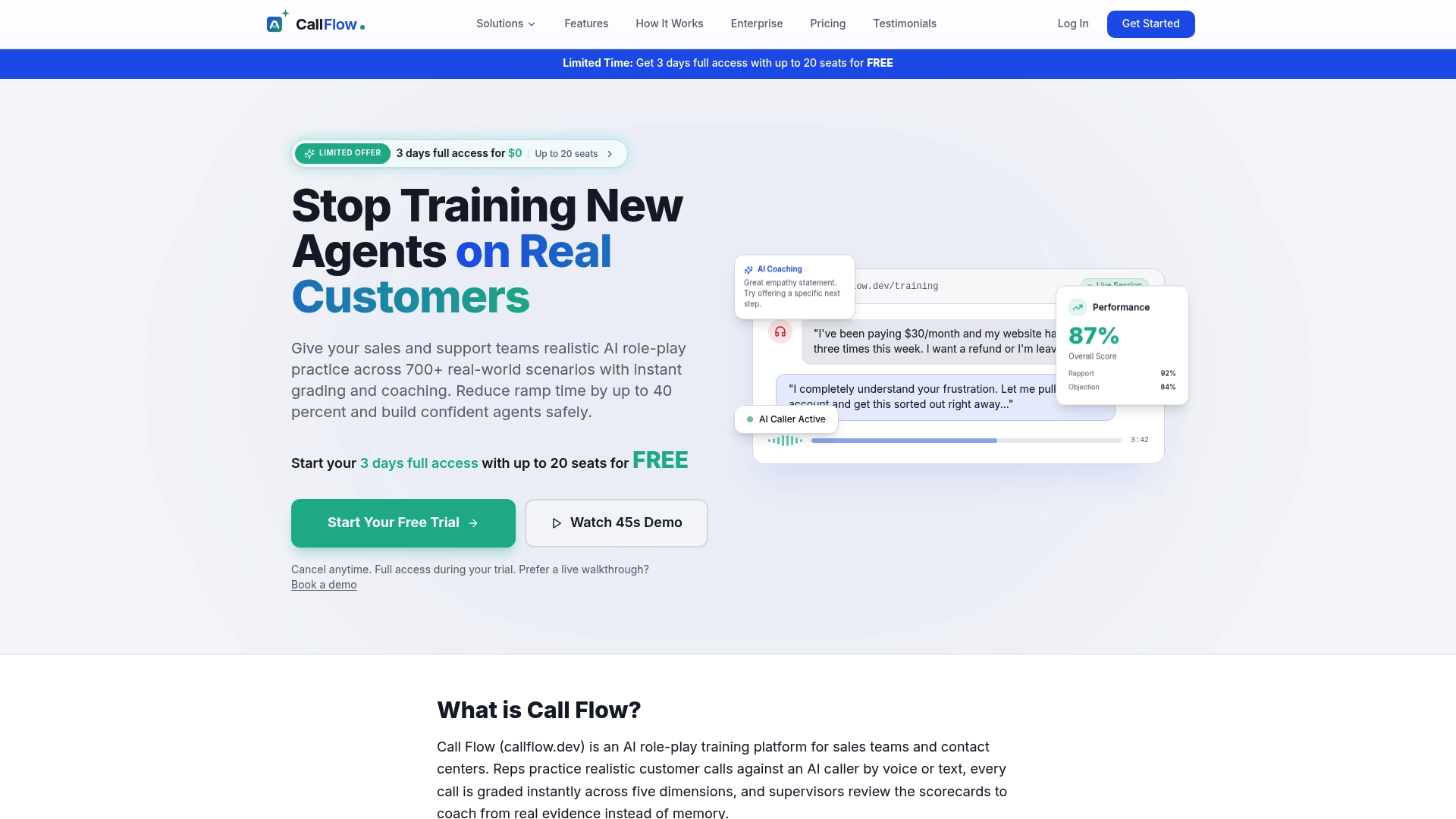
Reading a framework and running it live under pressure are two different skills, and the gap between them is where discounts leak out. Call Flow gives your team realistic role-play scenarios built around exactly the situations above (the "too expensive" pushback, the budget-frozen buyer, the procurement lead fishing for a discount) with instant AI grading across five performance dimensions so reps get feedback the moment the call ends, not a week later in a coaching session.
A practical starting point: pull six reps, run a three week pilot, and track discount rate and post-objection win rate as your two success metrics. Supervisor dashboards let managers calibrate scoring across the cohort instead of guessing at consistency. Plans start at $7.42 a month on the Starter tier, with Growth and Scale tiers available as your rollout grows, and teams with larger training needs can look at Enterprise options built for multi-team calibration. Every plan includes full access during a risk-free trial, so there's no reason to wait for next quarter's budget to test whether structured practice actually moves your numbers.
Sources
The Forbes Business Council breakdown of the four objection types explains the value-versus-price distinction in more depth. HubSpot's collection of price objection responses offers additional field-tested phrasing. The Revenue Coaches cover the calm-curiosity technique in detail, and Nimitai's framework offers a broader script library. For rollout materials, see Call Flow's guide to probing questions that prevent objections in the first place.
- The four types of sales objections and how to overcome them | Forbes Business Council
- 14 responses to the sales objection, 'Your price is too high' | HubSpot
FAQ
How do I handle a pricing objection politely?
Pause for a few seconds instead of reacting immediately, then ask a calm question like "What number did you have in mind?" to understand what's really driving the concern. Politeness comes from curiosity, not apology. Acknowledge the concern is fair before you reframe the value, and avoid sounding defensive about your number.
What does it mean to handle objections?
Handling an objection means diagnosing the real concern behind a buyer's pushback rather than reacting to the surface complaint. Since most price objections are actually value objections in disguise, effective handling focuses on uncovering need, authority, trust, or timing issues before responding to the number itself.
What are the three golden rules for objection handling?
Definitions vary across sales training programs, but a common version emphasizes: listen fully before responding, diagnose the specific concern instead of assuming it's price, and respond with a reframe or option rather than an immediate concession. The common thread across most frameworks is treating the objection as a request for more information, not a rejection.
What are the four types of objections?
Sales objections generally fall into four categories: price (cost concerns), need (unclear value or urgency), trust (doubt about results or the company), and timing (budget cycles or competing priorities). Most objections that sound like price are actually one of the other three wearing a price disguise.
Does practicing price objections actually improve close rates?
Teams that rehearse objection scenarios in realistic role-play see measurable gains, including 147% faster ramp time and 129% improvement in resolution rates reported through Call Flow's simulation training. Practice builds the pause and diagnosis habits that are hard to develop from reading scripts alone.