

A discovery to demo handoff is the moment the context from the first call moves into the demo. Do it well and the demo feels built for the buyer. Do it badly and the buyer sits through a generic tour. The fix is simple: capture the buyer's pain in their words, agree what the demo must prove, pass a short written brief to whoever demos, and confirm the agenda with the buyer.
This guide shows each step. It covers solo reps who demo their own deals and teams where an account executive (AE) hands off to a sales engineer (SE).
TL;DR
- Treat the handoff as a transfer of context, not a calendar invite. Pain, impact, people and timeline all move to the demo.
- Write the brief during or right after discovery. Keep it to one page.
- Show two or three capabilities tied to stated pain, not the whole product.
- Skip the demo when discovery shows no real pain, no champion and no path to a decision.
- Measure the handoff. Track whether each demo has a mapped problem, the right roles, buyer participation, a clear outcome and an owned next step.
Table of Contents
- What a discovery to demo handoff is
- Decide first if the demo should happen
- Close discovery with the handoff in mind
- Agree what the demo should prove
- What goes in the handoff brief
- Who owns what
- Send a recap within an hour
- Shape the demo around discovery
- Measure whether the handoff works
- Practice the handoff before it counts
- Our perspective
- Try the handoff in practice with Call Flow
- FAQ
- Sources
What a discovery to demo handoff is
A sales handoff is a structured move of an account or deal from one person to another. It makes sure key information, buyer expectations and next steps transfer without disruption. The discovery to demo version is narrower. One description defines it as the process where an AE passes what they know about the prospect's situation, pain and goals to the SE who builds the demo. It is the bridge between "what" and "how".
A handoff can also happen inside one person. If you run discovery and the demo yourself, you still need a pause between them. You write down what you heard, decide what to show and decide what to leave out.
One practitioner view says a good handoff keeps three things: the emotional temperature of discovery, the context, and a clear expectation of what the demo will prove. Miss one and momentum leaks.
A full handoff has four parts:
- A trigger. Discovery ended and the buyer agreed to see a demo.
- A named owner before and after.
- A written record of what the buyer already said.
- A point where the receiving side accepts the work.
These four parts match one glossary definition of a sales handoff. Use them as a test. If your process lacks one, that is where deals stall.
Decide first if the demo should happen
Not every discovery call earns a demo. Run the demo only when the buyer has shown real pain and intent. A template for this call says never to demo cold.
Use a fit check at the end of discovery. One playbook argues the fit check is the highest-leverage block of the call. Reps who skip it book a demo no matter what they heard. That pushes demo conversion rates above 80 percent while downstream metrics fall.
The same playbook sets a stricter rule for enterprise deals. A call that ends with no champion should not become a demo. The buyer should be able to quantify the pain. The economic buyer should be known. Decision criteria and process should be described. A named pain should have cost them something measurable.
A simple version for any deal size:
| Signal from discovery | Green light | Pause |
|---|---|---|
| Pain | Named, specific, costs time or money | Vague or "nice to have" |
| Impact | Buyer gave a number | No number offered |
| People | Champion and decision maker known | Only one contact, no sponsor |
| Process | Steps and timeline described | "We are just looking" |
| Next step | Buyer agreed to a date | Buyer avoids a date |
If most of the right column shows up, book a second discovery call or a short follow-up instead. Say so plainly: "We need a bit more detail before a demo is useful to you." Buyers respect that.
Close discovery with the handoff in mind
The handoff starts on the discovery call, not after it. One checklist for this has seven steps. Close discovery by naming the demo and tying it to the prospect's pains. Confirm the agenda. Book the slot on the call. Send a short recap within an hour. Tailor the demo to their three pains. Lead with their top problem. Reconfirm the agenda the day before.
Here is a closing script you can adapt:
"Here is what I heard. Reporting takes your team two days each month. Your director wants it in hours before the Q1 review. Does that sound right? Then in the demo, I will show you that one workflow first. Who else should join so we cover their questions?"
That short script does four jobs. It repeats the pain. It confirms the impact. It names the date. It asks for the other roles.
Then book the demo on the call. Do not leave it to email. A booked slot with an agreed agenda beats a promise to "send times."
Agree what the demo should prove
Before you build anything, write the question the buyer needs answered. One guide gives an example: can the regional manager identify and investigate inconsistent reporting definitions? Then decide which workflow answers it. Also decide what a demo cannot establish by itself.
This step stops scope creep. If the question is "Can my team find inconsistent reports?", a tour of the dashboard builder is noise.
Write one sentence in this form: "After this demo, the buyer can decide whether [workflow] solves [problem] for [role]." Put it at the top of the brief.
What goes in the handoff brief
The brief is the core of the handoff. Keep it short and put it in a shared system. One source suggests a CRM, a Notion page or a document template. It also says an AE who did proper discovery can finish the brief in about 10 minutes.
If your CRM has no place for this, fix that first. A CRM implementation guide can help you plan fields, governance and data quality so the brief lives where the deal lives.
The same source lists what the brief should hold:
- Account and players
- Current state
- The problem in the prospect's own words
- Business impact or ROI
- One to three must-show capabilities
- Red flags or landmines
- The desired next step
Another approach captures five things during or right after the call. These are the primary pain in exact words, the quantified impact the buyer said aloud, the critical event with its real date, a stakeholder map with each person's role and concern, and demo design notes on what to show and what to skip.
A third view organizes the brief by audience, workflow, evidence, demonstration, unknowns and decision. The "unknowns" part matters for SEs. It lists technical limits and questions that need specialist review.
These lists overlap. You do not need all of them. Pick one, keep it to a page, and use it every time. Here is a lean template:
| Field | What to write |
|---|---|
| Demo goal | One sentence: what the buyer should decide |
| Pain, in their words | A direct quote if you have one |
| Impact | The number they gave, and who gave it |
| Critical event | What happens, and the date |
| People | Name, role, main concern, champion or not |
| Show | Two or three workflows |
| Skip | What to leave out and why |
| Landmines | Past vendors, budget limits, internal politics |
| Unknowns | Technical questions to check before the demo |
| Next step | Who does what, by when |
For SE handoffs, add the technical side. One checklist lists company size, industry, buying stage, key personas and decision structure. It also lists known blockers, roadmap questions, unusual requests and environment details.
Who owns what
In a split team, the AE passes the prospect's situation, pain and goals to the SE or solutions consultant who builds and delivers the demo. That is the usual setup in one description of the handoff.
The same source offers a firm view. Presales teams can treat the brief as a gate and reject demo requests with half-filled briefs. That forces better discovery notes and stops context loss.
Before building, hold a short AE and SE pre-call. One workflow guide says to align on three things: the purpose, the expected outcomes (minimum and best case), and the core message the buyer should remember. Ten minutes is enough.
Split the roles this way:
- AE: owns the buyer relationship, the brief, the agenda and the recap.
- SE: owns the demo build, the technical answers and the unknowns list.
- Both: agree the win condition and the next step before the call.
After the demo, the roles flip. Presales guidance says to define what the AE needs from the SE to close and what follow-up the SE owns after the demo. The output is a checklist that covers confirmed technical needs, stakeholder concerns addressed, agreed next steps and open questions.
Solo reps do the same in two modes. Block 15 minutes after discovery to write the brief. Treat it as if someone else would read it. In a week, that someone is you.
Send a recap within an hour
The recap is the buyer-facing half of the handoff. Send it within an hour of the call. Keep it short:
- Two lines on the pain, in their words.
- The impact they named.
- The demo date, time and attendees.
- The agenda: two or three items, top problem first.
- One line asking them to correct anything you got wrong.
This gives your champion something to forward. It also gives the buyer a chance to fix errors before you build around them. If your team replies from a shared inbox or messaging tool, look at how AI inbox and CRM features can help keep the recap, the thread and the deal record in one place.
Send a reminder with the agenda the day before. Ask if the attendee list has changed.
Shape the demo around discovery
Discovery findings change the order of the demo, not just the content. One guide lays out the pattern. Open with the pain in the prospect's language. Show the workflow that resolves it before a broader tour. Build the story around the dollar or time figure they gave. Order the extra features by stakeholder. Close on the critical event timeline.

A call template makes a similar point. For a qualified prospect, discovery should uncover current state, pain, impact, decision process and timeline. Then the demo shows two or three capabilities that map to what they said. It adds a rule: never show a feature without a "so what" that comes from discovery.
Length matters too. One sales engineering group argues that a focused twenty-minute demo tied to the buyer's description usually persuades more than a ninety-minute walkthrough. Broad demos feel generic. Focused ones feel built for the buyer.
A workable run order:
- Restate (2 minutes). Repeat the pain and the number. Ask if it still holds.
- Show the answer first (10 to 15 minutes). Go straight to the workflow that fixes the top problem.
- Add by role (5 minutes). Show one extra item per stakeholder who joined.
- Tie to the date (3 minutes). Link the outcome to the critical event.
- Agree the next step (5 minutes). Name the owner, the action and the date.
Use the buyer's words on slides and in demo data when you can. If they say "month-end scramble," say "month-end scramble."
Measure whether the handoff works
Demo count is a weak metric. One framework suggests a Demo Gate Pass Rate: demos passing all five conditions divided by completed demos. If demo volume climbs while the pass rate stays flat or falls, the team is adding activity without progress.
The five conditions in that framework:
- Problem mapped: every capability shown ties to a documented buyer problem.
- Required roles involved: at least two relevant buyer roles attend.
- Buyer participation: the buyer tests, chooses, challenges or applies a capability.
- Outcome articulated: the buyer links a capability to a measurable result.
- Next action owned: the next step has a name, an owner, an outcome and a date.
Score every demo against these in your CRM. Review the misses weekly. Most misses trace back to one of two causes: a thin brief, or a discovery call that skipped a question.
Also track the plain numbers. Look at the share of discovery calls that become demos, the share of demos that reach a next step, and how often the SE says the brief was missing something.
Practice the handoff before it counts
The handoff breaks in three places: the discovery questions, the close of the call and the demo opening. All three are spoken skills. Reps get better at them with repetition, not reading.
Our guides on discovery call training and on scoring agent discovery show how to coach the first. For the call structure itself, see our 30 minute discovery plan. To find where your reps lose the thread, try a 30 day skill gap analysis using your CRM calls.
Our perspective
Most handoffs fail in the first five minutes after discovery, not in the demo. The rep heard the pain. Then the call ended, and the details stayed in their head.
We think the fix is practice. A rep who can close discovery by repeating the pain, the number and the date will write a better brief. A rep who has rehearsed that close under pressure will do it on a real call.
That is why we built Call Flow around role-play. Reps run realistic sales and support scenarios in voice or text. They get instant grading across five performance dimensions, plus coaching feedback they can act on. Managers see the scores in a dashboard and can review and override them. Our scoring is built to align with the QA standards a team already uses.
Use scenarios to rehearse the moments in this guide: the fit check, the closing recap, the demo opening. Compare scores across the team. Coach the gaps.
Costa
Try the handoff in practice with Call Flow
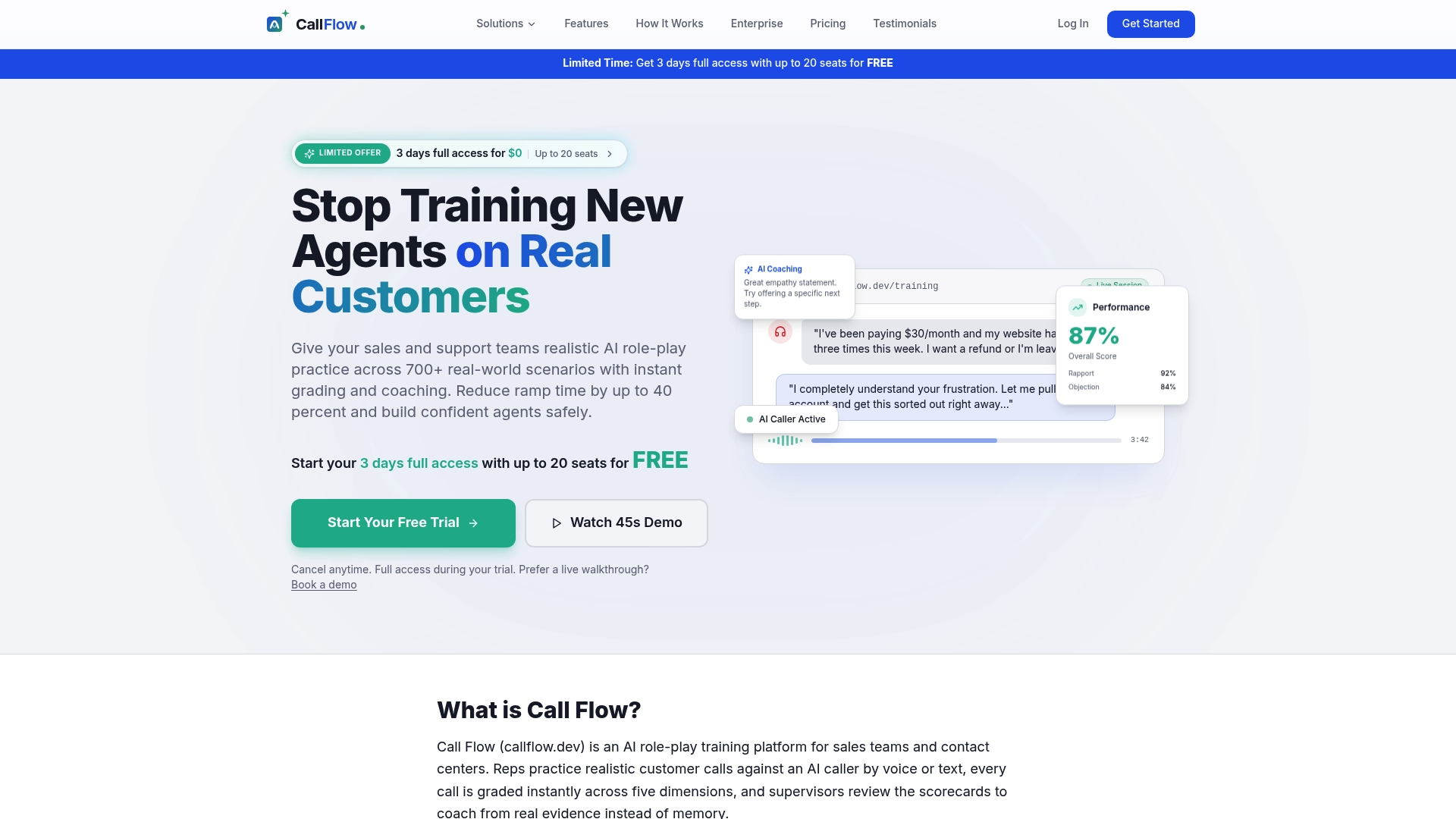
Call Flow is an AI role-play training platform for sales teams and contact centers. Reps practice discovery calls and handoff closes in realistic scenarios. They get instant feedback. Supervisors track skill progress across the team.
Plans are billed monthly or annually. Starter is $7.42 per month or $89 per year. Growth is $14.92 per month or $179 per year. Scale is $33.25 per month or $399 per year. Business and Enterprise plans have no published price. See Call Flow plans and pricing or the Business and Enterprise options. Trial access is risk-free, with full features. You can also start with a one-week sales call simulation pilot to get baseline scores.
FAQ
What are the steps in a discovery to demo handoff?
Close discovery by naming the demo and tying it to the buyer's pains. Confirm the agenda and book the slot on the call. Write the brief, send a recap within an hour, tailor the demo to two or three pains, and reconfirm the agenda the day before. The checklist comes from one practitioner guide.
What should a handoff brief include?
Include the account and players, the current state, the problem in the buyer's words, the business impact, one to three must-show capabilities, red flags and the desired next step. One source says a proper discovery lets an AE finish this in about 10 minutes. Keep it in a shared system.
Who prepares and delivers the demo after discovery?
In a split team, the AE hands the situation, pain and goals to the SE or solutions consultant, who builds and delivers the demo. A short AE and SE pre-call should settle the goal, the expected outcomes and the core message. In a small team, the AE does both, but still writes the brief first.
When should you skip or delay the demo?
Delay it when discovery shows no named pain, no number, no champion or no decision path. A playbook on discovery to demo conversion says a call with no champion should not convert to a demo. Book a second discovery call instead.
How long should the demo be?
As short as it can be while answering the buyer's question. One sales engineering group says a focused twenty-minute demo usually beats a ninety-minute walkthrough. Show two or three capabilities tied to stated pain.
Sources
- Discovery to Demo Handoff Done Right, Sell Successfully
- Deconstructed: The Discovery-to-Demo Handoff
- Discovery-to-Demo Handoff Checklist for AEs, Tech Sales Playbook
- Sales Handoffs: Speed Up Ramp Time and Customer Success
- Hand Off: What a Sales Handoff Is and How to Run One
- Discovery to Demo Conversion Playbook (2026), MapsLeads
- Discovery / Demo Call Template, OTP
- Discovery-to-Demo Alignment in Enterprise Sales, The Demo Lever
- The 5-Minute SE Handoff Checklist, Navattic
- How to build a presales process in 2026, Guideflow
- Sales Engineer Demo Workflow: 2026 Step-by-Step Guide
- Build Better Buyer-Focused Sales Demos Through Discovery, Sales Engineering Org
- Your Demo Isn't a Milestone. It's a Conversion Gate., SalesGSS
- Professional Services CRM Implementation Guide
- Features: AI Inbox, CRM & Automation, Sakhi.Chat