

A good call opening does four things in about ten seconds. It says who you are, asks for a short slice of time, gives a reason tied to this person, and ends with one question. Below you get that structure, 20 lines you can adapt, the lines to drop, the U.S. rules that apply, and a way to practice before real calls.
TL;DR
- Use four beats: name and company, permission or time limit, a reason specific to the prospect, one open question.
- Keep the opening to roughly 20 to 30 seconds. Then stop talking and let the prospect answer.
- Drop "Did I catch you at a bad time?" and any apologetic start. Be honest that the call is unplanned.
- For U.S. sales calls, say who you are and that you are selling. Do not call a sales call a "courtesy call."
- Practice each opener in role-play, with scoring, before you use it live.
Table of Contents
- How to start a call: the four beats
- What the data says about openers
- 20 call opening lines by situation
- Tailor the opener to the call
- Lines and habits to drop
- U.S. rules for the first seconds
- Our view on openers
- How to practice and assess an opener
- Practice openers with Callflow
- FAQ
- Sources
How to start a call: the four beats
Most advice on how to start a call comes down to the same short sequence. One sales-opening framework says a strong opener identifies the caller, asks permission or states a short duration, gives a prospect-specific reason, and asks one open question. Another 2026 guide says the first ten seconds should cover your name and company, the reason for calling, and either a permission request or a value-led transition.
Use this order:
- Identify. Say the prospect's first name, then your full name and company.
- Set the boundary. Ask for 30 seconds, or say the call is unplanned.
- Give the reason. Tie it to something you can observe: a role, a hire, a launch.
- Ask one question. Make it open. Then pause.
The opening is not a mini pitch. It earns the right to ask a question. Everything about your product comes later, in discovery. Our guide to sales call frameworks covers what follows the opener.
A template you can say out loud
"Hi Maria, this is Dan Ortiz from Northgate. I know I called out of the blue. Can I take 30 seconds to say why I called, and you can tell me if it makes sense?"
Then, after a yes:
"I saw you are hiring three support agents. Teams that grow that fast often struggle to get new hires ready. How are you handling ramp-up right now?"
That is name, company, honesty about the interruption, a time limit, a real reason, and one open question. Read it aloud. It takes under 25 seconds.
What the data says about openers
The best-known data set is a 2018 analysis of 90,380 cold calls. It reported that "How have you been?" led to a 10.01% meeting-booking rate against a 1.5% baseline. The same source describes correlation, not a controlled test. Treat the figure as a hint, not a guarantee. A friendly pattern interrupt can work, but it can also sound fake if you use it on a stranger in a flat voice.
The same analysis found that "Did I catch you at a bad time?" succeeded 0.9% of the time against that 1.5% baseline. A later summary of the same research put it at 40% lower odds of success than baseline. The line hands the prospect an easy exit.
A newer 2024 analysis of 300 million calls reported an 11.18% success rate for a permission-based opener. Its examples include "Could I get 30 seconds to tell you why I called?" It also describes a tailored permission opener: give context first, own the fact that the call is cold, then ask permission.
What do booked calls actually sound like? An October 2026 review of 171 booked calls found a role check, such as "Are you still the [title] at [company]?", in about 50% of them. About 38% used a timed ask such as "Can I take 20 seconds?" The percentages overlap, because one call can use several lines. This is one company's sample of calls that succeeded, so use it as a pattern to test, not as proof.

The common thread: confirm who you are talking to, be short, ask permission, and be honest.
20 call opening lines by situation
Adapt the words. Do not read them. Fill every bracket with a real detail.
Permission-based openers
Use these when you know little about the prospect.
- "Hi [Name], it's [You] from [Company]. Could I get 30 seconds to tell you why I called?"
- "[Name], this is [You] at [Company]. This is a cold call. Can I take 20 seconds, and you decide if we keep talking?"
- "Hi [Name], [You] with [Company]. I called without warning. Do you have a minute for a quick question?"
- "[Name], it's [You]. I'll be brief: I work with [role] teams on [one problem]. Is that something you handle?"
Guidance on permission openers suggests naming the prospect, yourself and your company, saying the call was unplanned, asking permission to explain, then moving to a relevant question.
Role-check openers (the "two yeses")
These get two small agreements before you ask for more. One guide to the pattern confirms the name, validates the role, then proposes a short exchange.
- "Is this [Name]?" (Yes.) "And you're the [title] at [Company], right?" (Yes.) "Great. [You] from [Company]. Do you have 30 seconds?"
- "Hi, are you still leading [function] at [Company]? Good. I'm [You]. I'll tell you why I called and you can stop me."
- "[Name]? You run the support floor at [Company], correct? I'm [You] from [Company]. Can I ask you one question about it?"
- "I'm trying to reach whoever owns agent training at [Company]. Is that you?"
Trigger-event openers
Use these when you can verify a recent change. A route recommended by one outbound team is to lead with research tied to hiring, funding, a launch or a role change, then end on a question.
- "Hi [Name], [You] from [Company]. I saw you opened [number] sales roles this month. How are you getting new reps up to speed?"
- "[Name], congratulations on the [launch]. I'm [You] at [Company]. When a product launches, calls tend to get harder. What are your agents hearing most?"
- "Hi [Name]. You joined [Company] as [title] in [month]. New leaders often review how the team is trained. Is that on your list?"
- "[Name], I saw your team grew past [number] people. Who handles onboarding for the new agents?"
Check the trigger first. A wrong detail is worse than none.
Warm openers (after an email or a LinkedIn message)
If there was earlier contact, say so. Do not pretend the call is cold.
- "Hi [Name], [You] from [Company]. I sent you a note on Tuesday about [topic]. Did it reach you?"
- "[Name], we connected on LinkedIn last week. I said I would call about [topic]. Is now a good time for two minutes?"
- "Hi [Name]. You opened our guide on [topic]. What made you look at it?"
Transparency and rapport openers
- "Hi [Name], [You] from [Company]. I'll be honest: you don't know me, and I'm calling to ask about [problem]. Fair to continue for a moment?"
- "[Name], this is [You]. I'm in sales, and I'm calling to see if [problem] is real for you. If not, I'll hang up."
- "Hi [Name], [You] from [Company]. How have you been?" Use this only if you can say it in a natural tone and go straight to your reason.
Gatekeeper openers
- "Hi, this is [You] from [Company]. I'm calling for [Name] about [topic]. Who handles that?"
- "Good morning. [You] at [Company]. I work with [role] teams at companies like yours. Who would be the right person for [function]?"
One widely cited gatekeeper line is about saying the most credible thing you can, which is experience with people like them. Keep that idea: name a real peer group, not a vague claim.
Tailor the opener to the call
Five opener types appear in the 2026 guide: permission-based, trigger-event, pattern-interrupt, transparency, and rapport-first. Pick by context, not by habit.
| Situation | Best opener type | Why |
|---|---|---|
| No contact, no research | Permission or transparency | You have nothing specific to cite. Be short and honest. |
| Verified hiring, funding or launch news | Trigger event | The reason is real and observable. |
| Email or LinkedIn sent first | Reference the earlier contact | You are not a stranger. Say so. |
| Gatekeeper answers | Role question | You need a name, not a pitch. |
| Inbound or referral | Rapport-first | The prospect asked, or someone vouched. |
Tie the reason to something you can see. One framework advises using a circumstance such as the prospect hiring SDRs, and then pausing after your open question instead of filling the silence.
Research takes time. If you build lists at scale, lead scoring models help you decide which accounts deserve a researched opener and which get a short permission line. For local business lists, map-based prospecting tools can supply the contact details you need to confirm a role before you dial.
Lines and habits to drop
- "Did I catch you at a bad time?" The data above shows it underperforms.
- Apologies. One guide advises acknowledging the interruption, pausing, and stating your reason, and warns against an apologetic start like "Sorry, I'm catching you out of the blue."
- Rushing. Slow down. A fast monotone sounds like a script.
- The salesy voice. Talk the way you would talk to a coworker.
- Product dumping. The same 2026 guide lists rushing, an overly salesy voice, premature product dumping, failing to confirm the contact, and generic openers among causes of early disengagement.
- Generic reasons. "We help companies like yours save money" fits every call, so it fits none.
- Two questions at once. Ask one. Wait.
U.S. rules for the first seconds
This part is not style. For covered outbound telemarketing sales calls, the FTC says you must promptly and truthfully disclose the seller's identity, that the purpose is to sell, and the nature of the offering before the pitch. Calling a sales call a "courtesy call" is misleading.
The same FTC page covers more:
- Calls to a person's home before 8 a.m. or after 9 p.m. local time at the place called are violations unless the person gave prior consent.
- Do-not-call requests, company-specific and National Registry, must be honored.
- Caller ID must be transmitted.
- Threats, intimidation, profanity and repeated calls meant to annoy are barred.
The Telemarketing Sales Rule has exemptions and applies differently to business-to-business calls, and states add their own rules. If your team calls at scale, ask your compliance lead or counsel which rules cover your calls. Then write the required disclosure into the opener so reps do not improvise it.
If you are considering automated dialing or AI voice agents for outbound campaigns, the same disclosure thinking applies: the opening still has to say who is calling and why.
Our view on openers
We see the same failure again and again. A rep learns a good opener, says it well in a team meeting, then freezes on a live call when the prospect says "Not interested" in the first four seconds. Knowing the line is not the skill. Saying it under pressure, and answering the first objection, is.
So we do not ask teams to memorize one best line. We ask for three things:
- Pick two or three openers that fit your calls and your voice.
- Practice each against different reactions: a yes, a "what's this about?", a brush-off, a gatekeeper.
- Score every attempt on the same criteria, so a manager and a rep agree on what "good" means.
That is why our platform scores calls instantly across five performance dimensions, with coaching notes after each attempt. The supervisor can review and override a score, and the scoring can be calibrated to the QA standards your team already uses. A line that sounds fine in a script often sounds rushed once you hear it back.
— Costa
How to practice and assess an opener
Use the four beats as a checklist. A manager can listen for these in each attempt:
- Was the rep clear in the first ten seconds?
- Was the reason truthful and tied to the prospect?
- Did the rep avoid rushing and product dumping?
- Did the rep ask one question?
- Did the rep leave space for the answer?
Then run the same opener in four contexts: truly cold, after an email, after a LinkedIn message, and after a trigger event. The 2026 guide recommends this split. Each context changes the first sentence.
A simple weekly routine:
- Monday: each rep picks one opener per context.
- Midweek: each rep runs five role-play attempts per opener and reads the feedback.
- Friday: the manager reviews the lowest scores with the rep and picks one fix.
Once the opener is steady, the next skill is the question after it. See our guide to probing questions in sales. For the end of the call, see call closing techniques. To test practice on a small group first, read how to pilot sales call simulation in one week.
Practice openers with Callflow

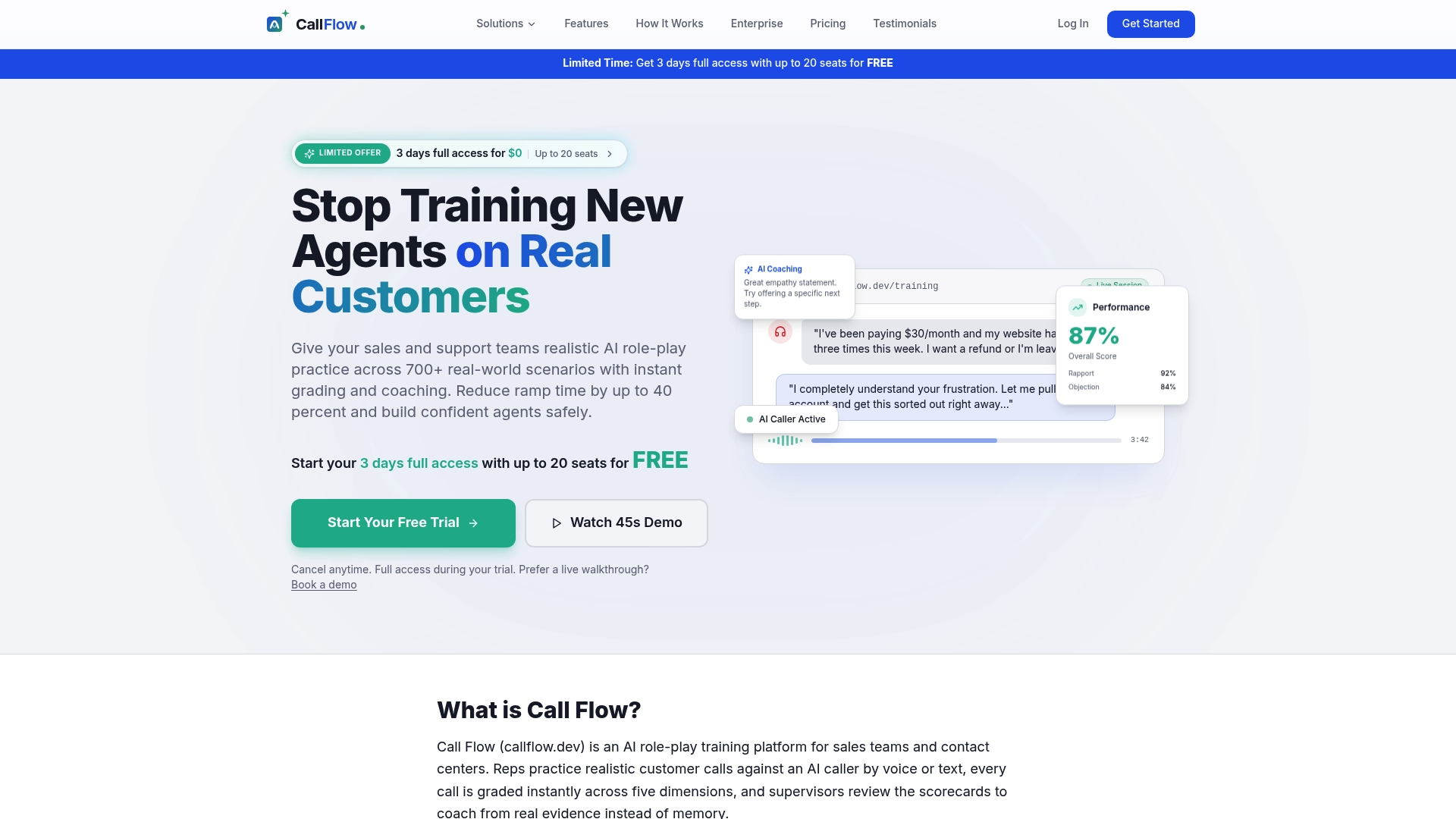
Callflow is an AI role-play platform for sales teams and contact centers. Reps practice realistic calls in voice or text mode. They get instant grading across five performance dimensions and coaching feedback they can act on. Managers get supervisor dashboards and skill analytics, and they can build custom scenarios, such as a cold call to a hiring manager or a call to a gatekeeper.
Plans are billed per team, monthly or annually. Starter is $7.42 per month or $89 per year. Growth is $14.92 per month or $179 per year. Scale is $33.25 per month or $399 per year. Business and Enterprise plans are quoted on request. You can see the details on the pricing page or the enterprise page, and the trial gives full access without risk.
Start with one scenario: your best opener, one skeptical prospect. Run it ten times and compare the scores. You can start on the Callflow site.
FAQ
How do you begin a call?
Say the person's name, then your name and company. Give a short reason for the call or ask for a short amount of time. Then ask one open question and pause. On a sales call, state that you are selling before you pitch.
How long should a call opening be?
About 20 to 30 seconds. HubSpot's guidance suggests a warm greeting, quick personalization from company research, and an opening of that length to build rapport, explain the purpose and give context. Shorter works for cold calls with no research.
What are the best sales call opening lines?
There is no single best line. Permission-based lines, such as asking for 30 seconds, and role checks are common in published call data. Pick the one that fits the context: cold, warm or trigger-based. Then test it with your own reps and your own scores.
Should you ask "Did I catch you at a bad time?"
No. In an analysis of 90,380 cold calls, it had a 0.9% success rate against a 1.5% baseline. Acknowledge that the call is unplanned and ask for 30 seconds instead.
Can I say it is a "courtesy call"?
Not if it is a sales call. The FTC says that calling a sales call a "courtesy call" is misleading for covered outbound telemarketing. Say who you are and that you are selling.
Sources
- Complying with the Telemarketing Sales Rule (FTC)
- Effective cold call opening lines: data-driven insights (2018)
- The best and worst cold call openers, 300 million calls (2024)
- The anatomy of successful cold calling (2018)
- Cold call opening lines from 171 booked calls (October 2026)
- Cold call opener: win the first thirty seconds
- Avoiding hang-ups: cold call opener essentials (2026)
- Cold call best practices
- Cold call opening lines that earn a minute
- Cold calling scripts and templates
- The best cold call opening lines to get prospects to stay on the line
- 30 sales call tips: how to start conversations (2026)
- Cold outbound for SaaS companies
- Lead scoring models for B2B
- AI-powered local prospecting