

AI training gets adopted when people practice on real work, get feedback fast, and have approved tools and leaders behind them. A course alone does not do it. For sales and contact center teams, the strongest form of that practice is realistic role play with instant grading. That is what Call Flow is built for.
This guide covers what the research says about adoption, where rollouts break, a step-by-step plan, and the numbers to track.
TL;DR
- Training raises AI use, but lasting use needs approved tools, workflow fit and peers who learn together.
- The main barriers are low trust, fear of job loss, thin training and poor workflow fit.
- Build in stages: shared basics, then role-based practice, then habits built into daily work.
- For sales and contact center teams, scenario practice with fast feedback beats generic refreshers.
- Measure use, accuracy and business results, not course completion.
Table of Contents
- What AI training adoption means
- Why a course alone is not enough
- The barriers that stall adoption
- A rollout plan that holds up
- Adoption in sales and contact center teams
- Leadership, culture and ongoing support
- How to measure whether it worked
- Our perspective
- Start with a trial
- FAQ
- Sources
What AI training adoption means
The phrase has two meanings. One is training employees to use AI tools. The other is getting a team to actually adopt a training program that uses AI. Both come down to the same thing: do people use what they learned, week after week?
The evidence says training helps. A 2026 analysis in California Management Review reports that employees who used AI for their job and had AI skills training in the past year saved about 10 hours a week, against five hours for those without training. The same piece warns that sustained productivity depends on approved tools, integrated workflows and colleagues learning alongside one another.
So adoption is not a single event. It is a habit, and habits need practice, support and a clear reason.
Why a course alone is not enough
Most companies know training matters. Few deliver it. SHRM's U.S. AI in the Workplace Playbook cites a 2023 Boston Consulting Group survey in which 86% of workers saw AI training as essential, while only 14% of frontline employees had received it. It also cites a Randstad survey in which 13% of workers were offered AI-specific training.
Hours matter too. BCG's 2025 workplace research found regular frontline AI use at 51%, while only about one-third of employees said they had been properly trained. Regular use was sharply higher among employees who got at least five hours of training and had access to in-person training and coaching.
The coaching part is the lesson. People adopt what they have tried, gotten wrong, and corrected with help.
BCG's 2026 workforce research makes the same point from the value side. It estimates that about 10% of AI value comes from algorithms, 20% from implementation technology and 70% from rethinking the people component. If you spend most of your budget on tools and a sliver on people, the math works against you.

The barriers that stall adoption
Research from the Wharton AI & Analytics initiative groups the barriers into trust and displacement fears, gaps in employee training, and difficulty fitting AI into workflows. Each one needs a different fix.
Trust and job-security worries
BCG found that employees at organizations redesigning work around AI worry more about their jobs: 46% versus 34% at less advanced organizations. Silence makes this worse. Say plainly how roles will change. Pair that with upskilling and a path to better roles.
Weak or generic training
A one-hour webinar does not change how someone handles a hard call or a tricky prompt. Training works when it is tied to the person's role and tasks, with hands-on practice. The Wharton work points to role-relevant examples and practice as the fix.
Poor change management
SHRM's U.S. research found only 17% of HR professionals described their organization's AI implementation as highly successful, and 43% reported using change-management best practices. The gap is wide. Where those practices were used, 26% of HR leaders rated outcomes very or extremely successful, against 9% where they were absent.
The midcycle dip
Early excitement fades. MIT Sloan Management Review describes a midcycle enthusiasm dip, function-specific training needs and cultural resistance as challenges when scaling generative AI. Champion networks are one remedy used in practice. Plan for the dip before it arrives.
Missing tools
If people lack approved tools, they find their own. BCG reports that more than half of employees without needed tools said they would find alternatives and use them anyway. Training on a tool nobody can access is wasted effort.
A rollout plan that holds up
BCG's 2025 capability-building guide describes three stages: foundational learning, applied learning on real workflows, and embedded learning through role expectations, support and incentives. Here is a practical plan built on that shape.
- Set the why. Leaders explain what AI is for in your team and what it is not for. Cover job impact honestly. Silence reads as bad news.
- Give people approved tools. Decide which tools are allowed and give access before the training starts. Write short, plain rules for data and customer information.
- Teach shared basics. SHRM's playbook advises starting with organization-wide AI fluency: concepts, vocabulary, prompting and how to check AI output.
- Move to role-based practice. Split paths by job. A sales rep and a support agent do not need the same drills. D2L recommends realistic, role-based scenarios where employees generate, inspect, find errors in and correct AI output before using it at work.
- Protect time. Set aside learning hours in the schedule. If practice only happens after hours, it will not happen.
- Name champions. Pick a few early adopters who coach peers. SHRM recommends AI champions, protected experimentation time and small pilots tied to real functions.
- Reinforce and measure. Hold office hours, share wins, and track the numbers in the measurement section below.
Start with a pilot on one team. Fix what breaks. Then scale.
Adoption in sales and contact center teams
These teams have a particular problem. Their work happens live, with a customer on the line. You cannot let a new agent learn on real customers and hope for the best. Long ramp times and under-prepared agents are the pain points we hear named most often in this field.
COPC's 2026 contact center guide says to train agents on where AI fits, when to trust it, when to use human judgment and when to escalate. It also recommends scenario-based practice built on difficult customer journeys, sensitive escalations and handoffs between AI tools and agents, rather than broad generic refreshers. Then use quality and customer-outcome data to tell training problems apart from workflow, policy, knowledge or tool-design problems.
That is a description of role play. The agent faces a realistic call, makes choices, and sees what happened. The missing piece in most programs is the second half: fast, specific feedback. A live coach cannot sit in on every practice call for every agent. An AI grader can.
Call Flow is an AI role-play training platform for sales teams and contact centers. Agents practice realistic scenarios that mimic actual customer interactions, in voice or text. Each session is graded instantly across five performance dimensions, with coaching feedback the agent can act on. Supervisors get dashboards and skill analytics, and they can review and override scores. Scoring is calibrated to match existing QA standards, so grades line up with how your team already judges calls.
What this does for adoption: practice becomes something agents can do on their own, on their own schedule, and see progress. Gamification adds a reason to come back. Custom scenario tools let a team build drills from its own hard calls. For more on how this works, see our guide to AI role play training for sales and contact centers and our walkthrough of AI contact center training. Managers can read how to practice, coach and measure with AI sales training.
Leadership, culture and ongoing support
Training ends. Adoption has to keep going. RAND's guide for U.S. leaders says that helpdesks, mentoring and communities of practice improve confidence and proficiency, while comprehensive training can increase acceptance of AI. It adds that leaders should explain the why, model appropriate use, give time and resources, and reward responsible experimentation.
Leaders matter more than most plans admit. BCG reports that strong leadership support lifted the share of employees feeling positive about generative AI from 15% to 55%.
Some practical moves:
- Managers use the tools in front of their teams and share what worked.
- Mistakes made while learning are not punished.
- One person owns the program, with clear rules and a place to ask questions.
- Wins are shared inside the company, with real examples.
Building company-wide support for AI also benefits from understanding the wider shift. This overview of AI trends transforming business gives helpful context for that conversation with executives.
How to measure whether it worked
Course completion tells you who clicked through. It does not tell you who changed. SHRM recommends measuring AI initiatives through productivity improvements, accuracy gains, successful system integration, employee adoption rates and return on investment.
GitHub's AI workforce playbook splits metrics in two. Leading indicators, such as monthly active users and user segments, come first. Lagging indicators, such as productivity, quality and satisfaction, follow. That split is useful because business results take months to show, while usage shows up in weeks.
D2L adds a simple method: compare competencies before and after training, and use workplace performance measures and feedback from employees and managers.
For a sales or contact center team, a working scorecard looks like this:
| Type | Metric | What it tells you |
|---|---|---|
| Leading | Weekly active practice users | Whether people are using the training |
| Leading | Score change across practice sessions | Whether skills are improving |
| Leading | Share of agents by skill level | Where to focus coaching |
| Lagging | Ramp time for new hires | How fast agents get ready |
| Lagging | First-call resolution | Whether calls are solved |
| Lagging | Customer satisfaction | How customers feel about the result |
| Lagging | Turnover | Whether confident agents stay |
If scores improve in practice but call results do not, look at the workflow, policy or knowledge base before blaming the agent. That is the COPC point about separating training problems from system problems.
Teams that want to see how ramp time moves can read our piece on cutting ramp 28% with AI role play in call center onboarding. The broader context is in workforce learning trends for 2026.
Our perspective
Most AI training programs fail on the same point. People learn about the tool, then go back to work with nobody watching and nothing to practice on.
We build for the other approach. Skills come from repetition with feedback. A rep who rehearses a hard objection ten times, and sees a grade and a note after each try, is more ready than one who watched a video once.
That is why Call Flow gives instant grading across five performance dimensions, plus coaching the agent can use right away. It is also why supervisors can review and override scores. Managers keep control, and scoring stays aligned with the QA standards the team already trusts.
Our published results show a 147% faster ramp time and a 129% improvement in resolution rates. We design the platform to shorten ramp, prepare agents before they face live customers, and give leaders numbers they can act on.
Adoption follows from practice that feels real and pays off quickly. Give people that, and they come back on their own.
Costa
Start with a trial
Call Flow runs as a subscription, billed monthly or annually per team, with tiered seat plans. You can try the full feature set during a risk-free trial before you commit. Published prices on the pricing page:
| Plan | Monthly | Annual |
|---|---|---|
| Starter | $7.42 per month | $89 per year |
| Growth | $14.92 per month | $179 per year |
| Scale | $33.25 per month | $399 per year |
Larger teams can look at the Business and Enterprise plans on the enterprise page.
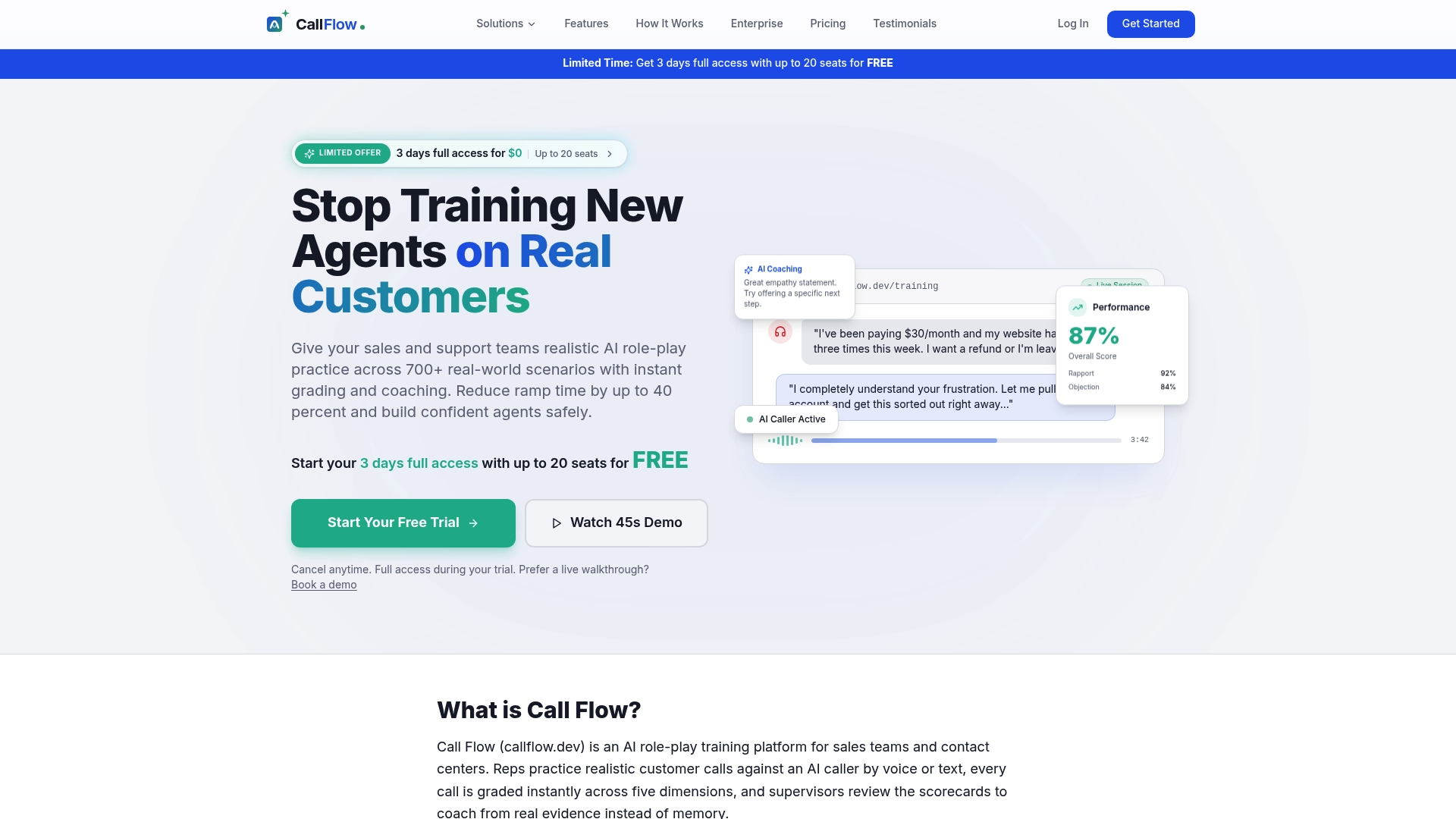
Setup is self-serve. Pick a scenario from the library, or build one from your own hardest calls, and run a first pilot with one team.
FAQ
What is the difference between AI training and AI adoption?
AI training teaches people skills. AI adoption is whether they keep using those skills at work. A 2026 California Management Review analysis found that training lifts usage, but lasting productivity also needs approved tools and workflow integration. Plan both together.
How many hours of training do employees need?
There is no single number. BCG's 2025 research found regular AI use was sharply higher among employees who received at least five hours of training, especially with coaching. Treat five hours as a floor and build in ongoing practice.
How do you get skeptical employees on board?
Start with honesty about how roles will change. Offer upskilling and a path to better roles, and give hands-on practice that relates to their own job. The Wharton research ties trust to reliable, transparent AI and role-relevant guidance. Peer champions help too.
How should contact centers train agents to work with AI?
Teach where AI fits, when to trust it, when to use judgment and when to escalate. Use scenario practice on difficult calls and handoffs, as COPC recommends. Call Flow gives agents that practice in voice or text, graded instantly.
What should we measure first?
Start with usage: active practice users and score changes. Then track ramp time, first-call resolution and customer satisfaction. SHRM advises looking beyond course completion to productivity, accuracy, adoption rates and return on investment.
Sources
- Why AI Training Is Driving Adoption but Not Sustainable Productivity (California Management Review)
- AI in the Workplace Playbook (SHRM)
- From Adoption to Empowerment: Shaping the AI-Driven Workforce of Tomorrow (SHRM)
- AI Transformation Is a Workforce Transformation (BCG)
- AI at Work 2025: Momentum Builds, but Gaps Remain (BCG)
- To Unlock the Full Value of AI, Invest in Your People (BCG)
- How to Train Employees on Generative AI (D2L)
- CX Training and Customer Experience Workflows in the AI Era (COPC)
- AI Adoption research paper (Wharton AI & Analytics)
- How to Scale GenAI in the Workplace (MIT Sloan Management Review)
- Leading with Artificial Intelligence: Insights for U.S. Leaders (RAND)
- GitHub's internal playbook for building an AI-powered workforce
- AI News & Trends: How Artificial Intelligence Is Transforming Business