

Peer coaching programs pair colleagues of equal status so they can practice skills, work through goals, and hold each other accountable without a manager in the room. They fit best for leadership development, onboarding, and building a culture where feedback flows sideways instead of only down. Formats range from a single confidential session to structured cycles running three to six months.
TL;DR:
- Peer coaching programs are most effective when paired with structured cycles lasting three to six months, with circles of four to five participants generally more resilient than dyads.
- Successful programs require clear purpose, measurable goals linked to task interdependence, and careful matching based on topic and expertise, not just seniority.
- Leadership support must include protected time, proper funding for coordinators, confidentiality protocols, and visible participation to ensure ongoing engagement and trust.
- Logistics such as dropout management, dedicated coordinators, and avoiding advice-only coaching prevent program failure, which is often due to operational issues rather than coaching quality.
- Integrating structured practice tools like AI-powered role-plays can enhance skills between sessions, leading to faster skill development and more effective coaching outcomes.
Table of Contents
- What Is Peer Coaching, and What Does It Actually Deliver?
- Which Program Format Fits Your Team?
- Setting Purpose and Success Criteria Before Launch
- Matching, Training, and Who Runs the Program
- Running a Session: Template and Sample Agenda
- What to Measure, and How Often
- Where Peer Coaching Programs Actually Break
- How Role-Play Tools Fit Alongside Peer Coaching
- Leadership's Job Is Logistics, Not Cheerleading
- Fitting Peer Coaching Into Your Broader L&D Strategy
- When Peer Coaching Is Worth the Investment
- A Complementary Way to Build Practice Reps Between Sessions
- Sources
- FAQ
What Is Peer Coaching, and What Does It Actually Deliver?
Stanford University Press defines peer coaching as a focused, mutual helping relationship between people of roughly equal status, built on trust, clear boundaries, and structured questioning. Neither party acts as manager or subject-matter expert. That distinction separates peer coaching from mentoring, which usually involves an experience gap, and from therapy, which addresses clinical needs a peer coaching program is never designed to handle.
Done well, the format builds four things: repeated practice under low stakes, structured reflection, mutual accountability, and a culture where asking for help stops looking like a weakness.
- Skill rehearsal in a setting with no performance review attached
- Reflection prompts that surface blind spots faster than solo journaling
- Peer-level accountability that outlasts a single training session
- A visible signal that colleagues, not just managers, own each other's growth
The catch: outcomes depend heavily on context. One study on leader coaching and team performance found the effect on team results was strongest where task interdependence was high. Loosely connected teams saw weaker translation into business outcomes. Treat peer coaching as a strong development lever, not a guaranteed performance fix.
Which Program Format Fits Your Team?
Two structural choices drive most of a program's resilience: pair versus group, and single session versus extended cycle.
- Dyads (pairs) are simple to run but collapse fast when one person drops out.
- Circles of 4 to 5 absorb dropout far better and keep momentum when a schedule conflict takes one member offline.
- Single sessions work for a specific question or a one-time skill check.
- Multi-month cycles suit deeper behavior change, like a first-time manager building delegation habits.
A widely cited 2025 implementation model recommends circles of about 4 to 5 participants, with roughly five hours of coaching given and five received per person across three to six months. Google's g2g program takes a different angle: it runs both single confidential sessions and multi-month engagements side by side, which widens access for employees who want a quick conversation without committing to months of scheduled contact.
Pro Tip: If you can only launch one format this quarter, start with circles over dyads. A five-person circle survives one dropout without a coordinator scrambling to rematch anyone.
Setting Purpose and Success Criteria Before Launch
A program without a written purpose drifts into whatever the loudest participant wants it to be. Before recruiting a single coach or coachee, nail down three things.
- Write the purpose in one sentence. "This program helps new managers practice delegation and feedback conversations" is usable; "support employee development" is not.
- Map each goal to a metric you can actually observe — completed action items, manager-reported behavior shifts, or reduced escalations, rather than vague sentiment.
- Check task interdependence before promising business impact. Coaching cases tied to shared workflows or team goals translate into measurable outcomes more reliably than one-off individual concerns, especially on tightly coupled teams.
Skipping this step is the single most common reason a pilot looks good on paper and produces nothing measurable six months later.
Matching, Training, and Who Runs the Program
Matching quality determines whether sessions feel useful or forced. Google's g2g model matches on topic, location preference, and coach expertise, then layers in training on listening and asking powerful questions so coaches resist the urge to just hand out advice.
- Match on the specific skill or topic at stake, not just seniority or department
- Train every coach on active listening, open questioning, and the discipline of not solving the problem for their partner
- Give the coordinator explicit ownership of first contact, attendance tracking, and rematching when a pair or circle stalls
- Set confidentiality limits up front, and define an escalation path for anything touching safety, harassment, or performance issues that a peer coach isn't equipped to handle
Pro Tip: Put the escalation rule in writing before day one. "If a session raises a safety or HR issue, the coach loops in the coordinator within 24 hours" removes ambiguity when it actually matters.
Coordinators are not optional overhead. A mixed methods process evaluation of a peer coaching intervention found that programs with a defined coordinator role and integration into existing group structures saw noticeably better uptake and follow-through than programs without one.
Running a Session: Template and Sample Agenda
Peer coaching works best as a repeatable loop: plan, practice or observe, reflect, then test the change back at work. A guide to peer coaching for health professions educators frames this cycle as benefiting both the person being coached and the person observing.
A one-page case template keeps sessions from turning into venting or informal performance reviews. Include:
- Desired outcome for this session
- Relevant facts (skip opinions and assumptions)
- What the coachee has already tried
- Two or three key questions the coach will ask
- The action the coachee chooses to take
- Who owns that action
- A review date for the next check-in
For pacing, a dyad session runs comfortably in 30 to 45 minutes; a circle session needs 60 to 90 minutes to give everyone airtime. Some programs add live observation or recorded practice calls as a follow-up artifact, giving the coachee something concrete to revisit before the next session.
What to Measure, and How Often
Satisfaction surveys tell you people enjoyed the conversation. They tell you almost nothing about whether behavior changed.
Track leading indicators instead: enrollment rate, first-contact completion, attendance, program completion, rematching frequency, and whether chosen actions actually got followed through on.
The overlooked metric: rematching frequency. A high rematch rate usually signals a matching or logistics problem, not a coaching problem, and it's one of the clearest early warnings a program is about to lose participants.
For teams with high task interdependence, connect these behavior measures to actual business outcomes, like reduced ramp time or fewer escalations. A process evaluation of peer coaching implementation recommends tracking these leading indicators over satisfaction scores alone, then running quarterly debriefs to catch problems before they compound. Pairing this with a training metrics dashboard makes the quarterly review far less painful to assemble.
Where Peer Coaching Programs Actually Break
Programs rarely fail because the coaching itself was bad. They fail on logistics.
- Dropout with no backup plan. A dyad losing one person kills that pairing outright; a circle absorbs it.
- No coordinator. Without someone owning rematching, stalled pairs just quietly stop meeting.
- Surveillance perception. If participants suspect notes are feeding into performance reviews, honesty disappears from sessions.
- The advice trap. Untrained coaches default to telling instead of asking, which flattens the mutual-learning dynamic the whole model depends on.
- No protected time. Evaluation research found that a lack of dedicated time was one of the biggest barriers participants cited, even when they valued the structure and colleague interaction itself.
Pro Tip: Default to circles of 4 to 5 or build a standing waitlist from day one. Both approaches absorb dropout without forcing a coordinator to rebuild the roster mid-cycle.
How Role-Play Tools Fit Alongside Peer Coaching
Peer coaching gives people reflection and accountability. It doesn't always give them repetition under realistic conditions, and that's where structured practice tools earn their place as a complement, not a substitute.
- Repeated scenario practice between peer sessions keeps skills sharp without waiting for the next scheduled meeting
- Standardized scenarios let every participant practice the same situation, which makes coaching conversations more comparable
- Objective, instant feedback gives coaches a starting point instead of relying purely on memory of how a call went
- Supervisor dashboards let coordinators see skill trends across a cohort, not just anecdotal session notes
A sales team running peer coaching circles, for example, might use practice calls between sessions so coaches spend their time on reflection and judgment calls rather than re-explaining basic mechanics.
Leadership's Job Is Logistics, Not Cheerleading
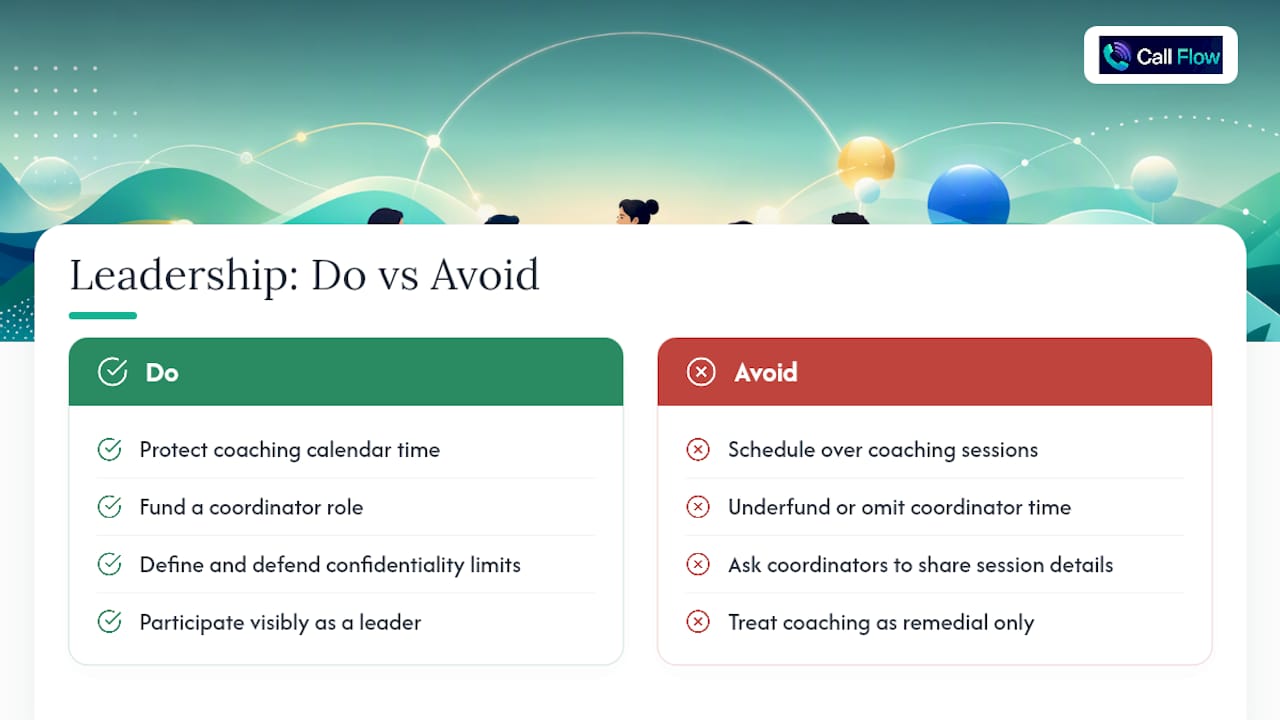
Leadership support for peer coaching isn't a kickoff speech and a Slack announcement. It's protecting the calendar time, funding the coordinator role, and modeling the behavior in their own meetings.
The single most concrete thing leadership controls is protected time. If managers schedule over coaching sessions the moment a deadline gets tight, the program dies quietly within two cycles, regardless of how good the training was. Leaders need to treat coaching slots the way they treat client meetings: fixed, rarely moved, and visibly respected.
Budget matters too, but not in the way most people assume. The expensive part isn't the training curriculum. It's the coordinator's time to handle matching, track attendance, and manage rematching when someone drops out. Underfunding that role is the fastest way to watch a promising pilot stall.
Leaders also set the tone on confidentiality. If a senior manager asks a coordinator to share what was discussed in a session, that single request can undo months of trust-building across the whole cohort. Confidentiality limits need to be defined once, communicated clearly, and defended consistently from the top.
Finally, visible participation matters more than most leaders expect. When a director or VP joins a peer circle as a participant rather than an observer, it signals the program is real development, not remedial training reserved for people who are struggling. That single act often does more for adoption than any amount of internal marketing.
Fitting Peer Coaching Into Your Broader L&D Strategy
Peer coaching works best as one layer in a stack, not a standalone initiative competing for attention against everything else on the training calendar.
Pair it with formal onboarding by using buddy system onboarding as the entry point, then transition new hires into a longer peer coaching circle once they've cleared their first 90 days. The buddy relationship handles day-to-day orientation questions; the coaching circle handles deeper skill and confidence building once the basics are covered.
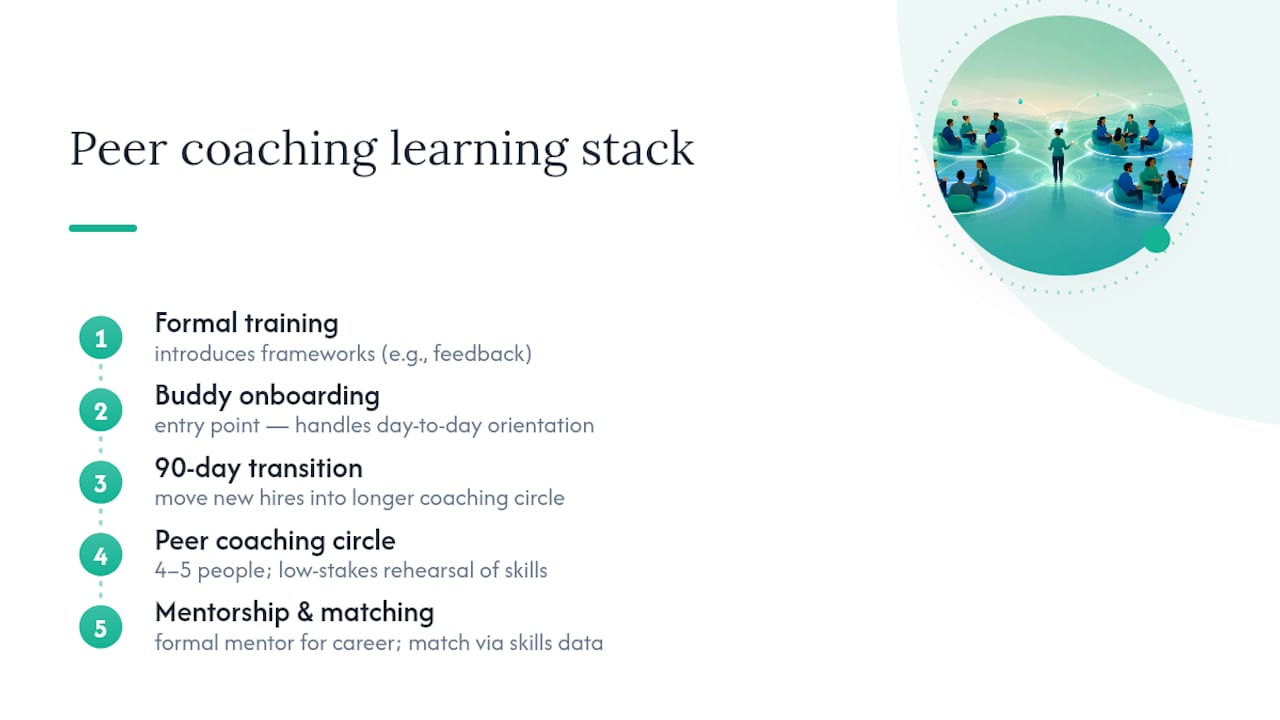
Connect it to existing mentorship and coaching programs rather than running them in parallel with no overlap. A new manager might have a formal mentor for career guidance and a peer coaching circle for practicing delegation conversations in real time. The two serve different needs and rarely compete for the same calendar slot if you're explicit about which is which.
Use group coaching strategies from your peer program to reinforce whatever skills your formal training already introduced. If a leadership course teaches a feedback framework, the peer circle is where people actually rehearse it under low stakes before using it on a direct report. Training introduces the concept; peer coaching is where it gets tested.
Finally, treat peer coaching data as part of your broader skills picture. If your organization already tracks competency gaps through performance reviews or skills assessments, feed those gaps into how you match peer coaching pairs. A manager's guide to hybrid team training covers how to keep this kind of coordination consistent when your team isn't sitting in the same room.
When Peer Coaching Is Worth the Investment
Peer coaching earns its place when teams need repeated skill practice, when new leaders need a low-stakes place to stretch, or when work is interdependent enough that one person's growth moves the whole team forward. It falls flat when organizations fund the kickoff and skip the coordinator, the templates, and the quarterly review that keep it alive.
— Costa
A Complementary Way to Build Practice Reps Between Sessions
Peer coaching circles give people reflection and accountability, but the time between sessions is where skills either sharpen or go stale. Callflow fills that gap with AI-powered role-play scenarios that give agents and sales reps unlimited practice reps, graded instantly across five performance dimensions, so coaches spend their limited session time on judgment calls instead of re-explaining basics.
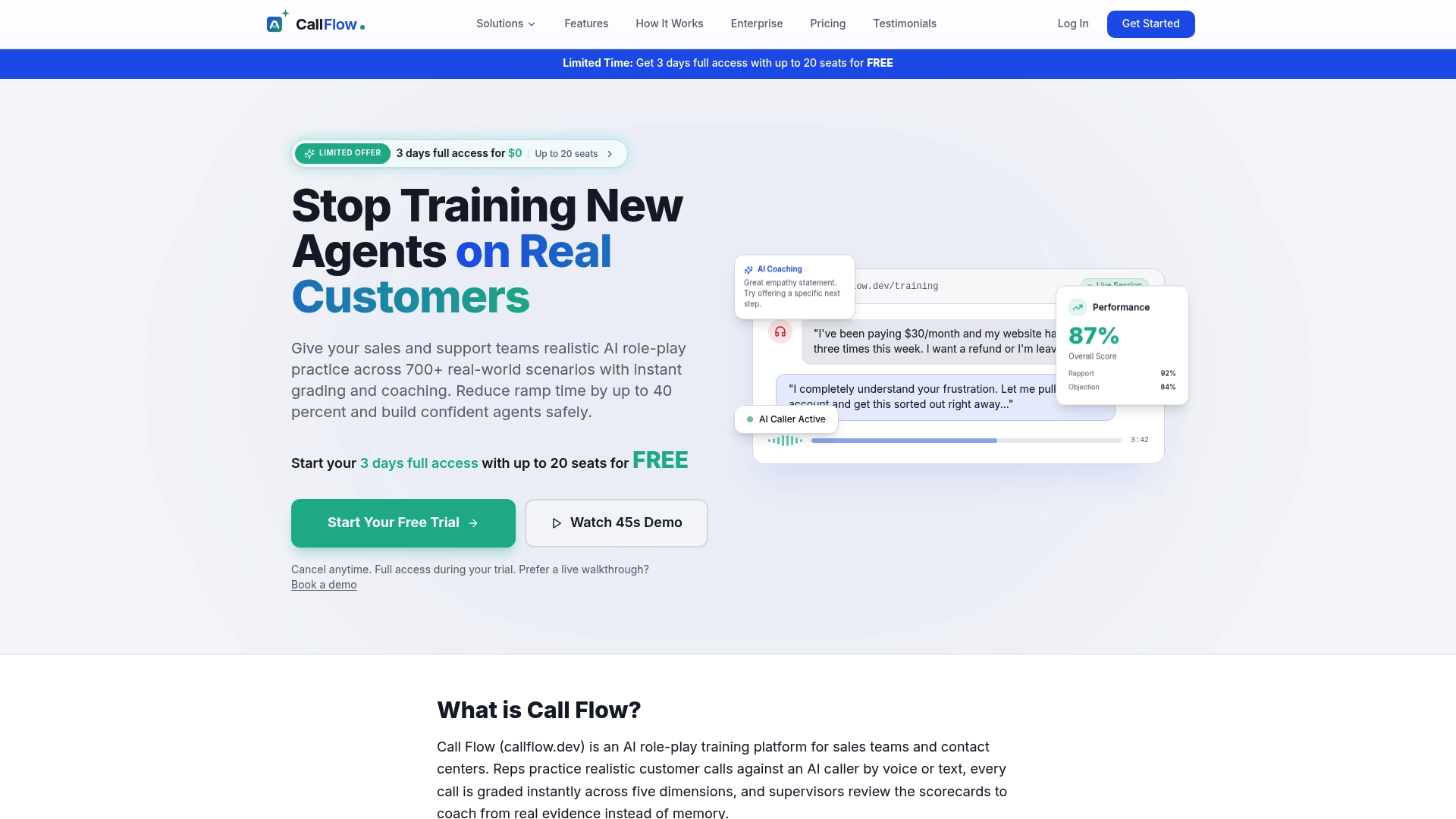
Coordinators running a peer coaching cycle can pair it with Callflow's supervisor dashboards to see skill trends across a whole cohort between sessions, not just anecdotal notes from the last meeting. Teams report 147% faster ramp time using structured practice this way. If you're running a program for a sales or contact center team, check pricing plans starting at $7.42 per month, or look at enterprise options if you need custom onboarding and integrated dashboards. A risk-free trial gives full access, so you can see whether it fits before committing.
Sources
- Peer Coaching at Work: Introduction | Stanford University Press
- Coaching for everyone: The amplified impact of peer coaching | Google re:Work
- A mixed methods process evaluation of the implementation of a peer coaching intervention | BMC Health Services Research
FAQ
What Are the 5 C's of Coaching?
Definitions vary across frameworks, and no single "5 C's" model applies universally to peer coaching. Most peer coaching guides instead emphasize trust, confidentiality, structured questioning, mutual accountability, and clear boundaries as the core pillars, per Stanford's definition of peer coaching.
What Is the 70/30 Rule in Coaching?
The 70/30 rule generally refers to a coach spending roughly 70% of a session listening and asking questions, and 30% offering structure or input. In peer coaching specifically, that balance skews even further toward listening, since the coach is a peer, not an expert authority.
What Does a Peer Coach Do?
A peer coach helps a colleague of equal status think through a specific goal or challenge using structured questions, active listening, and reflection, without acting as a manager or subject-matter authority. Google's g2g program trains coaches specifically in listening and asking powerful questions rather than giving direct advice.
What Type of Coaching Is Most in Demand?
Leadership development and skill-practice coaching, especially for new or first-time managers, tend to see the highest demand inside organizations right now. Sales and customer-facing teams also increasingly combine peer coaching with structured practice tools like Callflow to build both reflection and repetition into the same development cycle.
How Much Does Callflow Cost?
Callflow's Starter plan runs $7.42 per month or $89 per year, with Growth and Scale tiers available for larger teams, all listed on the pricing page. Business and Enterprise plans include custom onboarding and dashboard features, with pricing available on request through the enterprise page.