

An enterprise training rollout is the process of taking a finished training program and putting it in front of every person who needs it, in a set order, with owners, messages and measures. The plan that works has five parts: a needs check, a pilot, staged cohorts, manager follow-up and a metric tied to a business result. For sales and contact center teams, the strongest rollouts add live practice, because agents change behavior by doing the call, not by finishing a course.
This guide gives you the steps, a timeline, the owners and the metrics. It is written for sales managers, contact center leaders, training directors, HR leads and team leaders who have to show a result, not just a completion rate.
TL;DR
- Treat a rollout as a project with phases: plan, pilot, launch, reinforce, evaluate. Standard programs often take four to eight weeks from planning to full launch, and large or global ones take longer.
- Pilot first. In a BCG survey, 61% of companies that piloted a reskilling program for more than a year before scaling reported positive returns, against 26% of those that did not pilot.
- Set one measurable objective per audience before you build anything, such as ramp time, first-call resolution or customer satisfaction.
- Managers decide whether skills stick. Give them a script, a schedule and a dashboard.
- For call-based roles, put practice inside the rollout. We built Call Flow for this step.
Table of Contents
- What an enterprise training rollout includes
- Step 1: Find the gap and set a measurable goal
- Step 2: Build the plan, owners and timeline
- Step 3: Communicate before anyone logs in
- Step 4: Pilot, then scale in cohorts
- Step 5: Make practice part of the rollout
- Step 6: Reinforce with managers
- Step 7: Measure what matters
- Common rollout mistakes
- What this looks like on Call Flow
- Our view: practice is the missing phase
- FAQ
- Sources
What an enterprise training rollout includes
A rollout starts when the training is ready and ends when its effect is measured. One checklist-style definition splits it into eight phases: strategy and planning, stakeholder engagement, technical setup, content readiness, learner communications, pilot, full rollout, and post-rollout evaluation.
The U.S. Government Accountability Office describes the same flow in four parts: planning, design and development, implementation, and evaluation. Its 2026 guide on training and development says evaluation should feed back into planning, not sit at the end as a final report. That matters for you. A rollout is a loop. What you learn in week six changes what you do in week ten.
Three questions keep the plan honest:
- Who must change what they do, and by when?
- Who owns each step?
- What number will show it worked?
If you cannot answer these in one page, the rollout is not ready.
Step 1: Find the gap and set a measurable goal
Do not start with content. Start with the gap.
The CDC's guidance on training needs analysis says to describe the gap by looking at the current situation, not at solutions. It also says to involve people from the learner audience and to capture their barriers, preferences and reading levels.
For a sales or support team, the gap is usually visible in data you already have:
- New agents take too long to reach quota or a target handle quality.
- First-call resolution varies a lot between agents.
- Customer satisfaction drops on one call type, such as billing disputes or cancellations.
- Turnover is highest in the first 90 days.
Then write objectives that can be observed. The CDC's guidance on learning objectives asks that progress be observable or quantifiable, and that the evaluation method (a test, a presentation, a simulation) be chosen while you write the objective. "Agents understand the refund policy" is not measurable. "Agents handle a refund objection and score at least 4 out of 5 on empathy and accuracy in a scored practice call" is.
The GAO guide also advises tying training goals to the organization's strategic plans. Pick one business result per audience. Do not promise ramp time, satisfaction and retention from one program.
A worked example
A contact center with 120 agents has a 14-week ramp to full productivity. The training director sets one goal: cut ramp to 10 weeks for the next three hiring classes. The measurable objective for week four is that every new agent completes six scored practice calls on the top three call types and reaches a set score. The business metric is time to target first-call resolution. Everything else in the rollout serves that one line.
Step 2: Build the plan, owners and timeline
A rollout plan is a schedule with named people. The Connecticut Department of Social Services training management plan template asks for milestone-level tasks with a responsible party on each, a staffing balance so service continues while staff are in training, and a rule for make-up and remedial sessions. Contact centers need that last point. You cannot pull forty agents off the phones at once.
Timelines vary with size. Two published examples show the range:
| Scope | Timeline | Pilot size |
|---|---|---|
| Standard program | Typically 4 to 8 weeks from planning to full launch | A pilot group before full rollout |
| 500+ employees, 2026 checklist | 12 weeks: discovery, setup, pilot, communications, launch in week 12, ROI reporting in months 4 to 6 | 50 to 100 employees |
The same 500+ checklist advises a department-by-department go-live over two weeks, daily adoption checks in the first two weeks and a dedicated support channel for 30 days.
For owners, a short list is enough:
- Executive sponsor: removes blockers and speaks at launch.
- Training or L&D lead: owns content, schedule and results.
- IT or systems admin: access, logins, integrations.
- HR: communications, policy, links to onboarding and performance reviews.
- Line managers: coaching and follow-up after each session.
Add a go or no-go date before launch. Name who can say stop.
Step 3: Communicate before anyone logs in
Most rollouts lose people in the gap between announcement and first session. Training Industry's communication matrix advice is simple and useful: list who, what, how, when and owner for every message. Use channels people already read. Publish a manager FAQ. Message managers before learners so they can answer questions on day one. Track enrollment at a set interval.
Training Industry also notes that the rollout communication plan should say what is in it for the learner. For agents, that can be better performance, easier calls, a faster path to bonus or a promotion. Say it plainly. Do not write "mandatory training" in the subject line and stop there.
A minimal matrix for a contact center:
| Who | What | How | When | Owner |
|---|---|---|---|---|
| Team leaders | Goal, schedule, FAQ | Meeting plus email | 2 weeks before | Training lead |
| Agents | Why it matters, how long it takes | Team leader, then email | 1 week before | Team leader |
| Executives | Progress and early results | One-page update | Every 2 weeks | Training lead |
Step 4: Pilot, then scale in cohorts
Pilots find the problems that planning misses: a login that fails, a scenario that does not match real calls, a schedule that clashes with peak hours.
The evidence favors it. BCG's 2025 reskilling survey found that 61% of companies that piloted for more than a year before scaling reported positive return on learning investment, against 26% of companies with no pilot. It also found opt-in programs about 1.5 times more likely to yield positive returns than mandated ones. You do not need a year for a call training pilot. The point is to test before you commit everyone.

The Aspen Institute's upskilling playbook gives a clean pilot method: pick the pilot group based on skills gaps, set success metrics, hold a mid-pilot review, and form a view on the long-term effect at scale.
How to run the pilot
- Choose 10 to 15% of the audience, or one team per call type. Include one strong team leader and one skeptical one.
- Set the success metrics before day one: completion, practice scores, and one business metric.
- Hold a review at the halfway point. Fix what is broken.
- Collect feedback from agents and team leaders in the same short form.
- Decide: go, change, or stop.
Scale in cohorts
After the pilot, roll out in waves by team, site or call type. Keep one shared calendar and one point of contact. Let the pilot team leaders act as champions: they train peers, answer questions and report issues. Cohorts also protect service levels, because only a part of each team is in training at a time.
Step 5: Make practice part of the rollout
For sales and support roles, knowledge is not the hard part. Agents know the policy. They struggle to use it when a customer is angry, rushed or vague. Classroom sessions and e-learning cover the first part. They rarely give enough repetitions of the second.
The 70/20/10 model is a common way to think about this. It says most learning comes from experience (70%), some from others (20%) and a small share from formal courses (10%). One summary traces it to the Center for Creative Leadership's research. Treat the ratios as a rule of thumb, not a law. The useful lesson is that a rollout that delivers only courses leaves out most of the learning.
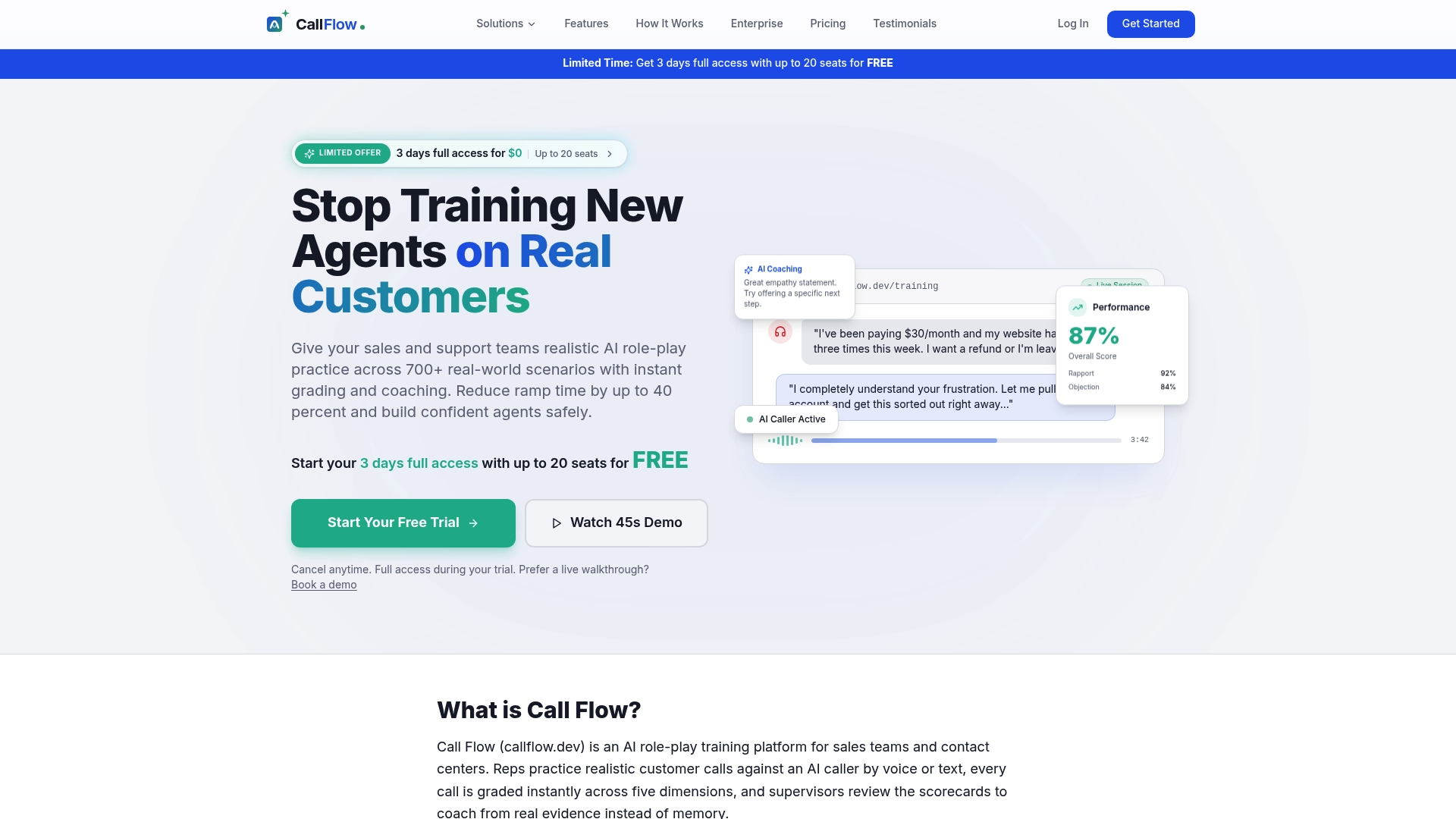
That is where role-play comes in. A scored practice call gives an agent experience before a real customer is on the line. This is the part of the rollout where we do the heavy lifting:
- Realistic scenarios. Agents practice sales and customer service calls that mimic real interactions, in voice or text.
- Instant grading. Each practice call is graded straight away across five performance dimensions, with coaching feedback the agent can act on.
- Scoring that matches your QA. Our scoring is calibrated to align with the quality standards you already use.
- Custom scenarios. You can build scenarios for your own products, policies and objections.
- Supervisor review. Supervisors can review and override scores and see results on a dashboard.
In a rollout, that means your pilot can include practice from week one, and your managers see scores per agent without sitting in on every session. Our own reported results are 147% faster ramp time and 129% improvement in resolution rates. Your numbers will depend on your starting point, which is why the pilot baseline matters.
For more on running practice across a large team, see our guide to coaching at scale and our piece on peer coaching circles.

Step 6: Reinforce with managers
Training that ends at the last session fades. Managers are the fix.
McKinsey's research, Getting more from your training, describes two cases worth copying. In a consumer goods company, leaders took the training first and then taught later courses, and the company moved from flat or declining volumes to double-digit volume growth. In a manufacturing plant, executives shadowed supervisors to force conversations about the new skills, and within two months the plant produced 25% more output.
You can apply the same ideas on a call floor:
- Managers take the practice scenarios first, so they know what agents face.
- Each team leader reviews two or three scored practice calls per agent per week and picks one skill to work on.
- Team huddles open with one scenario result, not a policy reminder.
- A short debrief after a live call connects the practice to the real thing.
Training Industry advises defining observable behaviors before training starts and reviewing them at 30, 60 and 90 days through manager observation, pulse surveys and workplace evidence, not self-reports alone. Calendar those checkpoints at launch, not later.
Step 7: Measure what matters
Completion rates tell you who clicked. They do not tell you who improved. The GAO guide says agencies should move beyond input and output data to performance indicators showing how training contributes to goals, and that not every effort needs a full ROI study.
McKinsey found that only 50% of organizations track participant feedback and only 30% use any other metric. Its advice: track the hard business metric the program is meant to improve, or leading indicators such as actual behavior change when you cannot.
A simple scorecard for sales and contact center rollouts:
| Level | Metric | Source |
|---|---|---|
| Activity | Practice calls completed, scenarios passed | Training platform |
| Skill | Score by dimension, change from baseline | Practice scores, QA |
| Behavior | Same skills on live calls at 30, 60, 90 days | Manager review, QA |
| Result | Ramp time, first-call resolution, customer satisfaction, 90-day turnover | CRM, contact center reports, HR |
The Aspen Institute playbook also urges shifting from completion metrics to business outcomes such as cost savings and retention. Business results such as turnover can take six or 12 months to move, so report leading indicators early and results later. BCG found that companies reviewing reskilling KPIs on a regular schedule, with senior leaders involved, were more likely to report positive returns.
For dashboard design, read our training metrics dashboard guide and the piece on skill analytics. To turn results into a business case, use our training ROI calculation guide.
Common rollout mistakes
- No baseline. Without pre-training numbers, you cannot show change. Capture ramp time, resolution rate and satisfaction scores before the pilot.
- One big launch. Everyone starts on the same day, support is swamped and the call floor is short-staffed.
- Managers left out. They learn about the program from their agents.
- Too many goals. A program meant to fix ramp time, satisfaction and retention at once fixes none.
- No reinforcement. Training ends, and nothing in the weekly routine asks agents to use it.
- Score drift. If practice scores do not match QA scores, agents stop trusting them. Calibrate early.
What this looks like on Call Flow
If your rollout includes call practice, you can start with our free full-feature trial. It is self-serve, so a pilot team can begin without a long setup. Plans are billed per team, monthly or annually. Published prices: Starter is $7.42 per month or $89 per year, Growth is $14.92 per month or $179 per year, and Scale is $33.25 per month or $399 per year. See the pricing page for what each plan covers.
For larger organizations with several sites or business units, the Business and Enterprise plans are described on our enterprise page. Pricing there is not published.
Our view: practice is the missing phase
Most rollout plans we read have a strong front half. They have needs analysis, content, a schedule and a launch email. Then they stop at a completion report.
The gap is between knowing and doing. An agent can pass a quiz on cancellations and still freeze when a customer says they are leaving. The only way across is repetition with feedback, and that has been hard to give at scale because it takes a manager's time.
That is why we built Call Flow around scored practice. Every agent can run a realistic call, get graded instantly on five dimensions and get coaching they can use on the next attempt. Supervisors keep control: they can review and override scores, and the scoring is calibrated to match the QA standards the team already uses.
Our advice for any rollout is to put practice in the pilot, measure skill change from the first week, and give managers the scores so their coaching time goes where it counts. We also like flat, published pricing, because a rollout budget should not hold surprises.
Costa
FAQ
What is a rollout plan?
A rollout plan is the schedule and set of owners for taking a training program from ready to live. It lists phases, dates, who does each task, how learners hear about it, how you handle make-up sessions and how you measure results. Most plans also name a go or no-go decision before the full launch.
How long does an enterprise training rollout take?
A standard program typically takes four to eight weeks from planning to full launch, and longer for complex or global programs. A 2026 checklist for 500 or more employees uses a 12-week timeline with a pilot of 50 to 100 people. Measuring business results takes longer, often several months.
What is the 70/20/10 rule for training?
It is a rule of thumb that about 70% of learning comes from on-the-job experience, 20% from other people and 10% from formal courses. It is often traced to research at the Center for Creative Leadership. Use it as a reminder to add practice and coaching to any course-based rollout.
Should we pilot before a full rollout?
Yes. BCG's survey found that 61% of companies that piloted before scaling reported positive returns, against 26% of those that did not. Pick a group based on skills gaps, set metrics in advance and review at the halfway point.
Which metrics should we track?
Track one business result, such as ramp time, first-call resolution or customer satisfaction. Add skill scores and behavior checks at 30, 60 and 90 days. Completion and satisfaction alone do not show whether agents apply the skills.
Sources
- GAO-26-108218, Human Capital: A Guide for Developing and Evaluating Training
- CDC: Assess Training Needs
- CDC: Design Training, Learning Objectives
- Connecticut DSS Training Management Plan Template
- Training Program Rollout Checklist Template
- LMS Implementation Checklist for Training 500+ Employees
- Training Industry: Delivering an Enterprise-Wide Training Solution
- Training Industry: The Rollout Field of Dreams
- Training Industry: Measuring Leadership Development
- BCG: Five Ways to Make the Most of Reskilling Investments
- Aspen Institute: Upskilling Playbook
- McKinsey: Getting more from your training
- The 70-20-10 Model for Learning and Development