

Spaced repetition training combines distributed practice with active recall: you review material at increasing intervals and test yourself instead of rereading. Reviews from Birmingham City University confirm this produces far better long-term retention than cramming. Structured platforms apply the same logic to skills training. Callflow uses spaced, scored role-play sessions to help sales teams retain scripts and objection handling long after a single practice run fades.
- Distributed sessions beat massed study for durable memory.
- Active recall, not passive review, drives the effect.
- The same principle works for facts, vocabulary, and full conversational skills.
Key Takeaways
Spaced repetition training works because it forces active retrieval at increasing intervals, and that combination builds durable memory far better than cramming or passive review ever can.
| Point | Details |
|---|---|
| Definition | Spaced repetition pairs distributed practice with active recall, testing yourself at growing intervals instead of rereading. |
| Proven schedules | Use 2-3-5-7 for quick facts and 1-3-7-14 for denser material, adjusting based on recall success. |
| Retrieval over review | Passive rereading fails to trigger the memory benefits; self-testing is the required ingredient. |
| Desirable difficulty | The mental struggle spacing creates is the mechanism, not a sign the method isn't working. |
| Beyond flashcards | Procedural skills like sales calls benefit from spaced, whole-task role-play with immediate feedback. |
Table of Contents
- What Spaced Repetition Training Actually Looks Like
- Why Spaced Repetition Works
- Schedules That Actually Work: 2-3-5-7 and Beyond
- Choosing Your Tools: Apps, Flashcards, and Classroom Methods
- Building Your Spaced Repetition Routine, Step by Step
- The Mistakes That Quietly Sabotage Your Practice
- Applying Spaced Repetition to Role-Play and Sales Training
- Give Spaced Practice Two Weeks Before You Judge It
- Ready to Put Spaced Repetition to Work
- Sources
What Spaced Repetition Training Actually Looks Like
Distributed practice means spreading study across days or weeks. Massed practice crams it into one long session. The spacing effect favors the former almost every time, but only when paired with active recall, meaning you retrieve an answer from memory rather than reread notes and assume you know it.
A typical session follows a simple shape:
- Learn the material once, in a focused block (a new vocabulary set, a script objection, a formula).
- Test immediately with a self-check, flashcard, or spoken run-through. No peeking at the answer first.
- Schedule the next review based on whether you got it right.
- Repeat at growing intervals, retiring items you consistently recall and shortening the gap for ones you miss.
The UC San Diego Psychology department recommends short, regular sessions over marathon review blocks, and that guidance holds whether you're studying for an exam or rehearsing a customer call.
Why Spaced Repetition Works
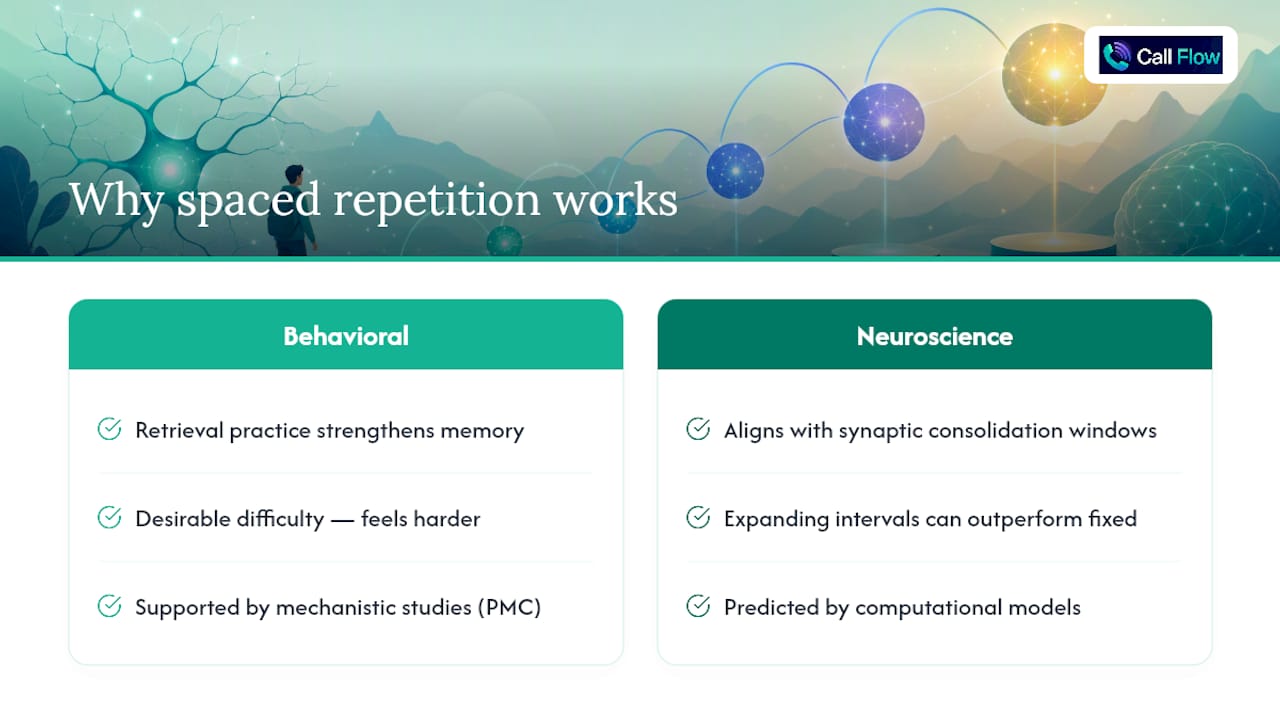
That's the core finding from mechanistic research on spaced learning published in PMC, and it explains why the method holds up across ages, subjects, and skill types.
The behavioral explanation is retrieval practice. Forcing your brain to pull an answer from memory, rather than recognize it on a page, strengthens the neural pathway more than passive review does. Psychologists call the resulting mental strain "desirable difficulty." It feels harder in the moment, and that discomfort is the mechanism, not a warning sign.
The neuroscience backs this up at a mechanistic level too. Spacing appears to align with how synaptic consolidation windows work. Computational models predict that irregular, expanding intervals sometimes beat fixed ones by matching review timing to when memory traces are most receptive to reinforcement.
Schedules That Actually Work: 2-3-5-7 and Beyond
You don't need custom software to start. Three schedules cover most study and training needs:
- 2-3-5-7 (days): Review on day 2, then 3, 5, and 7 after first learning. Works well for vocabulary, flashcard decks, and short factual recall where you need quick reinforcement.
- 1-3-7-14 (days): A slower ramp suited to denser material, like legal concepts, technical procedures, or multi-step sales scripts, where the first review should happen almost immediately to catch encoding errors.
- Expanding/irregular intervals: Instead of following a fixed formula, lengthen the gap each time you recall correctly and shorten it whenever you fail. This adapts the schedule to your actual retention curve rather than a generic template.
The University of Illinois learning resources note that these heuristics are starting points. Optimal spacing varies by material and how long you need to retain it, so intervals for exam cramming should stay tighter than intervals for skills you need a year from now.
Pro Tip: If you miss a review item twice in a row, don't just repeat the same interval. Cut it in half and add one extra retrieval attempt before resuming the normal schedule.
Choosing Your Tools: Apps, Flashcards, and Classroom Methods
Algorithm-driven flashcard apps automate the hardest part of spaced repetition: tracking when each item is due and adjusting intervals based on your performance. That removes the guesswork but requires digitizing your material first.
Low-tech alternatives work just as well for many learners:
- Physical flashcard boxes (the Leitner system) sort cards into review tiers by hand, which forces you to engage with the material during setup.
- Cumulative quizzes built into weekly lesson plans give teachers spaced re-exposure without extra prep, since old material simply reappears on new tests.
- Homework prompts that mix current and past-unit questions serve the same function as digital spacing algorithms, just scheduled by the instructor instead of software.
A York University review found that spacing benefits hold across math, vocabulary, and skill training when instructors deliberately plan cumulative exposure, not just isolated units. Digital apps scale better for individual learners managing hundreds of items; classroom methods scale better for group instruction where uniformity matters more than personalization.
Building Your Spaced Repetition Routine, Step by Step
Follow this sequence to turn the theory into a habit:
- Write retrieval-only questions. Avoid multiple choice or anything with recognition cues. "What's the formula for X?" beats "Is the formula for X: A, B, or C?" every time.
- Test yourself before reviewing the answer. Even a failed attempt strengthens the memory trace more than skipping straight to the answer.
- Schedule your first four to six reviews using 2-3-5-7 or 1-3-7-14 as a starting template.
- Record whether each retrieval succeeded or failed. This log is what lets you adjust intervals intelligently instead of guessing.
- Lengthen intervals after consistent success; shorten them after failure. Two correct recalls in a row usually justifies doubling the gap.
- Anchor a five to ten minute review slot to an existing habit (after breakfast, before a meeting) so consistency doesn't depend on memory or motivation.
Pro Tip: Keep a simple pass/fail column next to each item instead of a complex scoring system. Overengineering the tracking is a common reason people abandon spaced repetition within the first two weeks.
The Mistakes That Quietly Sabotage Your Practice
Spacing feels inefficient because your brain is working harder, and that struggle is easy to mistake for a sign you're doing it wrong. Research on metacognition and learning shows learners consistently prefer easier, immediate methods even when those methods produce worse long-term retention. Reframing the discomfort as a feature, not a flaw, is often the single biggest adherence fix.
Common mistakes worth catching early:
- Passive rereading disguised as review, with no actual self-testing involved.
- Inconsistent scheduling where reviews happen "whenever," which erases the spacing effect entirely.
- Ignoring difficulty signals by keeping intervals fixed even after repeated failures on the same item.
Habit stacking, short five-minute daily slots, and a peer or study partner checking in weekly all measurably increase follow-through.
Applying Spaced Repetition to Role-Play and Sales Training
Spaced repetition isn't limited to flashcards and vocabulary. Procedural skills, like handling a sales objection or de-escalating a frustrated customer, benefit from the same principle, but the unit of practice shifts from isolated facts to whole-task retrieval: running the entire scenario, not just recalling a line from a script.
- Repeated, spaced role-play sessions reinforce procedural memory the same way flashcard intervals reinforce vocabulary.
- Feedback delivered immediately after each attempt sharpens the next repetition, since agents can correct course before the error becomes habit.
- Platforms like Callflow's AI mock-call practice apply this by scoring performance across multiple dimensions right after each simulated call, closing the loop between retrieval and correction faster than a supervisor review cycle typically allows.
Give Spaced Practice Two Weeks Before You Judge It
The first few sessions will feel slower and more frustrating than rereading your notes. That's expected, not a sign to quit. Try one spaced module, real material, two weeks, and compare your recall against your usual method.
— Costa
Ready to Put Spaced Repetition to Work
Spaced repetition training works because distributed, self-tested practice builds stronger memory traces than any amount of massed rereading ever will. Applying that same logic to procedural skills, like sales calls, is where most training programs still fall short.
Callflow was built around exactly this gap. Its AI-powered role-play scenarios let sales teams and contact center agents run spaced, repeated practice sessions with instant grading across five performance dimensions, so every repetition comes with the immediate feedback that makes retrieval practice effective. Teams using this approach report substantially faster ramp time and notable improvement in resolution rates. You can test the full platform during a free mock-call practice trial with no commitment required.