

Behavioral Skills Training (BST) is a four-part teaching procedure, instruction, modeling, rehearsal, and feedback, used to build skills through direct practice rather than talk alone. Systematic summaries describe BST as a robust, evidence-based procedure for teaching skills to people with and without developmental disabilities, and to the staff who support them.
Use BST when a learner can attend to a model, imitate a demonstrated response, and follow simple instructions. It fits skill deficits, not motivation problems alone: teaching a new greeting, a safety response, a de-escalation script, or a parent's redirection technique. The NCAEP systematic review classifies social skills training built on these components as an evidence-based practice across age groups, and peer-reviewed work on staff training confirms it reliably raises implementation fidelity in real clinical and educational settings.
Key Takeaways
Behavioral Skills Training works because instruction and modeling teach the skill, while rehearsal and immediate feedback are what actually build and retain it.
| Point | Details |
|---|---|
| Four components, one sequence | Instruction, modeling, rehearsal, and feedback each play a distinct role and should not be skipped or reordered. |
| Immediate feedback beats delayed summaries | Specific, contingent feedback delivered right after rehearsal drives retention more than end-of-session debriefs. |
| Generalization needs a plan | In-situ practice and explicit probes prevent skills from staying trapped in the training room. |
| Fidelity checks protect outcomes | A simple observation rubric during sessions catches skipped components before a program stalls. |
| Rehearsal volume drives progress | Platforms like Callflow let teams multiply rehearsal-and-feedback cycles well beyond what live coaching sessions allow. |
Table of Contents
- What Behavioral Skills Training Actually Involves
- Does the Research Actually Support Behavioral Skills Training?
- Where Behavioral Skills Training Gets Used
- Building a BST Program That Actually Tracks Outcomes
- Adapting BST Without Forcing Compliance
- Session Scripts You Can Use Today
- Why BST Programs Stall, and How to Fix Them
- Keeping Skills From Fading After Training Ends
- A One-Page Checklist for Running BST With Fidelity
- What the Research Gets Right About BST, and What It Leaves Out
- Practice at the Volume BST Actually Requires
- Frequently Asked Questions
- Sources
What Behavioral Skills Training Actually Involves
BST is not a single technique. It is a sequence, and the sequence matters as much as the content inside it. Skip a component and the procedure tends to lose its punch: instruction without rehearsal produces knowledge without performance, and rehearsal without feedback lets errors calcify.
Each component has a specific job:
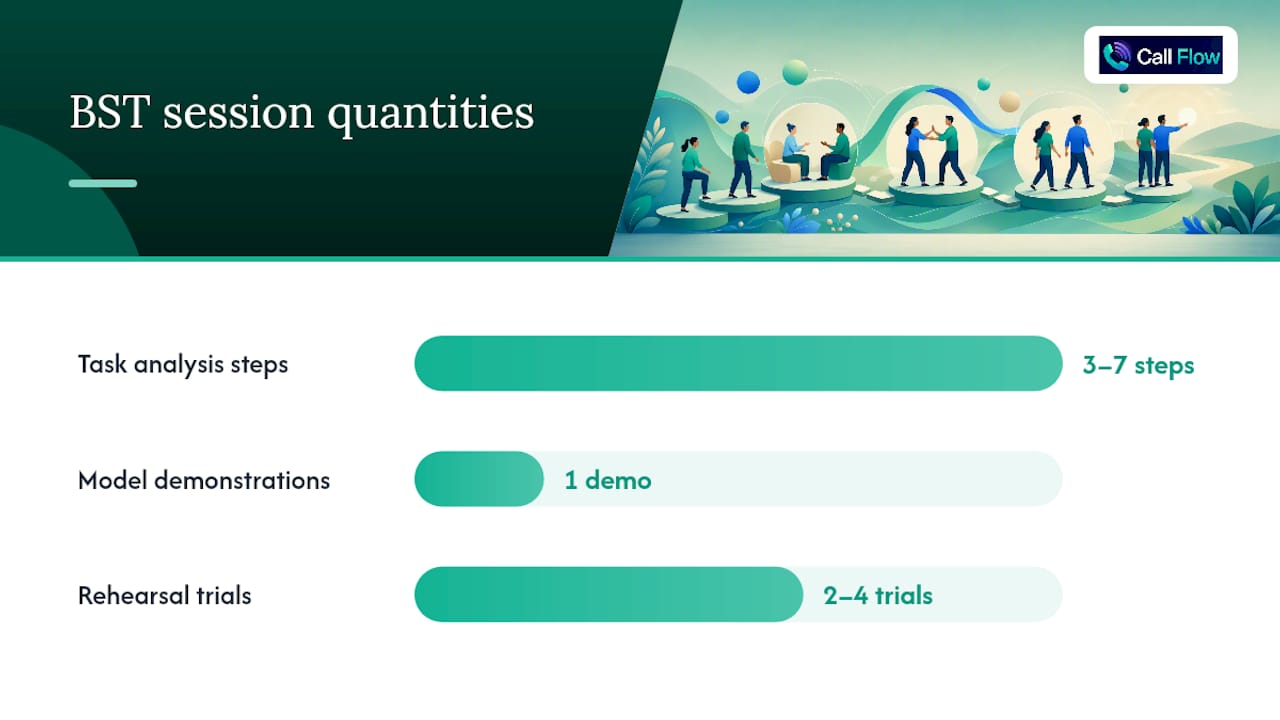
- Instruction: You tell the learner what the target skill is, why it matters, and the specific steps involved. Keep it short. A task analysis with three to seven steps outperforms a paragraph of explanation.
- Modeling: You demonstrate the skill, live or on video, exactly as you want it performed. Video modeling works well when live demonstration is inconsistent or when you need to standardize the model across multiple trainers.
- Rehearsal: The learner performs the skill immediately, ideally in a role-play that resembles the real situation. This is the step most programs shortchange, and it is the one that actually builds the behavior.
- Feedback: You deliver specific, immediate feedback, both what worked and what to adjust, right after the rehearsal ends.
Here is what a session flow looks like in practice, start to finish:
- State the goal in one sentence ("Today we're practicing how to ask a coworker for help without interrupting").
- Deliver instruction using a task analysis, no more than two minutes.
- Model the skill once, narrating each step as you go.
- Ask the learner to rehearse the skill in a role-play matched to a realistic scenario.
- Deliver feedback within seconds of the rehearsal ending, starting with what the learner did well.
- Repeat rehearsal and feedback for two to four trials, increasing scenario difficulty each round.
- Close with a brief recap and schedule the next practice opportunity.
Sample instruction script: "When you want a turn on the swing, walk up, wait until there's a pause, and say, 'Can I have a turn when you're done?' Then wait for their answer."
Sample modeling script: "Watch me do it. I'm walking up now. I'm waiting for a pause. I'm saying, 'Can I have a turn when you're done?' Now I'm waiting."
Sample rehearsal prompt: "Your turn. I'll play your classmate on the swing. Go ahead and try it."
Sample corrective feedback: "Good eye contact and good waiting. Next time, try starting with 'Can I' instead of 'Give me,' since that sounds more like a question."
Sample affirming feedback: "That was exactly right, you waited for the pause and used a full sentence. That's the skill."
Pro Tip: Deliver reinforcement immediately after a correct rehearsal, not at the end of the session. Delayed, summary-style feedback is weaker at building retention than a brief, specific comment delivered in the moment, largely because the learner can no longer connect the praise to the exact behavior that earned it.
Does the Research Actually Support Behavioral Skills Training?
Yes, with real caveats. Peer-reviewed studies consistently show that BST raises staff implementation fidelity and produces skill acquisition in learners across a wide range of settings, and remote-delivery packages have documented positive training effects too, which matters if your program spans multiple sites or relies on distributed coaching.
Several controlled and single-case studies extend that finding to specific populations. Work summarized in a PMC review of BST interventions reports increased correct responding on discrete safety and social skills among learners with autism and intellectual disabilities, particularly when feedback was immediate and tied directly to the response just performed. The NCAEP evidence summary goes further, classifying social skills training built on BST components as evidence-based across age groups, drawing on dozens of single-case and group-design studies.
Three factors show up repeatedly as moderators of how well BST works:
- In-situ training: practicing the skill in the actual environment where it will be used, not just a quiet office, substantially improves generalization.
- Tangible reinforcement and fading: adding real reinforcers alongside a planned fading schedule improves maintenance over time, rather than letting the skill fade once formal sessions end.
- Prompting and fading procedures: layering in prompts during early rehearsals, then systematically removing them, helps the skill hold up without artificial support.
None of this means BST is a guaranteed fix. Effect sizes vary meaningfully across studies, and the most consistent weak point across the literature is generalization: skills trained in a clinic room or a conference room often fail to transfer to the messier conditions of daily life. Telehealth and remote-delivery evidence is also thinner than in-person evidence, though early results are encouraging enough that most practitioners now treat remote BST as a viable option rather than a compromise.
Where Behavioral Skills Training Gets Used
BST shows up anywhere a person needs to learn a specific, observable behavior rather than absorb general information. The setting changes the scenario; the four-component structure stays constant.
- Education: classroom social skills (turn-taking, conflict resolution), safety skills (fire drills, stranger safety, crossing streets).
- ABA and clinical practice: functional communication requests, safety responses, self-advocacy phrasing.
- Parent training: redirection techniques, praise delivery, prompting hierarchies for home-based skill building.
- Staff and teacher training: correct implementation of a behavior plan, data collection procedures, crisis de-escalation steps.
- Workplace soft skills: customer service scripts, interview responses, active listening in high-pressure conversations.
For education settings, a strong target behavior is something narrow and observable: "asks for help using a raised hand" rather than "improves classroom behavior." For clinical and ABA settings, safety-related requests (asking for a break, communicating pain) tend to respond well because the stakes make rehearsal motivating on their own. Parent training benefits from teaching one prompting hierarchy at a time rather than an entire behavior plan in a single session, since parents juggling real-time parenting rarely retain more than one new procedure at once.
Group delivery works for skills that are naturally social, like turn-taking or conversation starters, since peers can serve as rehearsal partners. Individual delivery works better for high-stakes or personal skills, like disclosing a need for accommodation or responding to a safety threat, where privacy matters more than peer modeling.
Building a BST Program That Actually Tracks Outcomes
A BST program lives or dies on its measurement plan, not its enthusiasm. Here is the sequence that keeps a program accountable from day one:
- Define the target behavior operationally. Write it so two different observers would score the same instance the same way. "Greets a coworker" is too vague; "makes eye contact, says a verbal greeting, and waits for a response within three seconds" is measurable.
- Select materials. Task analyses, video models, role-play scripts, and data sheets should exist before the first session, not get improvised mid-session.
- Confirm learner prerequisites. The learner needs to attend to a model and imitate a demonstrated response. If imitation is inconsistent, build that skill first.
- Set session frequency and duration. Short, frequent sessions (two to three times weekly, fifteen to twenty minutes) tend to outperform long, infrequent ones for skill acquisition.
- Collect baseline data before teaching begins, so improvement has a reference point.
- Set a performance criterion for mastery, commonly 80 to 100 percent correct across two or three consecutive sessions.
- Schedule maintenance probes at increasing intervals after mastery to confirm the skill holds up without ongoing coaching.
A simple measurement template keeps sessions consistent across trainers:
| Measure | What It Captures | How to Record It |
|---|---|---|
| Correct responses per trial | Whether the skill was performed accurately | Tally correct/incorrect per rehearsal |
| Latency | Time between the cue and the response | Stopwatch or estimated seconds |
| Independence level | Whether a prompt was needed | Code as independent, prompted, or incorrect |
| Generalization probe score | Performance outside the training setting | Percentage correct in the natural environment |
A fidelity rubric for coaches should score, per session: whether instruction was delivered, whether modeling occurred correctly, whether the learner got at least two rehearsal opportunities, and whether feedback was immediate and specific. Score each item as met or not met, and use the pattern across sessions, not one bad session, to guide coaching conversations.
If you are rolling BST out across a team, pyramidal training, where a small group of expert trainers teaches a larger group of trainers, who then teach direct staff, scales the procedure without diluting it, provided fidelity checks happen at every layer of the pyramid.
Pro Tip: Build your fidelity rubric before your first session, not after a program stalls. Retrofitting measurement onto an existing program almost always reveals gaps that were invisible without a checklist in hand.
Adapting BST Without Forcing Compliance
BST is a teaching procedure, not a values statement, which means it can be used well or used carelessly depending on how goals get chosen. Informed consent matters here in a very literal way: the learner, or their guardian, should understand what skill is being taught and why, and should have a real say in whether that skill reflects their own goals rather than someone else's comfort.
Neurodivergent learners often need script flexibility rather than a single "correct" response. A rigid eye-contact requirement, for instance, can turn a communication skill into a masking exercise that costs the learner energy without adding real functional value. Building in acceptable alternative responses, and checking in on whether a target skill actually matters to the learner, keeps BST focused on capability rather than conformity.
Experts caution that BST should be implemented with compassion: avoid training that forces the masking of neurodivergent behaviors, and instead focus on functional communication and learner empowerment. The goal of any script or rehearsal should be that the learner gains a tool, not that they perform normalcy for an observer's comfort.
Cultural tailoring follows the same logic. A greeting script built around direct eye contact and a firm handshake reflects specific cultural norms, not universal social competence. Reviewing scripts with someone familiar with the learner's cultural context before rolling out a program prevents you from teaching a skill that reads as competent in one community and as rude in another.
BST pairs well with token systems for motivation, and with cognitive behavioral training techniques when a skill deficit is tangled up with anxiety or negative self-talk. It works less well as a standalone fix when the core issue is not a skill gap at all: if someone can already perform the skill but chooses not to in specific contexts, that is a motivation or environmental problem, and BST alone will not resolve it.
Pro Tip: Frame every BST goal in terms of what it lets the learner do, not what it makes them look like. "This skill helps you get what you need faster" lands very differently than "this skill helps you fit in."
Session Scripts You Can Use Today
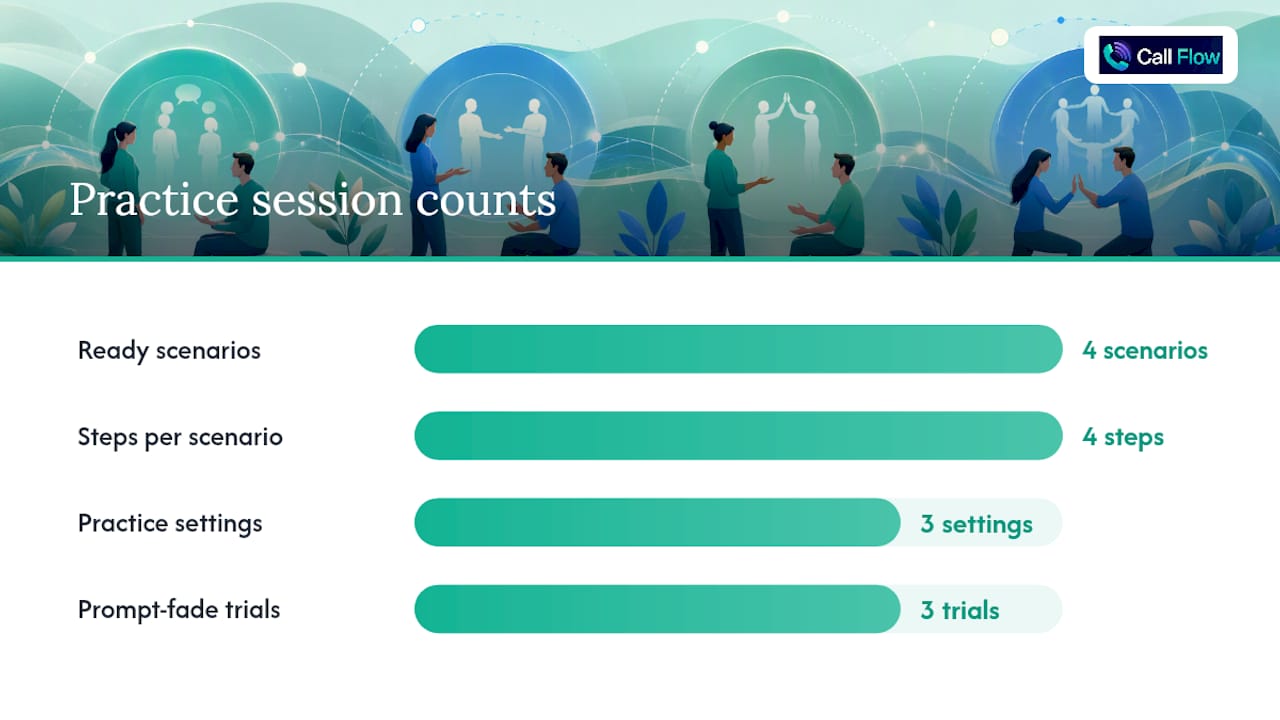
Four ready-to-adapt scenarios, each following the same instruction, model, rehearsal, feedback sequence.
Scenario 1: Asking for a turn on the playground
- Instruction: "Walk up, wait for a pause, and ask, 'Can I have a turn when you're done?'"
- Modeling: Demonstrate the full sequence once, narrating each step out loud.
- Rehearsal: Role-play with the trainer as the peer holding the toy.
- Feedback: "Great waiting and a clear question. Next time, try standing a little closer so they can hear you."
Scenario 2: Interview greeting for a young adult
- Instruction: "Shake hands, say your name, and say 'thanks for having me' before you sit down."
- Modeling: Trainer performs the greeting as the interviewer would expect to see it.
- Rehearsal: Learner practices with the trainer playing the interviewer, starting from the door.
- Feedback: "Firm handshake, good pace. Try slowing down your name slightly so it's easy to catch."
Scenario 3: Customer service de-escalation
- Instruction: "Acknowledge the frustration first, then offer one concrete next step, before explaining any policy."
- Modeling: Trainer plays the agent responding to a scripted angry caller.
- Rehearsal: Learner takes the agent role while the trainer plays an increasingly frustrated customer.
- Feedback: "You acknowledged their frustration right away, that's the hardest part. Hold off on the policy explanation until after you've offered the next step."
Scenario 4: Parent redirection technique
- Instruction: "State the alternative behavior in a positive command, then immediately praise compliance."
- Modeling: Trainer demonstrates redirecting a tantrum-adjacent behavior using a scripted example.
- Rehearsal: Parent practices with the trainer simulating the child's response.
- Feedback: "Good positive phrasing. Try praising within two seconds of compliance instead of waiting until the end of the interaction."
Scaffold difficulty by increasing distraction, emotional intensity, or unpredictability across rehearsals, quiet room first, then a noisier room, then the real setting. Fade prompts gradually: full verbal prompt in trial one, partial prompt by trial three, no prompt by trial five, and note when the learner needs the prompt reinstated.
Why BST Programs Stall, and How to Fix Them
Most BST implementation problems trace back to a handful of predictable causes, and each one has a specific fix rather than a vague "try harder" solution.
- Low engagement during rehearsal: Scenarios feel abstract or repetitive. Fix it by tying rehearsal scenarios to situations the learner has actually encountered recently, and rotate scenario details even when the target skill stays the same.
- Skills that don't generalize: Training happens only in a quiet, controlled room. Add in-situ practice in the natural environment and run explicit generalization probes rather than assuming transfer will happen automatically.
- Feedback that discourages rather than builds: Corrective comments arrive without any acknowledgment of what went right. Lead every feedback statement with a specific positive observation before naming the adjustment.
- Poor fidelity among trainers: Different staff run sessions differently, which muddies the data. Use a written fidelity checklist during every session, not just during initial training, and re-certify trainers periodically.
- Rehearsal steps that are too complex: A task analysis with more than seven steps overwhelms most learners early on. Break the skill into smaller chained components and master each piece before linking them.
Pro Tip: If a skill isn't sticking, check reinforcement timing before you touch anything else. A brief, immediate, specific comment right after a correct rehearsal beats a longer, delayed debrief at the end of the session almost every time, because the learner's brain needs the praise and the behavior to happen close enough together to connect them.
Keeping Skills From Fading After Training Ends
Mastery in a training room means nothing if the skill disappears once formal sessions stop. Measurement after mastery should track three things: accuracy (is the skill still performed correctly), fluency (is it performed at a natural pace), and latency (does the response happen quickly enough to be functional in real time).
| Phase | What to Measure | Frequency |
|---|---|---|
| Baseline | Accuracy before training starts | Once, before session one |
| Acquisition | Accuracy and independence per trial | Every session |
| Mastery check | Accuracy across consecutive sessions | Two to three sessions in a row at criterion |
| Maintenance probe | Accuracy without coaching present | Two, four, and eight weeks post-mastery |
Generalization improves with a few concrete tactics: rehearsing with multiple examples of the same scenario rather than one repeated script, practicing with more than one trainer or peer model so the skill isn't tied to a single person's voice, and fading prompts systematically rather than removing them all at once. Booster sessions belong on the calendar the moment a maintenance probe shows any decline, typically a single short refresher session rather than a full restart of training.
A One-Page Checklist for Running BST With Fidelity
Print this, laminate it, or drop it into your program binder. It covers the full arc from goal selection to generalization.
- Define the target behavior in observable, measurable terms.
- Confirm the learner can attend to a model and imitate a demonstrated response.
- Collect baseline data before any teaching begins.
- Deliver instruction using a task analysis of no more than seven steps.
- Model the skill correctly, live or via video.
- Provide at least two rehearsal opportunities per session.
- Deliver feedback immediately, leading with what the learner did correctly.
- Track correct responses, latency, and independence level every session.
- Set a mastery criterion (commonly 80 to 100 percent across two or three sessions).
- Add in-situ practice in the natural environment before declaring mastery final.
- Schedule maintenance probes at two, four, and eight weeks post-mastery.
- Reinstate a short booster session at the first sign of decline.
Fidelity rubric for coaches to score during observation: instruction delivered clearly (yes/no), model performed accurately (yes/no), at least two rehearsal chances given (yes/no), feedback delivered within seconds and specific to the behavior (yes/no). Four "yes" scores indicate a session run with strong fidelity; any "no" flags a specific coaching conversation, not a general note to "do better."
Pro Tip: Use the rubric on your own sessions before you use it to coach anyone else. Most trainers are surprised by which component they skip most often under time pressure, usually rehearsal repetitions or immediate feedback.
What the Research Gets Right About BST, and What It Leaves Out
The evidence base for BST is genuinely strong on one specific claim: when all four components are present and delivered with fidelity, skill acquisition happens reliably across an unusually wide range of learners and settings. That is not a marginal finding. It holds across staff training, parent training, safety skills, and social communication, which is rare for any single behavioral procedure.
Where the conventional advice falls short is generalization, and it falls short in a very specific way: most program write-ups treat generalization as an afterthought, a hopeful assumption tacked onto the end of a training plan rather than a designed feature of it. The research is blunt about this. Skills trained exclusively in a quiet room routinely fail to transfer, and the fix, in-situ practice and explicit probes, is neither expensive nor complicated. It just requires practitioners to treat the natural environment as part of the curriculum rather than an optional bonus round.
The other gap worth naming plainly: feedback quality gets far less attention in typical training write-ups than instruction and modeling do, even though the research on reinforcement timing suggests it may matter just as much. A trainer who nails instruction and modeling but delivers vague, delayed feedback is running an incomplete procedure, even if every box on a checklist got technically checked.
If you take one thing from this away, prioritize rehearsal volume and feedback immediacy over instructional polish. A slightly rough model demonstration followed by five well-fed-back rehearsals will outperform a beautifully scripted instruction followed by one rushed rehearsal, almost every time.
Practice at the Volume BST Actually Requires
BST works because of repetition, and repetition is exactly what most training schedules can't afford to give a human coach's calendar. Callflow closes that gap by putting the rehearsal and feedback components of BST into an AI role-play environment, so a sales rep or support agent can run scenario after scenario without waiting for a manager's free hour.
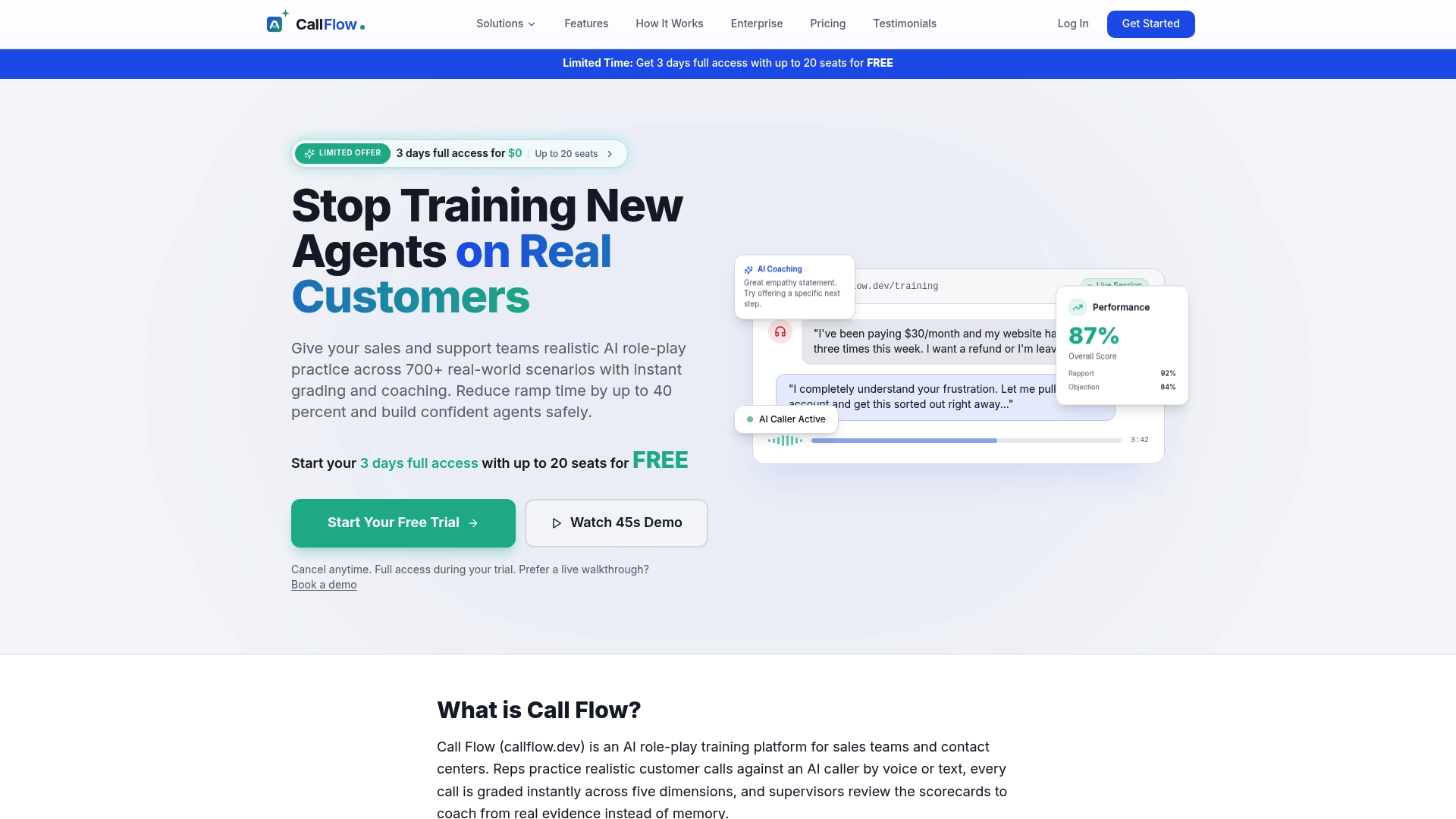
The platform grades every rehearsal across five performance dimensions and delivers coaching feedback immediately, the same immediacy that the research behind BST identifies as one of the strongest drivers of retention. Instead of one rehearsal a week during a scheduled coaching session, agents get as many rehearsals as they need, each one followed by specific, actionable feedback rather than a delayed summary at quarter's end. Teams using this approach have reported significantly faster ramp time and notable improvement in resolution rates, results consistent with what happens when the rehearsal-feedback loop runs at higher frequency and lower latency.
If your team is applying BST principles to sales calls, customer service interactions, or onboarding scripts, try Callflow's AI mock-call practice environment during the risk-free trial and see how many rehearsal cycles your team can run in a single week.
Frequently Asked Questions
What are the four components of Behavioral Skills Training? Instruction, modeling, rehearsal, and feedback. Each component serves a different function: instruction explains the skill, modeling demonstrates it, rehearsal gives the learner practice, and feedback corrects and reinforces performance immediately after each attempt.
Who is a good candidate for BST? Learners who can attend to a model and imitate a demonstrated response are the best fit. BST addresses skill deficits, not motivation problems, so it works best when the learner genuinely does not yet know how to perform the target behavior.
How is BST different from general social skills training? Social skills training (SST) is often the content area, teaching conversation, turn-taking, or cooperation, while BST is the delivery method. Many SST programs use BST's four-component structure as their teaching procedure.
How long does it take to see results with BST? Timelines vary by skill complexity and learner, but many programs see measurable acquisition within a handful of sessions when instruction is followed by consistent rehearsal and immediate feedback. Full generalization and maintenance typically take longer and require deliberate probes.
Can BST be delivered remotely? Yes. Remote BST packages have documented positive training effects, particularly for staff training, though in-person delivery still has a broader evidence base for direct client-facing skill instruction.
What is the most common reason BST programs fail? Skipping generalization planning. Training a skill only in a clinical or classroom setting, without in-situ practice or fading of support, is the most frequently cited reason trained skills fail to transfer to real-world use.